


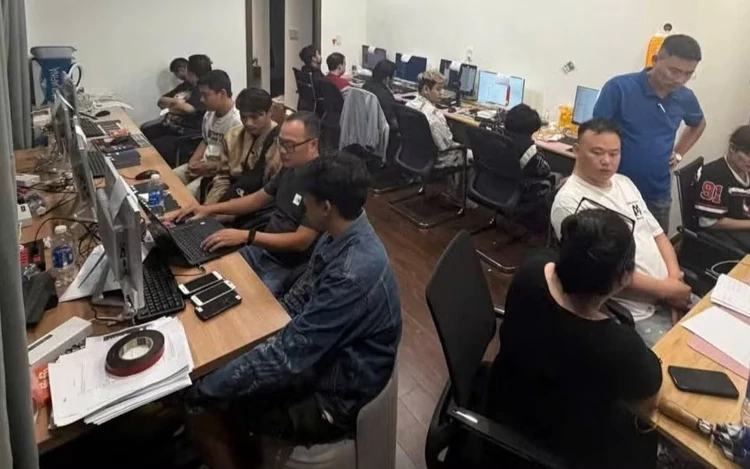
Da Nang Police inspect the villa where the foreigners allegedly operated their closed online scam network. Photo: Supplied
Da Nang Police said on Wednesday that at about 9:30 am on October 28, they conducted an unannounced inspection at a villa in the Regal Victoria urban area in Dien Ban Dong Ward and found 13 foreigners staying at the villa, local media reported.
The suspects used dozens of mobile phones and computers, along with WhatsApp and Telegram, to approach victims, build romantic relationships with them, and persuade them to invest money or complete online tasks in exchange for commissions.
Initial investigations identified Xiong Zhouhua, born in 1993 and a Chinese national, as the alleged ringleader who organized and managed the operation at the villa.
Aditya Aldi Pratama, born in 2001 and an Indonesian national, served as team leader, overseeing and assigning tasks to the other 10 Indonesians.
Huang Shuo, born in 1992 and also a Chinese national, was hired to cook, purchase essential supplies and take care of the group's daily needs.
The operation was organized as a closed system, with clearly defined roles covering management, customer data provision, approaching potential victims, building trust and instructing them to transfer money.
Investigators found that Xiong entered Vietnam from China on August 27 before traveling to Da Nang to find a location for the online scam.
On September 9, he rented a villa in the Regal Victoria urban area, installed an internet connection and equipped it with 12 desktop computers and 87 mobile phones for the criminal operation.
Through personal connections, Xiong recruited 11 Indonesians to work in Vietnam, arranging their accommodation at the villa and confiscating their passports.
He also hired another Chinese national to cook, purchase essential supplies and take care of the group's daily needs.
The total cost of hiring personnel, purchasing equipment and customer data, obtaining accounts and maintaining the operation was estimated at US$60,000.
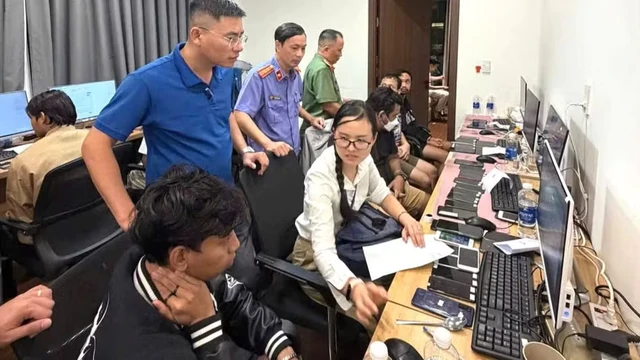
Authorities inspect the rented villa, where the suspects had installed equipment to carry out their alleged illegal activities. Photo: Supplied
Money flows through bank accounts, USDT cryptocurrency
To encourage the group's activities, Xiong promised a monthly salary of $700 and a $200 attendance bonus.
He also imposed fines of $400-1,000 on members who failed to meet revenue targets and offered commissions of 5-13 percent to groups generating at least $10,000 in revenue.
The entire operation was tightly controlled, with members' earnings directly tied to the amounts they managed to defraud victims of.
Xiong searched for and modified scam scripts on Telegram before providing customer data and WhatsApp accounts to the Indonesian employees.
Starting October 1, the suspects were divided into five teams of two, operating under the supervision of team leader Aditya Aldi Pratama.
The suspects used WhatsApp and Telegram to approach potential victims, strike up conversations and, in some cases, pretend to be women to establish romantic relationships and gain their trust.
They then persuaded victims to visit websites, register accounts and deposit money to complete online shopping tasks in exchange for commissions.
One member contacted around 50 potential customers a day to identify people who could be persuaded to transfer money.
The group initially allowed victims to withdraw their original deposits along with commissions after making small payments to build trust.
When victims deposited larger amounts, however, the suspects came up with various excuses to demand additional payments. They also interfered with the system to prevent victims from withdrawing their money and ultimately misappropriated their assets.

To receive and transfer the proceeds, Xiong set up two separate Telegram groups. One provided Indonesian bank accounts to receive money from victims, while the other handled refunds to maintain the appearance of legitimacy.
Aditya Aldi Pratama acted as an intermediary, providing bank account details to employees, collecting transaction receipts and reporting directly to Xiong.
After victims transferred money, transaction details were posted in an internal group, where unidentified individuals used automated Telegram tools to convert Indonesian rupiah into Tether (USDT), a cryptocurrency.
At the end of each day, all incoming and outgoing funds were consolidated, converted into USDT and transferred to a digital wallet address provided by Xiong. A fee equivalent to 3 percent of the total amount defrauded each day was charged.
The Da Nang Police Department warned the public to remain particularly vigilant against investment offers and online shopping task schemes that require upfront deposits.
People were advised not to transfer money at the request of strangers they meet on social media or disclose personal information and bank account details to unidentified individuals.
Police also urged the public to be wary of requests to deposit additional money to withdraw funds, complete tasks or receive commissions, and to promptly report suspicious activities to the authorities.


Max: 1500 characters
There are no comments yet. Be the first to comment.