


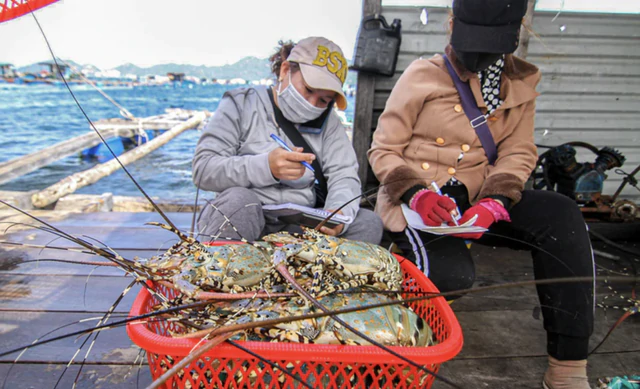
Lobsters have generated significant value for Vietnam’s aquaculture industry over the years. Photo: Xuan Hoat / Tuoi Tre
Authorities in Khanh Hoa Province on August 30 detained two people over 180,000 lobster seedlings illegally brought from Singapore into central Vietnam. The seedlings are to be destroyed under Vietnamese law.
The case highlights the dilemma facing Vietnam's lobster industry, caught between its reliance on imported seedlings, mainly from Indonesia, and increasingly strict rules in its main export market, China.
Destruction of 180,000 smuggled lobster seedlings
The seedlings were found on August 17 in 112 plastic bags packed inside four checked suitcases carried by two passengers arriving on a SCOOT flight from Singapore to Cam Ranh International Airport in Khanh Hoa.
The shipment was valued at more than VND7 billion (US$268,000) and had not been declared to customs or accompanied by quarantine certificates or documents proving its origin.
The two suspects were later charged with illegally transporting goods across the border, an offense that carries a prison term of five to 10 years or an additional fine of VND1-3 billion ($38,000-$115,000), according to lawyer Phan Bach Mai, deputy head of the Khanh Hoa Bar Association.

Stevanus Donny Kurnain (L) and Ngo Duy Linh, suspects in the illegal transport of 180,000 lobster seedlings. Photo: Khanh Hoa Provincial Police Department
Lobster farming faces uncertainty
Along with Dak Lak Province, Khanh Hoa is one of the two provinces in central Vietnam with the most developed lobster farming industries, accounting for 95 percent of the country's commercial lobster output in 2025.
Van Phong Bay is one of Khanh Hoa's four major lobster-farming centers, known for high-value spiny lobsters exported to China. But farmers have faced growing uncertainty as China has tightened traceability requirements.
Vo Van Thai, director of the Van Phong Aquaculture and Tourism Cooperative, said some farmers have switched to fish farming as they struggle to source seedlings with proper documentation.
"In the past, farming was small-scale, so farmers sourced lobster seedlings partly from local divers who caught them in the wild and partly from traders who imported them, but the seedlings rarely came with sufficient paperwork," Thai said.
Buying seedlings from unofficial sources may lower costs, but can make it difficult to sell mature lobsters through official channels.
Some farmers turn to informal trade, where prices can fall to about half their actual value, Thai said.
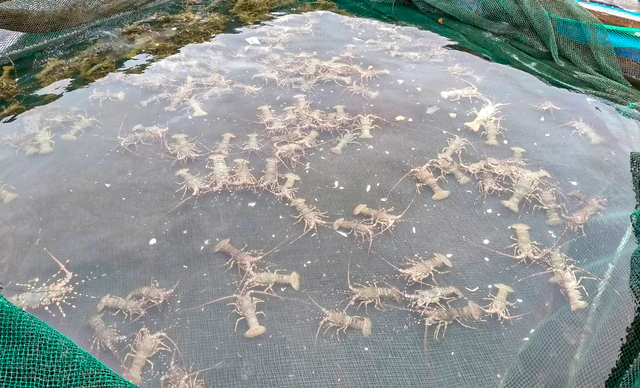
Khanh Hoa has the largest number of lobster-farming cages in central Vietnam. Photo: Xuan Hoat / Tuoi Tre
Khanh Hoa needs 60 to 70 million lobster seedlings a year, while local wild harvesting supplies only about 5 percent, leaving farmers heavily dependent on imports.
When supplies are tight and prices rise, some farmers take the risk of buying seedlings of unknown origin to cut costs.
"The availability of seedlings and the sale of mature lobsters both depend on traders. Farmers have no control over either stage," said Dao Xuan Hoa, director of the Van Ninh Aquaculture Cooperative.
Hoa said the industry's reliance on imported seedlings leaves farmers particularly vulnerable to fluctuations in supply and prices.
Vietnam's lobster-farming industry also faces other challenges, including weak links across the value chain and heavy reliance on imported seedlings.
Rising feed and input costs, environmental pressures in farming areas, disease risks, climate change, and increasingly severe natural disasters are adding to the strain.
External pressures from both sides of the supply chain
Vietnam's lobster industry faces pressure at both ends of the supply chain, from securing imported seedlings to meeting requirements in key export markets.
On the import side, Indonesia is Vietnam's main source of lobster seedlings, but its policies have been subject to frequent changes.
Under Indonesia's KP 7/2024 regulation, only live lobsters weighing more than 50 grams can be exported, while foreign businesses are required to invest in local lobster hatcheries, according to Nguyen Huu Dung, secretary-general of the Vietnam Fisheries Society.
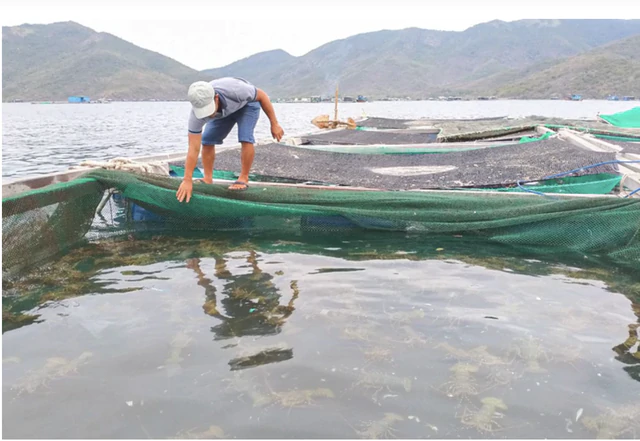
Despite the high income it generates, Vietnam’s lobster farmers face mounting difficulties and challenges. Photo: Xuan Hoat / Tuoi Tre
On the export side, China remains Vietnam's dominant market, accounting for nearly 98 percent of lobster exports.
Most of Khanh Hoa's commercial lobsters are shipped live to China, but the market has tightened restrictions on spiny lobsters.
Since May 2023, China's amended wildlife protection law has prohibited the catching, use, trading and sale of spiny lobsters, creating difficulties for Vietnamese farmers.
"Not only China, but other export markets also have increasingly stringent requirements for product quality, food safety, traceability and environmental protection," a leader of the Khanh Hoa Department of Agriculture and Environment said.
Experts have called for Vietnam to reduce its dependence on imported seedlings by developing domestic production technology, while also improving farming infrastructure, live-lobster transport, traceability and the legal and technical framework for exports.
Authorities should also help farmers and businesses standardize data from farming areas to exports to meet market requirements









Max: 1500 characters
There are no comments yet. Be the first to comment.