


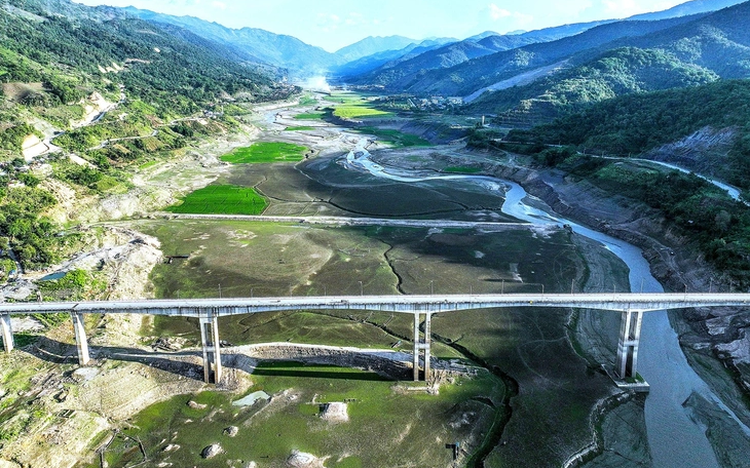
The Son La hydropower reservoir in the Muong Lay area of Dien Bien Province, northern Vietnam was left dry in 2023. Photo: Nguyen Khanh / Tuoi Tre
El Niño has formed and is likely to continue affecting Vietnam’s hydrometeorological conditions in the second half of 2026 and part of 2027, according to an El Niño forecast report released by the Meteorological and Hydrological Administration under the Ministry of Agriculture and Environment earlier this week.
The actual impacts will depend not only on the intensity and duration of El Niño but also on rainfall distribution, water availability at the beginning of the dry season, reservoir storage capacity and regulation, and river flows.
The meteorological agency has therefore developed two risk scenarios to support monitoring, updates, and reviews of response plans.
High-risk scenario
This scenario assumes moderate to strong El Niño conditions that gradually weaken in the early months of 2027.
Under this scenario, sea surface temperatures in the Niño 3.4 region, which is a region of the tropical Pacific Ocean used by meteorologists to monitor El Niño, would remain between +1°C and below +2°C and gradually weaken from late winter 2026-27, with a probability of about 88-98 percent.
Average temperatures nationwide would be about 0.5-1°C higher than the long-term average, while the number of hot days would increase, particularly in northern Vietnam, the north-central region, the south-central coast, the Central Highlands, and southern Vietnam.
Heatwaves would tend to arrive earlier and last longer than usual, increasing demand for electricity, domestic water, and irrigation water.
Rainfall during the 2026 rainy season is forecast to be 10-20 percent below average, with localized deficits of more than 25 percent along the south-central coast.
River flows in many basins could decline by about 10-20 percent, reducing reservoir storage before the dry season.
The rainy season along the south-central coast, in the Central Highlands, and in southern Vietnam could end earlier, prolonging water shortages toward the end of the 2026-27 dry season.
As a result, the risks of drought, water shortages, and saltwater intrusion are considered high, particularly in the south-central coastal region, the Central Highlands, and the Mekong Delta.
Saltwater intrusion in the Mekong Delta could occur earlier and penetrate farther inland than usual, affecting domestic water supplies and agricultural production in coastal areas.
In the energy sector, lower inflows into hydropower reservoirs could reduce electricity generation capacity toward the end of the dry season.
Very high-risk scenario
This scenario assumes very strong El Niño conditions that persist until mid-2027, with the Niño 3.4 index reaching +2°C or higher and remaining at that level.
The probability of Niño 3.4 reaching the very strong threshold is estimated at around 60-65 percent during the peak period. However, whether the conditions will persist until mid-2027 remains uncertain and will require further updates.
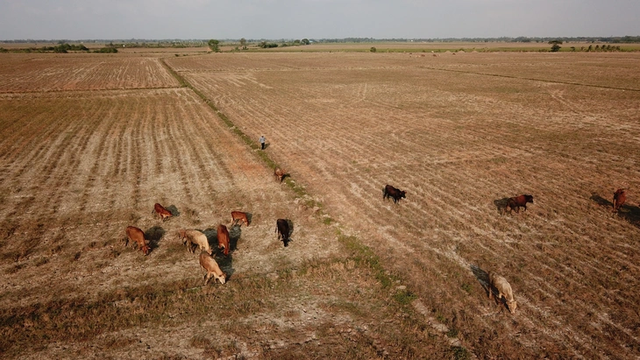
The Mekong Delta faces risks of drought, water shortages, and saltwater intrusion during the 2026-27 dry season. Photo: Tuoi Tre
Under this scenario, average temperatures nationwide could be 1-2°C above the long-term average. Heatwaves could arrive earlier, last longer, and become more intense, particularly from March to June 2027.
Rainfall during the 2026 rainy season could be 20-40 percent below average, with localized deficits exceeding 50 percent along the south-central coast.
River flows in many basins could fall by 20-40 percent, making it difficult for irrigation and hydropower reservoirs to store sufficient water.
If El Niño persists into the transition between seasons, the 2027 rainy season could arrive later than usual, particularly in the Central Highlands and southern Vietnam, prolonging water shortages and delaying the recovery of water resources.
The risks of drought, water shortages, and saltwater intrusion would be considered very high.
Saltwater intrusion in the Mekong Delta could reach levels comparable to those recorded during previous very strong El Niño events.
Many small- and medium-sized reservoirs along the south-central coast and in the Central Highlands could fail to store enough water for summer-autumn crops and daily needs.
Inflows into major hydropower reservoirs, particularly those in the Da River system, could decline significantly, while prolonged heatwaves would drive up electricity demand, putting additional pressure on national energy security.
The areas likely to be most severely affected are the south-central coastal region, the Central Highlands, and the Mekong Delta.
They are followed by Thanh Hoa Province, Hue City, the Red River Delta, and the Northwest, where localized water shortages and prolonged heatwaves could become more severe toward the end of the dry season.








Max: 1500 characters
There are no comments yet. Be the first to comment.