


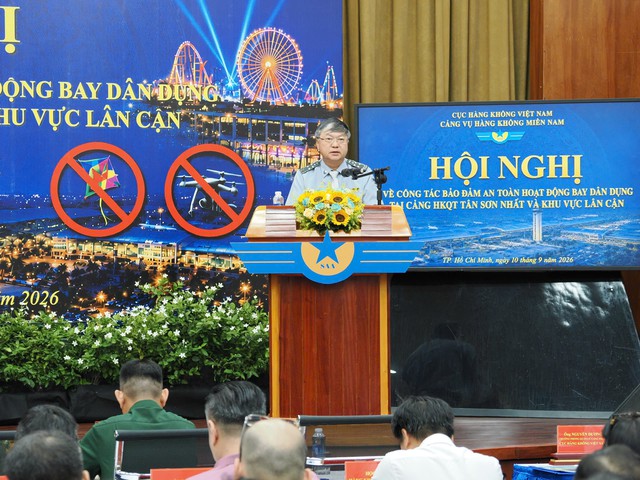
Tran Doan Mau, director of the Southern Airports Authority, speaks at the conference on September 10. Photo: H.H. / Tuoi Tre
A drone, kite or laser beam appearing near a flight path can pose a collision risk and force dozens of flights to enter holding patterns or divert, putting increasing pressure on aircraft fuel management.
Drones, kites, balloons and lasers pose growing risks
The Southern Airports Authority held a conference on Thursday on ensuring the safety of civil aviation operations at Tan Son Nhat International Airport and surrounding areas, with representatives from aviation agencies, police, the military, air traffic management and local authorities.
Speaking at the conference, Tran Doan Mau, director of the Southern Airports Authority, said Tan Son Nhat is one of Vietnam's busiest aviation hubs but is located in a densely populated urban area.
The airport handled more than 255,000 takeoffs and landings and served over 42.4 million passengers in 2025.
In the first eight months of 2026, it recorded nearly 180,000 takeoffs and landings and served more than 30.2 million passengers.
With such a high operating intensity, even a brief disruption caused by an abnormal object can affect the entire aviation system.
Potential hazards around the airport range from drones, flycams, kites and balloons to lasers, high-powered lights, fireworks and other airborne objects.
Data from the Southern Airports Authority showed that 34 incidents involving unidentified airborne objects, lasers and high-powered lights were recorded in 2024.
The figure rose to 43 in 2025, an increase of about 26.5 percent.
From the beginning of this year through September 4, 32 incidents had been recorded, including 13 laser incidents, eight kite-flying incidents, four involving balloons, three involving drones, three involving other airborne objects and one involving fireworks.
The airport said drones pose the greatest risk when they appear as aircraft are approaching, taking off or landing, when planes are at low altitudes and safety requirements are particularly stringent.
Even without a collision, detecting an unidentified airborne object can force air traffic control to increase separation between aircraft, change the order of takeoffs and landings, restrict operations or temporarily suspend part of the airport's activities.
Aircraft already in the air may have to enter holding patterns while flights on the ground are unable to take off, with some flights forced to divert.
The disruption can then spread to aircraft turnaround schedules, parking positions, ground personnel and subsequent flights.
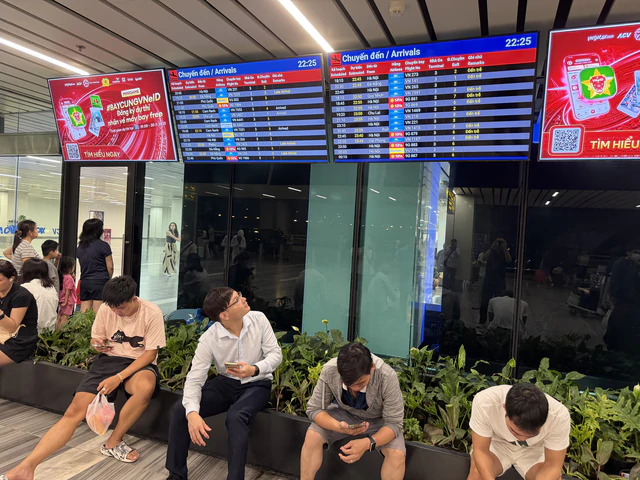
A drone disrupts operations at Tan Son Nhat International Airport on the evening of August 11, affecting multiple flights and leaving passengers waiting until late at night to pick up their relatives. Photo: Cong Trung / Tuoi Tre
What happens when alternate airports cannot take more planes?
Vo Thanh Hai, head of the Safety and Quality Department under Vietnam Airlines' Flight Division 919, said the greatest pressure when an airport has to suspend takeoffs and landings falls on aircraft that are already in the air.
Airlines now calculate fuel requirements very tightly.
While aircraft could previously carry hundreds of kilograms or even tons of additional fuel, the aviation industry is now implementing various measures to optimize payload and save every kilogram of fuel.
During some peak periods, an airline may calculate fuel loads to allow an aircraft to remain in a holding pattern for about 50 minutes to an hour.
However, it is difficult to predict how long an airport may be affected by a drone.
Pilots must continuously weigh whether to continue holding or divert to another airport.
The longer an aircraft remains in a holding pattern, the more fuel it consumes.
If it diverts, the aircraft must land at another airport, creating a chain of issues involving passengers, parking stands, ground services and subsequent flight schedules.
For flights bound for Tan Son Nhat, Can Tho International Airport can be considered as an alternate airport.
But if multiple aircraft have to divert at the same time, the alternate airport also has limited runway, parking and service capacity.
"When the alternate airport can no longer accept more aircraft, where do the planes go?" Hai asked.
He said this is why the drone issue must also be viewed from the perspective of aircraft already in the air.
As fuel continues to fall while the destination airport remains closed and alternate airports risk becoming overloaded, pressure on flight crews can quickly increase.
When necessary, pilots can report their fuel status and request priority under operating procedures to manage risks early, rather than waiting until fuel levels become dangerously low.
Hai also warned that lasers can pose a similarly serious danger.
A high-intensity light beam directed into a cockpit at close range can temporarily blind pilots or impair their vision, creating particular risks during takeoff and landing.
Vietnam Airlines proposed that, in addition to dealing with drones, authorities should prepare plans for situations in which a major airport has to suspend operations, including which alternate airports can receive aircraft, how many planes they can accommodate, where they can park and how they can be served if multiple flights divert simultaneously.
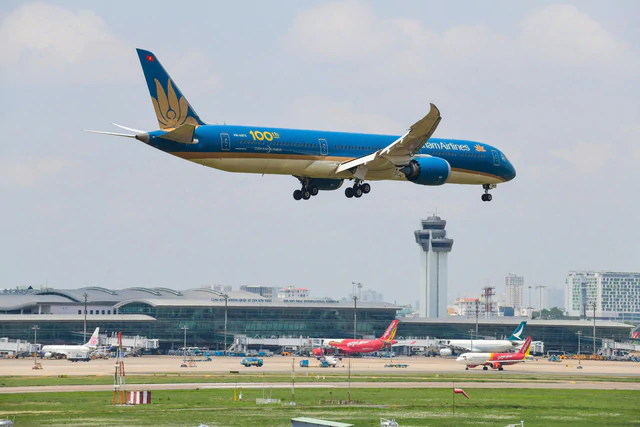
An aircraft takes off from or lands at Tan Son Nhat International Airport. Photo: Quang Dinh / Tuoi Tre
227 drones detected in 13 days
Another notable figure was presented by Nguyen Truong Long, deputy head of the Tan Son Nhat International Airport Border Gate Police.
From August 27 to September 8, authorities detected 227 drones operating in prohibited or restricted airspace through surveillance systems.
The Tan Son Nhat airport border gate police subsequently coordinated with police in local communes and wards to investigate and verify more than 60 people and seize 88 devices.
The remaining cases are still being investigated and handled.
Long said most of the drones were detected flying at low altitudes for short periods, mainly for recreational or business purposes, and had not directly affected flight operations.
However, most of the devices had not been registered, while users were also unfamiliar with regulations and, in some cases, did not know that the locations where they were operating fell within prohibited or restricted airspace.
Authorities also found numerous social media groups dedicated to buying, selling and repairing flycams and drones and sharing operating experience, with memberships ranging from tens of thousands to more than 200,000 people.
Long said the number of detected cases had fallen sharply after the Ministry of Public Security, Ho Chi Minh City police and the city stepped up inspections and public awareness campaigns.
The figure fell from around 25-30 cases per day in the initial period to eight cases on September 8.
Calls for joint drills, not just coordination
"We often talk about inter-agency coordination, but there must be scenarios for joint response drills," said Lieutenant Colonel Vo Nhan Tiep, deputy commander of Air Defense Division 367.
The rapid spread of drones has changed the challenge of managing airspace, he said.
Previously, airspace management mainly relied on flight permits and flight notifications.
Drones are now easy to buy and operate and can be launched from numerous residential areas, requiring authorities to adopt a new approach.
One issue Tiep called for authorities to address is two-way data sharing.
When police detect a drone, information such as its location, altitude and operating time should be passed to air defense forces for comparison with airspace management data.
Conversely, information detected by the military should be quickly shared with police and aviation agencies so they can identify and locate the operator.
Tiep also noted that some flight permits are issued for periods ranging from several days to several weeks, while permit holders may not provide precise information on the actual dates and times of operations.
This makes it difficult for surveillance forces to determine whether a detected drone is operating legally or has entered restricted airspace without authorization.
Authorities therefore need scenarios involving prolonged drone activity, multiple aircraft being forced to hold or divert, and flights experiencing low-fuel situations.
Only by having police, military, air traffic management agencies, airports and airlines respond to specific scenarios together can authorities identify bottlenecks in information sharing and command.
Areas requiring tighter surveillance
The Southern Airports Authority has identified several areas requiring greater preventive measures, including Van Phuc City, Thanh Luong, Tay Thanh, Binh Hung Hoa, the area near AEON Mall Tan Phu, the foot of Thu Thiem Bridge, The Global City, Thao Dien, the area near Tan Binh Industrial Park, Ho Da and Vietnam National University Ho Chi Minh City.
The authority has called on Ho Chi Minh City to step up public awareness campaigns in residential areas, schools, businesses and event-organizing units.
For programs involving lasers or high-powered lights, licensing agencies should consider the location, direction of the beam, power and distance from flight-operation areas.








Max: 1500 characters
There are no comments yet. Be the first to comment.