


A 'sleeping box' in a house in Tan Son Nhi Ward is just large enough for one person to lie down and store a few personal belongings. At night, the occupant locks the door. Photo: Minh Hoa / Tuoi Tre
Dozens of 'sleeping boxes' under one roof
In early September, as new university and college students began the new school year, demand for affordable housing surged. Social media was flooded with listings for 'sleeping boxes,' 'sleep pods' and dorm-style beds for rent.
At a shophouse in an apartment complex on Kenh 19-5 Street in Tan Son Nhi Ward, a space of just a few dozen square meters spread across a ground floor and two upper floors has been fitted with about 58 sleeping boxes.
Each floor has around 15 to 20 boxes packed closely together and stacked on top of one another. Separate areas are provided for men and women, with units available for rent by the month or by the hour.

A room in a house in Tan Son Nhi Ward contains more than 20 sleeping boxes, each about 2 meters long and 1.2 meters wide, stacked on top of one another. In an emergency, evacuating so many people could be difficult. Photo: Minh Hoa / Tuoi Tre
A young man said each sleeping box is about 2 meters long and 1.2 meters wide, and comes with a mattress, pillow and light.
Rent is VND1.9 million (US$72) a month, including electricity and water. Tenants share the bathroom and kitchen.
With just enough room for one person to lie down and store a few personal belongings, the sleeping boxes are advertised as an affordable housing option for students and young workers.

A room of just a few dozen square meters in a house in Tay Thanh Ward contains eight sleeping boxes. The house has four such rooms. Photo: Minh Hoa / Tuoi Tre
At a house in an alley off Tay Thanh Street in Tay Thanh Ward, each room has about eight sleeping boxes, with around 32 boxes throughout the house.
Each box rents for VND1.6 million ($61) a month. Tenants with motorbikes pay an additional VND100,000 ($4) a month.
Motorbikes are parked on the ground floor, directly below the sleeping boxes. The bathroom and dining area are shared. The rooms receive little natural light and need to have the lights on even during the day.
Similarly, in Vuon Lai Ward, a house in an alley off Su Van Hanh Street has also been converted into a sleep box rental.
The ground floor is used for motorbike parking, while the two upper floors contain about 18 sleeping boxes.
Each box is about 2.2 meters long and 1 meter wide and rents for VND1.8 million ($69) a month. Tenants with motorbikes pay an additional VND200,000 ($8) a month.


A sleeping box in a house in Vuon Lai Ward. Each box has just enough space for one person to lie down, with every inch of the length and width put to use. A mattress placed directly on the floor fills almost the entire space. Photo: Minh Hoa / Tuoi Tre
$69 a month for 2.4 square meters
At a house deep inside an alley off Le Van Sy Street in Nhieu Loc Ward, one ground floor and one upper floor have been divided into four rooms containing about 25 sleeping boxes.
Each box is about 2 meters long and 1.2 meters wide and rents for VND1.8 million ($69) a month, with no additional fees.
A man showing prospective tenants around said the air conditioning runs 24/7. The kitchen is on the ground floor, while the rooftop has a laundry area and drying space. Tenants can enter and leave freely using fingerprint locks.
The sleeping box model is not the only option. Dorm-style bunk beds are also becoming a popular choice.
In Thanh My Tay Ward, a house in an alley off Nguyen Huu Canh Street has one ground floor and three upper floors, with about 38 sleeping spaces.
Each space is large enough for one person to lie down and store a few personal belongings, and rents for about VND2.3 million ($88) a month.
A similar sleeping box rental model can also be found on Dang Van Bi Street in Thu Duc Ward.
A common feature of these properties is the effort to maximize space, leaving each sleeping area quite small while accommodating a relatively large number of people under one roof.
More concerning is the limited ability to evacuate when dozens of people are living in the same house and a fire breaks out.
The presence of motorbike parking, kitchens, electrical equipment and personal belongings in or near densely occupied living areas makes strict fire-safety requirements even more important.
Fire safety concerns over mixed-used homes
Ho Chi Minh City is stepping up fire prevention and rescue efforts as the city continues to see serious fires, including at homes used for both living and business.
In a document dated August 28, the Ho Chi Minh City People's Committee said the city recorded 228 fires in the first six months of 2026, leaving 14 people dead and 27 injured.
The committee ordered local authorities to strengthen inspections and monitoring and promptly identify, prevent and handle, or recommend action against, properties that fail to meet fire safety and evacuation requirements.
The city has recorded several deadly fires in recent months.
A hotel fire in Tan Son Nhi Ward on September 7 killed two people, while firefighters rescued 26 others.
A fire at a vegetable shop in Dong Hung Thuan Ward on September 5 killed a husband and wife and injured their child.
Other fatal fires were reported at a house on Nguyen Van Dau Street on August 6 and at a home used for both living and business on Ngo Duc Ke Street on July 11.
The growing number of sleeping boxes has raised additional concerns.
A fire prevention and rescue officer in Ho Chi Minh City said the model has not yet been classified as a separate type of accommodation, and there are no specific regulations governing it.
Most sleeping boxes are created by dividing existing homes into numerous small sleeping spaces to maximize the available area.
A single house can accommodate dozens of people, increasing concerns over living conditions, fire safety and evacuation.
The officer warned that the boxes are often small, enclosed and packed closely together. If a fire breaks out, smoke can spread quickly, while people inside the compartments may have difficulty detecting the fire and getting out.
Potential violations include inadequate escape routes, unsafe electrical systems, insufficient fire alarms and firefighting equipment, inadequate measures to contain fire and smoke, and converting a private home into a high-occupancy rental property without meeting the required safety standards.


Inside each sleeping box, the enclosed space is used to store personal belongings and everyday items, with some tenants even installing electrical outlets and light bulbs inside. Photo: Minh Hoa / Tuoi Tre

A sleeping box in a room of a house in Nhieu Loc Ward. The enclosed space is almost completely separated from the outside, resembling a 'box' just large enough for one person to sleep and store personal belongings. Photo: Minh Hoa / Tuoi Tre

Stacked dorm-style beds are also becoming increasingly common in central Ho Chi Minh City. Photo: Minh Hoa / Tuoi Tre
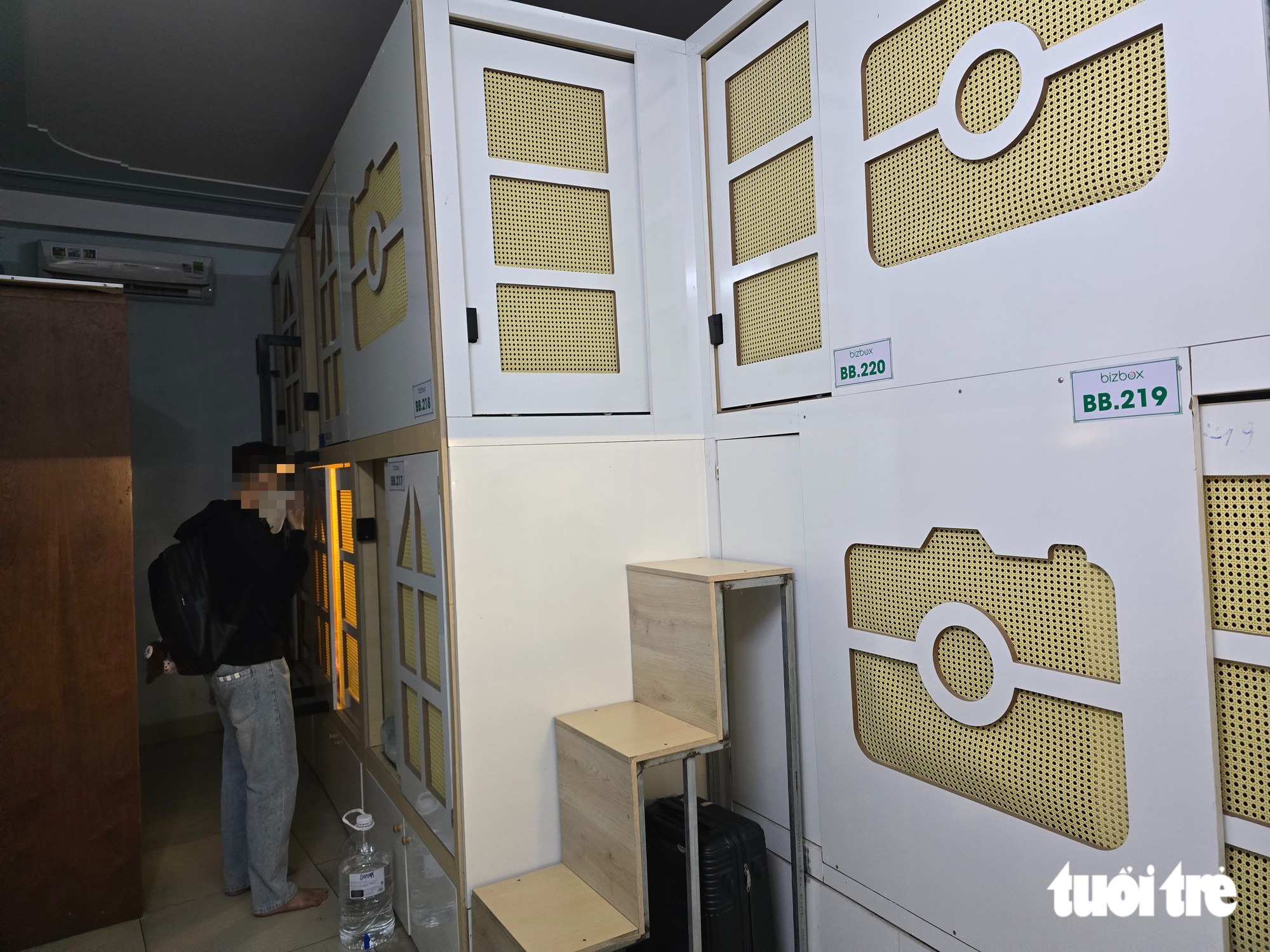

In Thu Duc Ward, every inch of wall space around the sleeping boxes is put to use. Once the small door is closed, the occupant is enclosed on all sides in a space just large enough for one person to lie down. Photo: Minh Hoa / Tuoi Tre

A shared bathroom at a sleeping box rental. Photo: Minh Hoa / Tuoi Tre

A shared living and dining area. Photo: Minh Hoa / Tuoi Tre
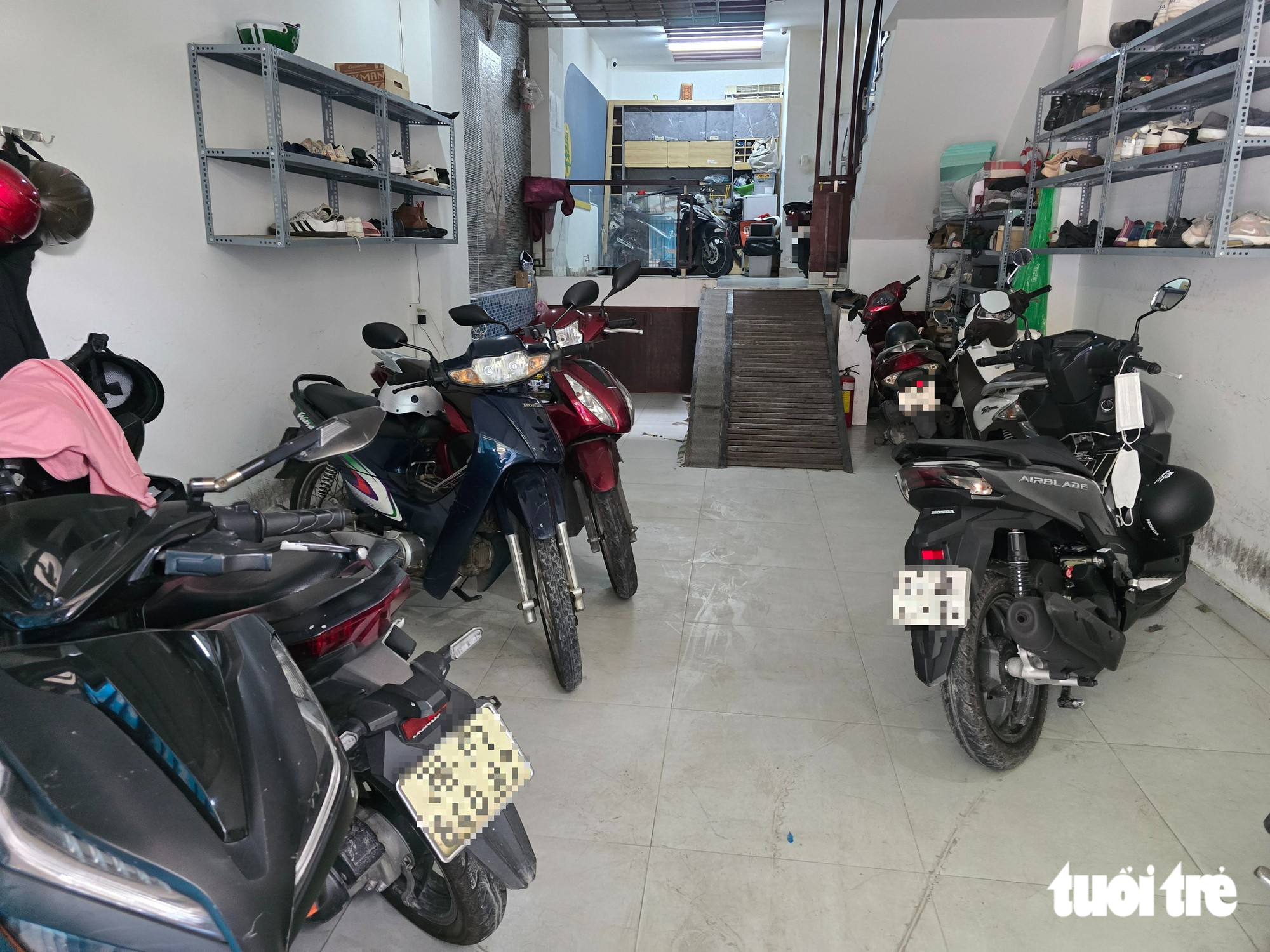
A motorbike parking area on the ground floor, directly below the sleeping boxes. Photo: Minh Hoa / Tuoi Tre


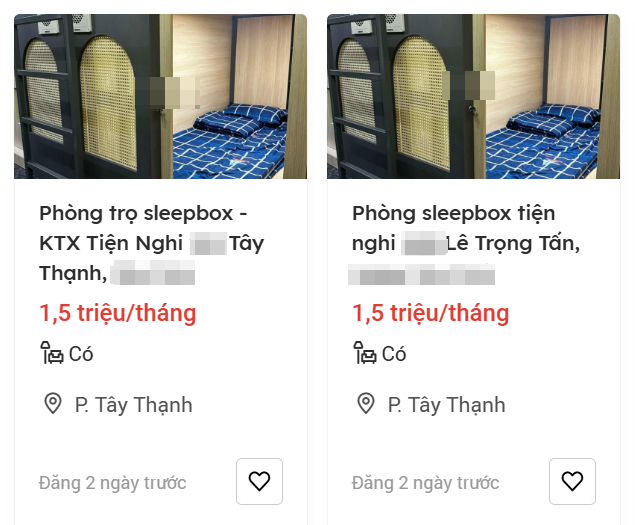
Sleeping box rentals are widely advertised by brokers on social media and websites for rental housing in Ho Chi Minh City. Photo: Screenshot
- REFERENCE MORE








Max: 1500 characters
There are no comments yet. Be the first to comment.