


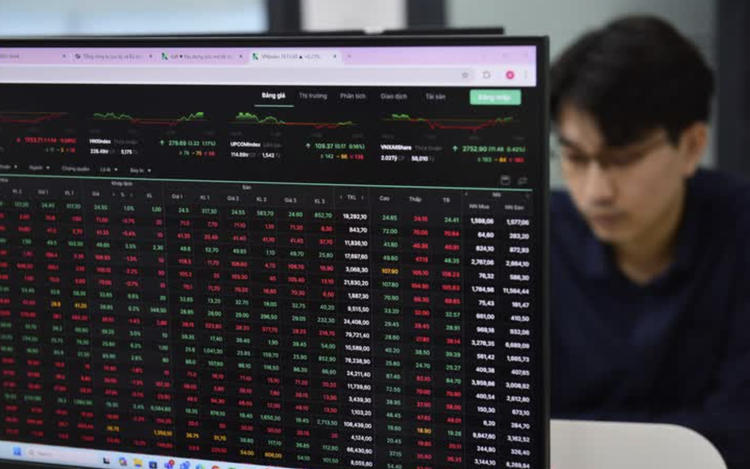
30 firms generated 75% of Ho Chi Minh City stock exchange’s profit in the second quarter of 2026. Photo: Quang Dinh / Tuoi Tre
According to second-quarter financial statements released by listed companies on HOSE, 366 of the exchange’s 396 companies reported profits, while 30 posted losses.
These companies generated a total of VND220 trillion (US$8.4 billion) in after-tax profit.
Of this amount, the 30 stocks in the VN30 basket contributed roughly VND165 trillion ($6.3 billion), or about 75 percent.
The 75-percent share was largely unchanged from the first quarter of this year, when VN30 companies accounted for 75.4 percent of total profits.
However, the figure rose considerably from a low of 67 percent in the third quarter of 2025.
Over the past 12 quarters, the VN30 group’s share of total HOSE profits has ranged between 67 and 79 percent.
In the second quarter of the year, the VN30’s combined profit increased by some VND25 trillion ($956.3 million), or 17.9 percent, from the first quarter.
However, the increase was far from evenly distributed.
Vietnamese conglomerate Vingroup (VIC) and lender Vietcombank (VCB) alone contributed more than VND14.2 trillion ($543.2 million) to the overall increase, making up nearly 57 percent.
Vingroup posted an after-tax profit of over VND14.7 trillion ($564.7 million) in the second quarter, 2.6 times higher than the figure recorded in the previous quarter.
According to its consolidated financial statements, the group recorded nearly VND15.9 trillion ($607.5 million) in gains from the disposal of financial investments and the transfer of subsidiaries, providing a major boost to quarterly earnings.
Vietcombank was the second-largest contributor to the increase.
Its after-tax profit rose from nearly VND9.5 trillion ($362 million) to over VND14.5 trillion ($556.6 million), a quarter-on-quarter increase of 53.8 percent.
The main driver was net interest income, which climbed about 35 percent.
The bank also sharply reduced credit-loss provisioning during the quarter.
At the other end of the spectrum, steel giant Hoa Phat (HPG) recorded the sharpest decline in profit among the 30 largest listed firms.
Its after-tax profit fell from VND9 trillion ($346.4 million) to VND6.4 trillion ($245.7 million), a decline of 29 percent.
However, the drop was not caused by weakness in its core steel business, where output continued to grow.
Instead, it reflected an unusually high comparison base in the first quarter.
During that period, Hoa Phat recorded some VND3.8 trillion ($145.4 million) in non-core profit from the transfer of part of a real estate project in Hung Yen Province, northern Vietnam.
The gain was not repeated in the second quarter.
In absolute terms, Vinhomes (VHM) was the most profitable company in the VN30 basket in the second quarter, with its after-tax profit nearing VND26.5 trillion ($1.01 billion), almost twice that of Vingroup.
Its profit, however, increased by only 3.3 percent from the previous quarter.
In terms of growth, PetroVietnam Gas (GAS) and Masan Group (MSN) were among the standout performers, with their quarterly profits roughly doubling from the first quarter.
By contrast, Vietjet’s profit plunged 65.9 percent quarter on quarter to VND349 billion ($13.3 million).
Le Anh Tuan, general director of Dragon Capital, said this could be one of the years with the strongest corporate profit growth in the past decade.
Nevertheless, the improvement has been highly uneven between large- and small-cap companies.
For every VND100 of earnings before interest and taxes, large-cap companies spend only about VND10 on interest payments, while small-cap companies spend as much as VND30.
The disparity stems from the fact that smaller companies tend to carry heavier debt burdens while also facing higher borrowing costs.
The VN30 Index comprises the 30 largest and most liquid stocks listed on HOSE.
HOSE reviews the index twice a year, in January and July.
In the latest review, effective August 3, HOSE added Masan Consumer (MCH) and Techcom Securities (TCX) to the VN30 basket, while removing Petrolimex (PLX) and TPBank (TPB).








Max: 1500 characters
There are no comments yet. Be the first to comment.