


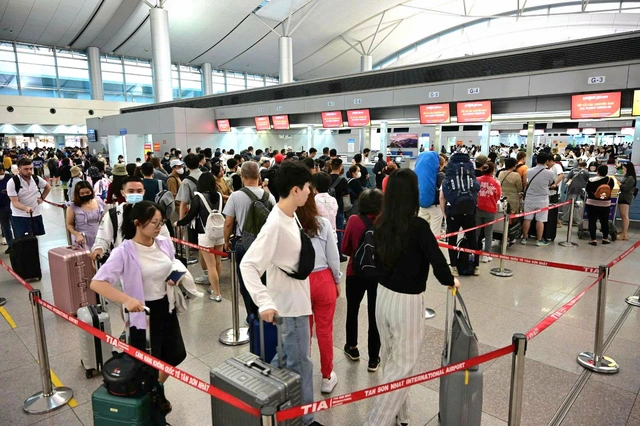
Passengers queue at Vietjet check-in counters at an airport in Vietnam. Photo: Tuoi Tre
At 11:00 pm on November 28 (Vietnam time), Airbus issued an urgent alert, and the European Union Aviation Safety Agency (EASA) immediately ordered all A319, A320, and A321 aircraft to update or replace their ELAC flight-control software, which is responsible for pitch and roll, before 6:59 am on November 30.
The software was found vulnerable to solar radiation interference that could trigger uncommanded nose-down inputs, an issue previously linked to an emergency landing of an A320 in the United States.
'A historic race against time'
Within hours, the Civil Aviation Authority of Vietnam convened an emergency meeting with carriers.
By 5:30 am on November 29, regulators confirmed that 81 of Vietnam’s 169 Airbus narrow-body aircraft required the urgent update.
Airline leaders and engineering teams described it as 'a historic race,' with less than 32 hours from notice to deadline.
On the night of November 28, Vietjet CEO Dinh Viet Phuong received a call from Airbus’ chief executive advising that an emergency technical directive would be issued that same night.
Soon after, EASA announced the hard deadline: from 6:59 am on November 30, any aircraft not updated would be grounded.
Globally, nearly 6,000 aircraft were affected.
Vietnam had 69 from Vietjet and 18 from Vietnam Airlines.
Airbus estimated each update would take two to three hours.
Vietnam, however, had only a few specialized equipment sets available, while affected aircraft were operating across Vietnam, Laos, Thailand, and China.
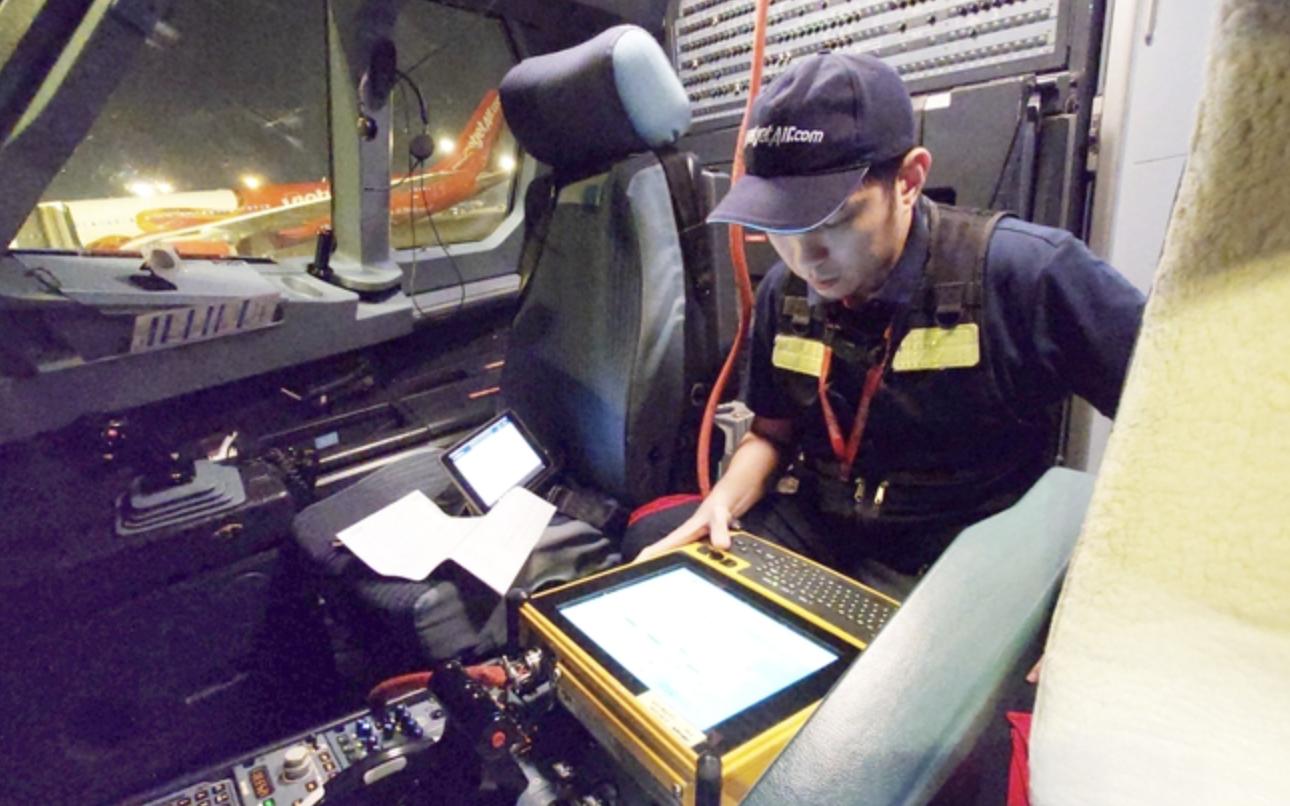
Airlines began drafting contingency schedules, including redeploying wide-body jets to cover core routes.
Any delay risked disrupting tens of thousands of passengers and causing widespread network chaos.
Vietjet immediately activated its Emergency Response Committee and deployed its AMOS big-data and AI system to review fleet status in real time.
Across all bases, teams coordinated overnight to keep operations running.
Cutting update time from 3 hours to 45 minutes
Da Nang had five aircraft requiring immediate updates that night and four more the next morning.
Although Airbus estimated two to three hours per aircraft, Vietjet engineer Nguyen Van Trung, who has more than 15 years of experience, completed the full procedure in a record 45 minutes.
According to Trung, updating aircraft flight-control software is far more complex than clicking 'update' on a phone or laptop.
It involves a sequence of tightly controlled steps, including verifying the exact configuration of each aircraft.
Engineering teams must simultaneously inspect systems, standardize software, run tests, and cross-check data.
One technician executes the procedure while another monitors and verifies documentation.
“You can’t skip any steps, but experience tells you exactly where you can move faster,” Trung said.
Years of experience with the software helped him optimize the workflow, shorten technical actions and data searches, and still meet all safety requirements.
The first aircraft to finish, VN-A644, completed its update in just 45 minutes, a moment Vietjet’s emergency command called 'a breath of life.'
The 45-minute protocol was immediately shared with engineering teams at Hanoi, Ho Chi Minh City, and international airports, reshaping the entire operation.
Alongside software updates, Vietjet also prepared a ‘hardware fallback,’ removing ELAC units from grounded aircraft for rapid replacement if needed.
Vietjet Thailand, Vietnam Airlines, and Bamboo Airways provided equipment to accelerate the work.
On November 29, affected aircraft were cycled through updates between scheduled flights in Hanoi, Ho Chi Minh City, and Da Nang.
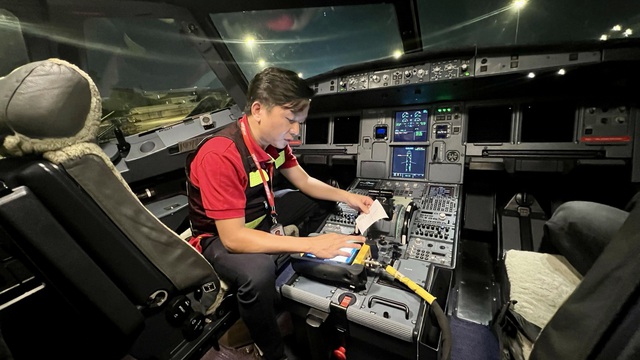
Vietjet engineers work through a 32-hour window to update software on the airline’s Airbus A320 fleet. Photo: N. Quang
Even updating an aircraft being painted in Indonesia
Vietnam Airlines, though handling fewer aircraft than Vietjet, also activated emergency procedures late on November 28.
Its teams in Hanoi, Da Nang, and Ho Chi Minh City carried out the updates through the night, assisted by manufacturer support and coordinated flight operations.
By 1:00 am on November 30, all 19 Vietnam Airlines A320 and A321 aircraft, including one undergoing repainting in Indonesia, had completed updates.
The carrier returned to normal operations on November 30.
“Acting early helped minimize schedule disruptions,” a Vietnam Airlines representative said.
“Although a few flights were delayed, the impact was limited.”
For Vietjet, success hinged on its AMOS and AI systems, which enabled real-time configuration checks and immediate data verification.
A standardized software library and fully digitalized checklists on iPads helped shorten administrative steps and accelerate technical tasks without compromising safety.
In just over 32 hours, every affected aircraft was cleared. None were grounded due to the software issue.
“When Da Nang reported the first 45-minute completion, the emergency control room erupted,” said To Viet Thang, Vietjet’s standing vice-president.
“Only then did we feel confident tackling all 69 aircraft.”
By 3:00 am on November 30, nearly four hours ahead of deadline, the carrier completed all updates.
For Vietnam’s engineers, the operation showcased technical capability, data readiness, and coordination under intense pressure.
According to Thang, the final 32 hours of November 2025 will likely be remembered as a landmark technical campaign, compressing a three-hour procedure into just 45 minutes per aircraft during an unprecedented emergency.

To Viet Thang, Vietjet’s standing vice-president, oversees the airline’s emergency effort to update software on 69 Airbus A320-series aircraft. Photo: Tuoi Tre
How int’l airlines were affected
Many global carriers also raced to update their A320 fleets and faced disruptions from sudden grounding requirements.
According to Asahi Shimbun, Japan’s ANA had to ground 34 aircraft, cancel 95 flights, and disrupt travel for 13,500 passengers.
Nippon Airways canceled 65 flights.
Japan Airlines remained unaffected because it primarily operates Boeing aircraft.
In India, IndiGo had 200 aircraft and Air India 113 requiring updates.
Most met the deadline, though IndiGo subsequently canceled around 1,000 flights due to new pilot duty-time regulations.
Despite the broad impact, several airlines noted that Airbus issued its alert in the evening, when A320 operations are lighter, allowing overnight updates and reducing disruptions.
Many carriers reported completing the process in under an hour per aircraft.
Rapid response to an unexpected event
Uong Viet Dung, director general of the Civil Aviation Authority of Vietnam, said that despite the large number of aircraft requiring updates, Vietnamese carriers responded swiftly as soon as Airbus issued its urgent alert and EASA formalized the directive.
Airlines prepared thoroughly, both technically and logistically, allowing them to meet the Emergency Airworthiness Directive before it took effect.
By reviewing personnel, equipment, tools, software, and operational schedules, carriers developed optimal plans to balance flight operations with the required ground time, ensuring continuity of service while completing the updates at maximum speed.








Max: 1500 characters
There are no comments yet. Be the first to comment.