


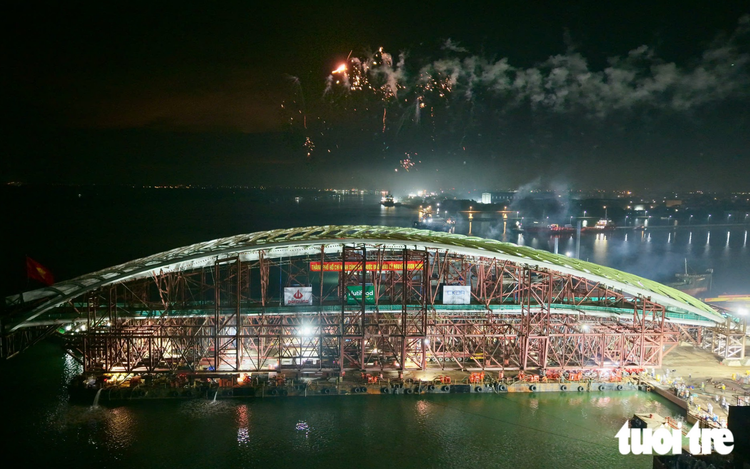
The 3,400-metric ton main steel arch of a pedestrian bridge over the Saigon River in Ho Chi Minh City is safely positioned on a heavy-duty barge at around 2:30 am, October 16, 2026. Photo: Thuan Van / Tuoi Tre
At around 2:30 am, the massive steel structure was safely positioned on the barge amid applause and cheers from hundreds of engineers and workers who had worked through the night to complete the challenging operation.
Over the next 48 hours, the technical team was set to tighten the anchoring cable assemblies connecting the supporting framework to fixed hooks on the barge’s deck to ensure the structure remains stable during transportation.
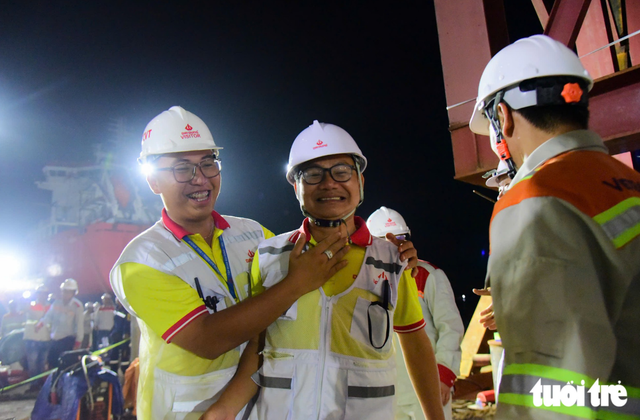
Cheers erupt as engineers and workers complete the transfer of the 3,400-tonne steel arch onto a barge. Photo: Tri Duc / Tuoi Tre
Once the securing work is complete, the construction contractor and supervision consultants will jointly inspect the entire anchoring system to ensure that it meets technical requirements and the planned towing route.
The Ho Chi Minh City Maritime Port Authority will then conduct an acceptance inspection and issue the necessary permits, completing the procedures required before the barge can begin its journey to the city center, where the bridge structure will be joined to complete the main span.
At around 10:00 pm on Thursday, the main steel arch began its gradual movement toward the barge anchored in Ganh Rai Bay in preparation for the tow to downtown Ho Chi Minh City.
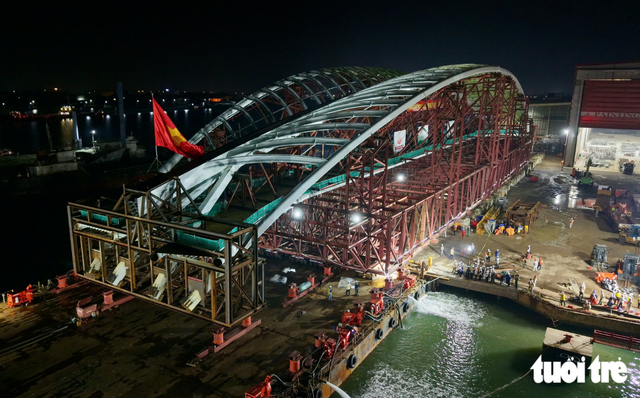
At 10:50 pm on October 16, 2026, the steel arch is moved toward the barge and covers approximately 30 meters. Photo: Thuan Van / Tuoi Tre
A fleet of 30 self-propelled modular transporters, capable of rotating 360 degrees, carried the main bridge structure and its supporting framework, measuring 156 meters in length and more than 20 meters in height, with a combined weight of 3,400 metric tons.
The structure was moved in short increments, allowing engineers to measure its elevation and inclination and monitor the barge’s response before proceeding.
The cautious, step-by-step approach was designed to distribute the load evenly across the barge and minimize safety risks.
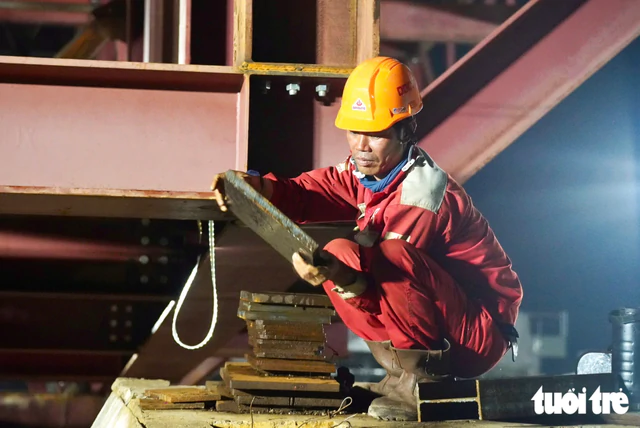
Workers clean up the site in preparation for the transfer. Photo: Thuan Van / Tuoi Tre
Duong Phuc Loi, director of Dai Dung Shipyard, said controlling the barge’s draft and maintaining its balance were among the most critical stages of transferring the bridge structure onto the vessel.
The barge has a carrying capacity of 14,000 metric tons and is equipped with 40 pumps with a combined pumping capacity of 2,000 cubic meters.
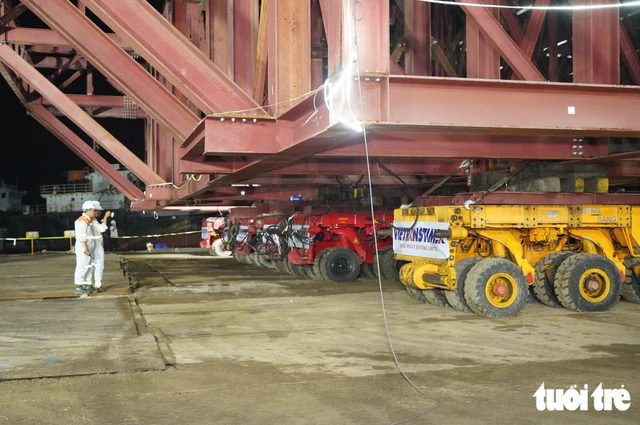
Transporters begin moving, slowly carrying the 3,400-tonne steel arch toward the barge. Photo: Thuan Van / Tuoi Tre
The pumping system is used to adjust the vessel’s ballast water, allowing its draft to be altered as required while receiving the bridge structure and aligning the barge with the wharf surface.
As the structure is transferred onto the barge, ballast levels must be adjusted accordingly to maintain balance, ensure stability and reduce the risk of accidents.
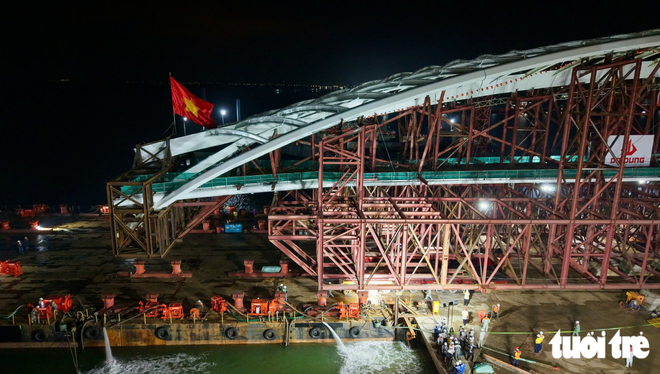
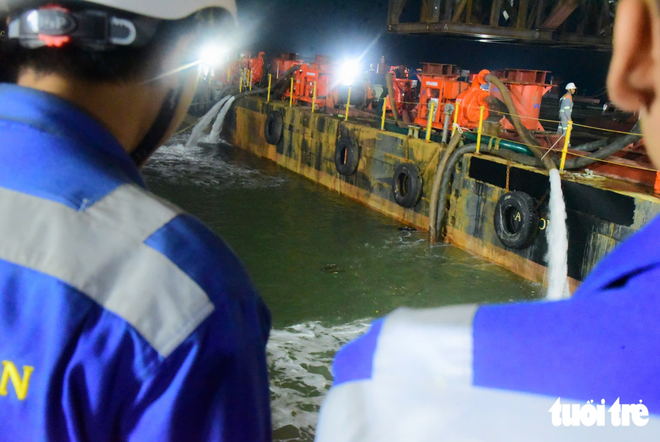
The barge continuously pumps water to maintain its balance as the steel arch is slowly lowered into position. Photo: Tri Duc / Tuoi Tre
In addition to the pumping equipment, the barge is fitted with winches and an anchoring system at eight positions to keep it secure throughout the loading operation.
The team scheduled the transfer to coincide with a favorable tidal window, when water levels were expected to range from three to 3.9 meters.
The operation was planned between 10:00 pm and 6:00 am the following morning to take advantage of suitable water conditions.

Technical parameters are continuously monitored and updated throughout the transfer operation to ensure maximum safety. Photo: Duc Phu / Tuoi Tre
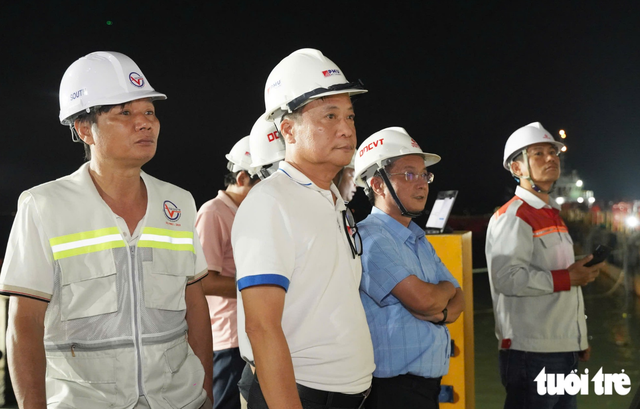
Project leaders, managers, and engineers closely monitor the transfer operation on the night of October 15, 2026. Photo: Thuan Van / Tuoi Tre
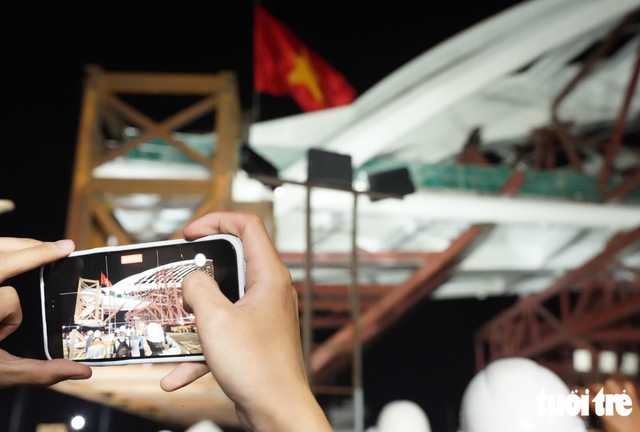
Onlookers eagerly use their phones to capture the moment as the steel arch inches toward the barge. Photo: Thuan Van / Tuoi Tre
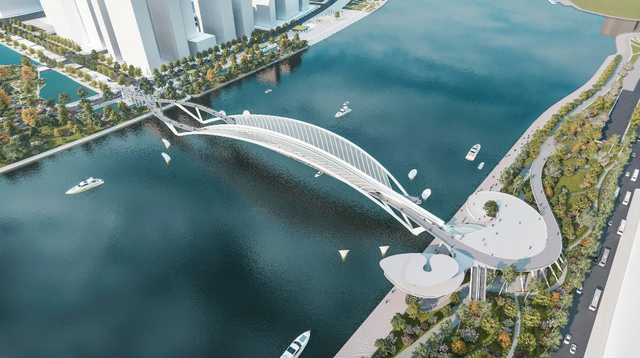
An artist’s impression of the pedestrian bridge across the Saigon River in Ho Chi Minh City
Waterway traffic on the Saigon River will be temporarily suspended on October 19, 21, and 22 to facilitate the installation and joining of the main steel arch of the pedestrian bridge worth nearly VND1 trillion (US$38 million).
The pedestrian bridge, which broke ground in late March 2025, has reached over 90 percent completion.
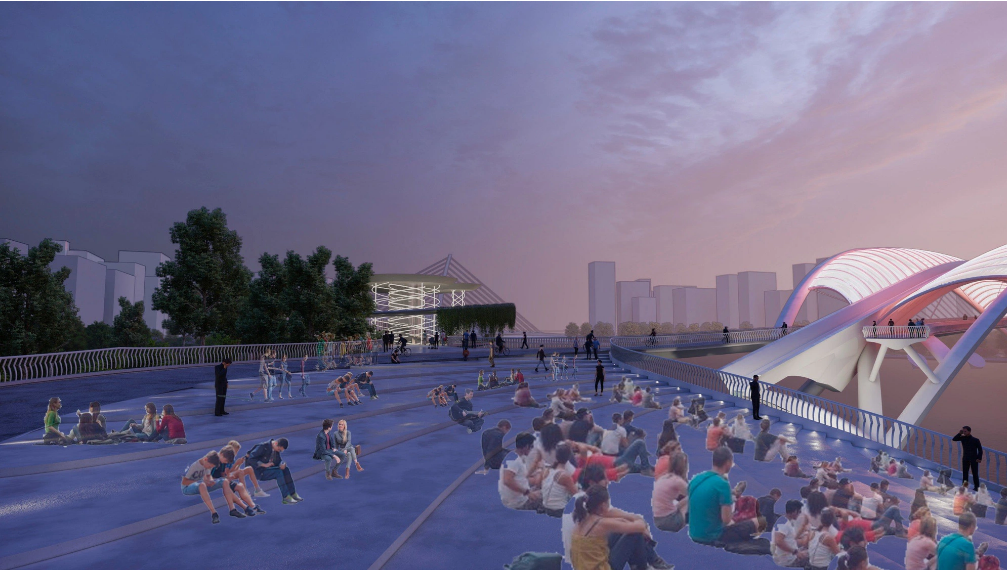
In October 2023, the Ho Chi Minh City administration publicized images of the architectural design featuring nipa palm leaf imagery for the pedestrian bridge across the Saigon River.
The design was proposed by a consortium of Japanese-invested Chodai - Takashi Niwa Architects and Chodai Kisojiban Vietnam.
One end of the bridge will be at Bach Dang Wharf Park and the other end will be in the Thu Thiem New Urban Area in Thu Duc.
The bridge is Ho Chi Minh City's first project implemented under a build-transfer (BT) model without government payment, with the approach subsequently adopted for other landmark projects in the city.








Max: 1500 characters
There are no comments yet. Be the first to comment.