


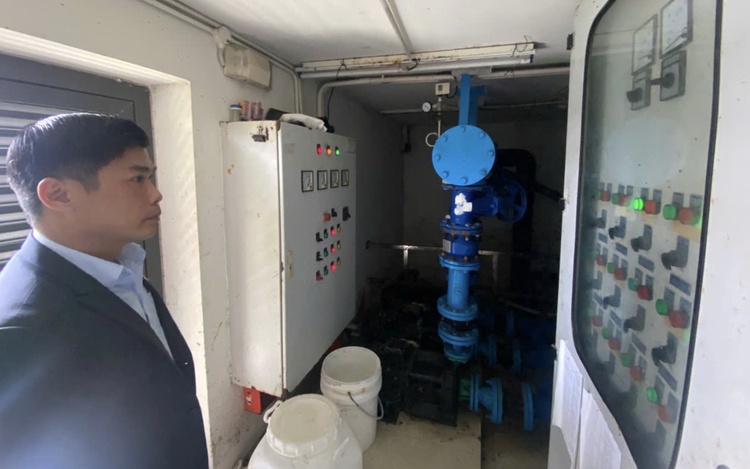
A wastewater pumping station feeds into a treatment tank at The Pearl Hoi An in Da Nang City, central Vietnam. Photo: B.D. / Tuoi Tre
The penalty followed inspections by local police and environmental authorities, which found the company operating without a required environmental permit and breaching several waste management and food safety rules, according to the Da Nang People’s Committee.
Do Duc An, deputy director of The Pearl Hoi An, said on Thursday that the resort is situated in a relatively low-lying area along the coastal stretch between Hoi An and Da Nang.
As a result, heavy rainfall often leads to large volumes of water pooling on the coastal road in front of the property.
Some residents reported this situation to local authorities.
The Hoi An Tay Ward People’s Committee conducted an inspection and subsequently submitted a report to relevant agencies.
Shortly thereafter, an inspection team comprising the economic police division of the municipal Department of Public Security, the environmental protection agency under the municipal Department of Agriculture and Environment, and police in Hoi An Tay Ward conducted an on-site inspection at The Pearl Hoi An.
An said that at the time of the inspection, authorities determined that The Pearl Hoi An did not have an environmental permit as required.
The inspection record also noted several other violations, including failure to properly collect and store hazardous waste, and failure to submit environmental protection reports to designated state agencies as required.
Besides, inspectors found that staff directly involved in food preparation were not consistently wearing hats or masks, and that kitchen layouts did not adequately prevent cross-contamination between raw and cooked foods.
The resort was also found to have failed to properly implement the legally mandated three-step food inspection process and food sample retention procedures.
Addressing public concern over how a large, five-star beachfront resort could operate without an environmental permit, An explained that the facility had previously been granted a wastewater discharge permit by the People’s Committee of former Quang Nam Province in 2018.
The current Da Nang City was formed by merging the former Da Nang City and neighboring Quang Nam Province on July 1, 2025, as part of the major administrative restructuring in which Vietnam’s total number of provinces and cities was reduced to 34 from 63.
Subsequent regulatory changes required businesses to obtain a comprehensive environmental permit, An said, adding this is a substantial dossier that takes considerable time to complete.
During this period, The Pearl Hoi An underwent organizational and personnel changes, which delayed the process, he elaborated.
“At the time of the inspection, we were in the process of completing the environmental permit application as required," An said.
“Regardless, the law is the law, and we acknowledge the violations as concluded by the authorities."
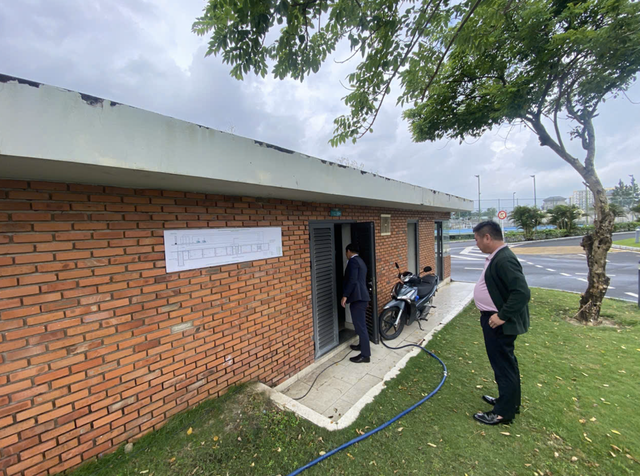
A wastewater treatment facility at The Pearl Hoi An in Da Nang City, central Vietnam. Photo: B.D. / Tuoi Tre
Regarding issues such as improper hazardous waste management, failure to submit environmental reports, and lapses in food safety practices, the representative of The Pearl Hoi An acknowledged a degree of operational inconsistency.
“Within the resort, there are multiple sources of waste generated daily, and the collection and classification process has not always been done correctly," said Nguyen Van Thang, director of customer service at The Pearl Hoi An.
“Kitchen staff do wear masks and gloves, but at times not strictly in accordance with regulations.
“These are internal process-related issues. We will rectify them to ensure they do not recur."
The Pearl Hoi An is a large-scale resort located along the Hoi An-Da Nang coastline and was officially recognized as a five-star property in 2024.
It currently operates 594 accommodation units, including hotel rooms, villas, and apartments.
The resort treats some 380 cubic meters of wastewater per day, with about 50 percent of the treated volume reused for irrigation purposes.








Max: 1500 characters
There are no comments yet. Be the first to comment.