


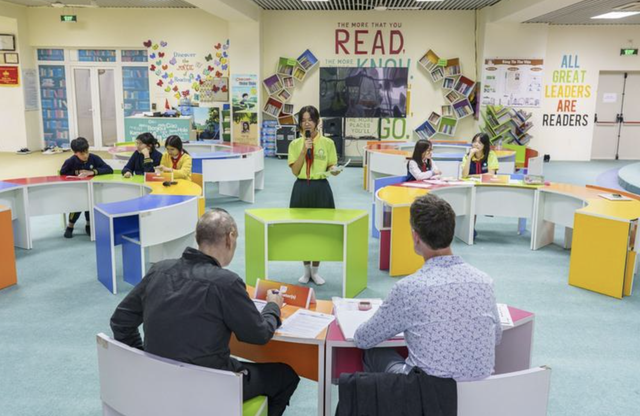
Students take part in an English class in Vietnam. Photo: Tuoi Tre
A recent conversation about birthdays during one of my English lessons in Ho Chi Minh City stayed with me long after the class ended.
My students and I were discussing what makes a birthday enjoyable and memorable.
The classroom quickly filled with excited answers.
Some children talked about cakes, sweets, and magic shows. Others mentioned games, balloons, parties, and spending time with family and friends.
Almost every child agreed on one thing: the best part of a birthday is receiving presents.
At their age, it is hardly surprising. Childhood is filled with anticipation.
Children wait eagerly for birthdays because they expect joy to arrive wrapped in colorful paper.
As I listened to the discussion, I found myself smiling at their enthusiasm.
The answers were exactly what one would expect from a room full of children.
Then came the answer I did not expect.
She is usually quiet, always smiling and polite, never the loudest voice in the room.
While her classmates excitedly spoke about the gifts they hoped to receive, she softly yet confidently said that birthdays make her happy because they give her a chance to buy presents for her friends.
For a brief moment, the classroom grew quiet.
A few students turned toward her. Some smiled. Others simply listened.
I commended her response and applauded her thoughtfulness.
What struck me most was not only what she said but how naturally she said it.
There was no hesitation, no performance, and no attempt to sound thoughtful.
She simply answered the question.
As adults, we often imagine that character reveals itself during life's biggest moments.
We associate it with difficult decisions, personal sacrifice or extraordinary acts of courage.
Yet I have come to believe that character often reveals itself much earlier and much more quietly than that.
Sometimes it appears in an ordinary conversation, a passing remark or a moment when nobody is trying to reveal it.
Perhaps that is why the moment stayed with me.
The discussion was about birthdays but the answer revealed something more.
While most of the class was thinking about what they hoped to receive, she was thinking about what she could give.
Later in the lesson, I asked the students what they wanted to become when they grew up.
The usual answers came quickly: game designers, police officers, teachers, YouTubers, football players, and singers.
When it was her turn, she answered without hesitation.
"I want to be a doctor." Hearing that, I smiled.
Many children dream of becoming doctors.
There was nothing unusual about the profession itself.
What stayed with me was the connection between her two answers.
The first revealed kindness and the second suggested where she hoped to put it into practice.
Teachers spend much of their time helping students improve academically.
We teach reading, writing, speaking, and critical thinking. These skills matter and they should.
But every so often, a student reveals something that cannot be measured by a test or reflected in a report card.
Report cards tell us what children have learned.
Ordinary moments sometimes reveal who they are becoming.
The qualities that shape a person's future are often the hardest to measure when they are young.
Kindness, generosity, and empathy cannot be fully captured by an examination or proven by a certificate.
Yet they influence how people build relationships, earn trust, and navigate the world.
That may be why certain memories remain with teachers long after lessons end.
Not because of a perfect answer or academic achievement, but because, for a brief moment, we catch a glimpse of character quietly taking shape.
By the end of the class, the discussion itself was no longer what stayed with me.
It was the child.
Not because she gave the 'right' answer, but because, in a simple conversation about birthdays, she revealed something about the kind of person she was becoming.
Perhaps somewhere in the future, she will care for patients with the same thoughtfulness she showed her classmates.
If that happens, I will not be surprised.
The signs were already there in a classroom discussion about birthdays.








Max: 1500 characters
There are no comments yet. Be the first to comment.