


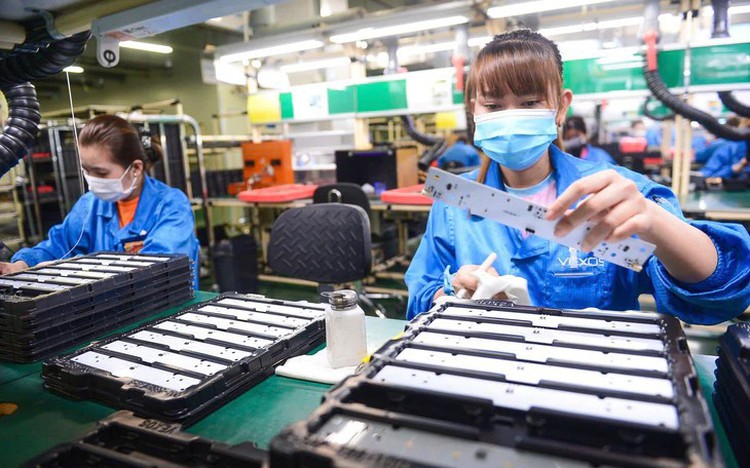
Workers at Vexos, a wholly foreign-owned company, at the Tan Thuan Export Processing Zone in Ho Chi Minh City, southern Vietnam. Photo: Quang Dinh / Tuoi Tre
The ADB also raised its growth forecast for Vietnam in 2027 to 7.6 percent.
Shantanu Chakraborty, ADB country director for Vietnam, said the revisions were based on the economy's strong performance in the first half of 2026, when GDP expanded about 8.2 percent, driven by processing and manufacturing, domestic consumption, and foreign direct investment.
He said the results showed that the economy continued to demonstrate resilience and maintain its growth momentum.
The ADB forecasts Vietnam's inflation at 4.3 percent this year and four percent in 2027, amid sustained demand and rising energy and import costs.
Growth drivers identified
Bui Minh Giap, ADB chief economist for Vietnam, said public investment, foreign direct investment (FDI), manufacturing, and domestic demand are important drivers of Vietnam's growth.
Public investment focused on key connectivity projects could create spillover effects and help spur private investment, he said.
FDI remains a bright spot, particularly in manufacturing, with both registered and disbursed capital continuing to show positive trends.
However, strong growth also raises questions about sustainability if the economy becomes too dependent on investment and credit, Giap said.
"Policies should continue to support growth without sacrificing macroeconomic stability," he said.
For FDI, the key issue is not only how much capital Vietnam attracts but also how much added value is retained domestically, the level of linkages with Vietnamese businesses, and the ability to transfer technology, Giap said.
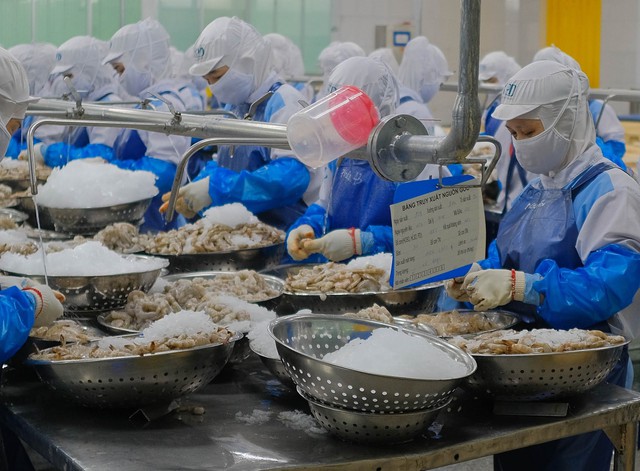
Workers process shrimp for export at a factory in Da Nang City, central Vietnam. Photo: Tan Luc / Tuoi Tre
Vietnam's processing and manufacturing sector continues to expand and support exports, logistics, transport, and related services.
However, production remains heavily dependent on imported raw materials, components, and export orders.
Vietnam therefore needs to increase localization, develop supporting industries, and help domestic businesses participate more deeply in supply chains, Giap said.
Challenges ahead, including trade deficit
The ADB also noted that imports are rising rapidly alongside the expansion of production, with Vietnam recording a trade deficit of around US$23 billion since the beginning of the year.
Giap said the figure is not yet a major concern if most imports consist of machinery, raw materials, and components used as production inputs.
Rising imports of production inputs indicate increasing demand for manufacturing and reflect expanded production capacity.
However, they also show that the economy remains significantly dependent on imported inputs.
"If imports are transformed into production capacity, productivity, and exports in the future, this is a positive signal," Giap said.
"Conversely, a prolonged trade deficit without creating additional domestic value could increase pressure on the current account, exchange rate, and foreign exchange reserves."
The ADB also warned that rapid credit growth needs to be monitored because it could increase risks to the financial system, while small businesses continue to face difficulties accessing capital.
Against these risks, Chakraborty said Vietnam needs to continue prudent macroeconomic management, control inflation, ensure financial stability, accelerate structural reforms, and improve productivity.
He said the short-term outlook remains positive, but risks are tilted to the downside, with weaker global demand, external uncertainties, higher energy prices, and tighter global financial conditions potentially putting additional pressure on growth, inflation, and the exchange rate.
In the longer term, the ADB recommended that Vietnam improve the efficiency of public investment, develop capital markets, strengthen the private sector, and improve productivity to lay the foundation for its goal of becoming a high-income country.









Max: 1500 characters
There are no comments yet. Be the first to comment.