



The Autumn Economic Forum 2026 (AEF 2026), themed “Collaboration in a New Era,” takes place in Ho Chi Minh City from October 26 to 29, bringing together emerging global growth hubs. Photo: Organizers
The issue was highlighted at a panel discussion titled “ESG as a Strategic Pillar and Standard for Competitive Advantage,” held on Tuesday as part of the Autumn Economic Forum (AEF) 2026.
Panelists emphasized that sustainability starts with practical steps, including greater data transparency, regulatory compliance, and improved worker welfare.
ESG builds trust and competitiveness
Bolat Duisenov, chairman of the Board of Directors of Coteccons Construction JSC, said ESG is often perceived as an abstract or overly sophisticated concept, but its essence comes down to three elements: people, the environment, and trust.
“ESG is first and foremost a common language of business – a language of transparency, data, consistent assessment criteria, and, above all, trust,” he said.
Duisenov emphasized that sound corporate governance starts with compliance, which helps build lasting trust among contractors, subcontractors, and customers.
In the emissions-intensive construction sector, Coteccons has promoted greener materials, including green concrete, and optimized steel use, helping reduce CO2 emissions by more than 300,000 metric tons over the past year.
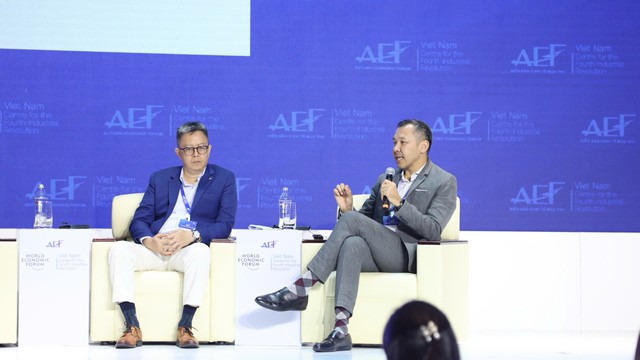
Bolat Duisenov, chairman of Coteccons Construction Joint Stock Company (right). Photo: Cong Trieu / Tuoi Tre
Dr. Kim Jae Hong, standing chairman of the National Alliance for ESG Action, said ESG requirements are becoming increasingly important in international trade and investment.
He cited the European Union's Corporate Sustainability Reporting Directive (CSRD) as an example of growing sustainability disclosure requirements.
Rather than treating ESG standards as regulatory burdens, businesses should proactively strengthen their capacity to meet them, he said.
Kim also highlighted the shift toward a circular economy, which focuses on managing materials and resources throughout their life cycle, from design and production to consumption and reuse, rather than simply recycling waste.
Data gaps hinder access to green financing
For SMEs, weak management systems and inadequate ESG data remain major obstacles.
Hoang Van Tam, head of the General Affairs Division at the Ministry of Industry and Trade's Department of Science, Technology, and Digital Transformation, said surveys showed that many manufacturers had made little progress in collecting ESG data or lacked such information altogether.
These gaps make it harder for businesses to access green financing and respond to technical barriers in international markets.
To address these challenges, he said businesses should adopt ESG practices in stages, starting with existing electricity, water, and fuel bills, then installing low-cost sensors on major energy-consuming equipment, and ultimately measuring the carbon footprint of each product.
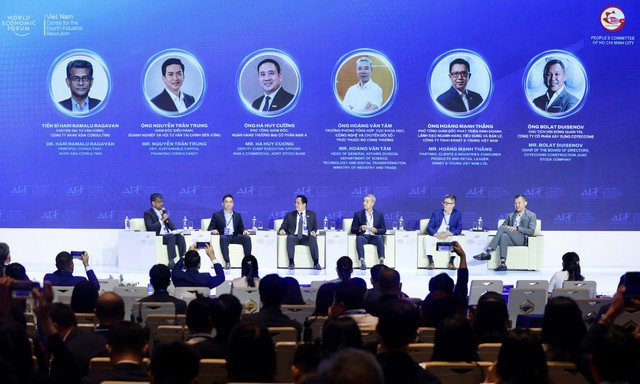
An overview of the panel discussion titled “ESG as a Strategic Pillar and Standard for Competitive Advantage” at AEF 2026. Photo: Organizers
Ha Huy Cuong, deputy general director of Nam A Bank, said many companies already practice ESG through everyday activities such as saving electricity, water, and paper or complying with labor regulations.
However, these efforts are rarely documented in standardized ESG reports.
He noted that relatively few borrowers currently have sufficiently developed ESG practices to qualify for green credit.
To bridge the gap, Nam A Bank has introduced technical advisory support and environmental and social risk management frameworks to help businesses meet lending requirements.
Companies that satisfy these requirements can access green loans at preferential interest rates, potentially strengthening their long-term competitiveness.
ESG credentials could determine contract wins
Hoang Manh Thang, deputy general director of business development and consumer products and retail sector leader at Ernst & Young Vietnam, said ESG credentials are increasingly becoming a competitive advantage in global supply chains.
In business-to-business markets, where suppliers may offer similar prices, quality, and delivery schedules, a strong ESG track record could determine who wins a contract.
Describing trust as a form of currency, Thang stressed that ESG reports must be supported by reliable data and evidence to avoid greenwashing.
He advised companies to avoid pursuing too many initiatives at once, recommending that they start with a priority product or issue, establish a baseline, and measure progress.
Nguyen Tran Trung, executive director of a social enterprise specializing in sustainable finance consulting, echoed this view, urging SMEs in global supply chains to align their governance systems with buyers' standards and financial institutions' requirements.
Such preparation could help businesses secure sustainable financing and improve their market position.
The experts agreed that ESG should be viewed as a process of continuous improvement rather than a short-term goal, with transparent data, consistent implementation, and practical actions forming the foundation for long-term competitiveness.


Max: 1500 characters
There are no comments yet. Be the first to comment.