


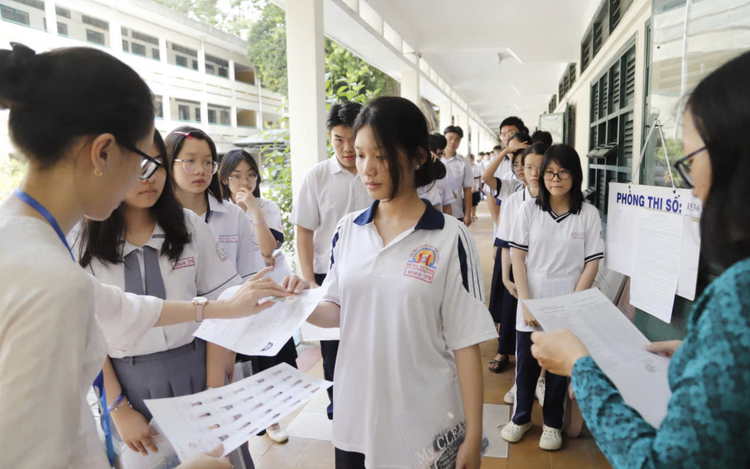
Students in Ho Chi Minh City. Photo: Nhu Hung / Tuoi Tre
According to the Ministry of Education and Training, PISA 2025 found that Vietnamese students spent an average of 2.2 hours a day using digital devices at school, higher than the international average.
While the widespread use of AI reflects students’ capacity to adapt quickly to new technology, their ability to critically assess what AI produces appears to be lagging behind.
As such, experts say a range of measures is needed to help students identify unsupported information and use AI more effectively as a learning tool.
When an essay is ‘too perfect’
Tran Le Duy, a lecturer in literature at the Ho Chi Minh City University of Education, told Tuoi Tre (Youth) online newspaper on Sunday that when marking literature tests, he does not encounter many essays with obvious inaccuracies caused by AI.
“Instead, I see essays that are too perfect,” Duy said.
Such essays are often written at a level significantly beyond the student’s actual ability.
These overly polished writings are not without flaws, but they often carry linguistic fingerprints that reveal their AI origins.
Duy said teachers may notice formulaic expressions, particularly sentences structured around a pattern of definition, negation and redefinition, such as ‘X is not simply A. Rather, it is B.’
Other passages may sound sophisticated and authoritative while making claims that are difficult to verify.
Some statements are so broadly applicable that they could be inserted into almost any literary analysis without changing their meaning.
AI-generated essays also tend to rely heavily on repetitive concluding phrases such as ‘therefore’ and ‘thus,’ creating a mechanical rhythm.
In some cases, the writing suddenly shifts into a highly academic register before returning to the student’s ordinary style.
“My purpose is to develop skills, so I ask them to rewrite the work,” he said.
He also prefers having students write in class rather than assigning take-home essays.
In his view, AI should be used primarily as an editing assistant: students should write the original piece themselves, ask AI for feedback, and then make their own revisions.
The revised version should be accompanied by evidence showing what the student asked the AI and how the student responded to its suggestions.

From knowing how to use AI to knowing how to evaluate it
From a technology perspective, Prof. and Dr. Nguyen Truong Thinh, vice-rector of the College of Technology and Design, a member of the University of Economics Ho Chi Minh City, said the figures reveal a clear gap between students’ rapid adoption of AI and their ability to control and evaluate the technology.
“The fact that most Vietnamese students are already using AI is a positive sign of their ability to adapt to new technology,” Thinh said.
“However, if their ability to read, verify, and evaluate information does not keep pace, they can easily accept answers that sound reasonable but are actually inaccurate.”
The solution, he argued, is not to prevent students from using AI.
Instead, education must move from ‘knowing how to use AI’ to ‘knowing how to evaluate AI.’
Students need to understand that AI is not infallible.
It can produce inaccurate or unsupported information, and the user ultimately bears responsibility for verifying what it provides.
That skill should be developed across subjects, he said.
Instead of simply asking students to use AI to find an answer, teachers could give them an AI-generated response and ask them to identify its arguments, verify its sources, cross-check its data, and identify questionable claims.
In this model, AI does not replace critical thinking.
It becomes an object through which critical thinking can be practiced.
A technology expert in Ho Chi Minh City similarly noted that Vietnamese students are increasingly capable of using AI to produce results and complete assignments quickly.
But speed can come at a cost: students may not understand the reasoning process that produced the final answer.
Teachers need to help students distinguish between situations in which AI is useful and those in which it may undermine learning.
They should also understand the basic nature of large language models, which generate responses through statistical patterns, synthesis, and inference.
“The learner needs to know which reasoning is sound and which is not,” the expert said.
Instead of banning AI outright, teachers should determine how far and to what extent students can use it while still strengthening their reasoning abilities.
Nearly 60 percent below basic reading proficiency
PISA, an international assessment organized by the Organization for Economic Co-operation and Development (OECD), tests 15-year-old students.
Rather than focusing solely on how much knowledge students can memorize, the assessment examines whether they can apply what they have learned to problems in school and everyday life.
PISA 2025 involved 91 countries and economies and some 765,000 students worldwide.
Vietnam participated with over 7,350 students from 194 schools, representing more than 1.1 million 15-year-olds.
The results showed that the Vietnamese students scored an average of 457 points in science, 443 in math, 392 in reading, and 461 in computer-based problem solving.
These scores were some 15-70 points lower than those recorded in the 2022 assessment.
PISA does not set a minimum or maximum score; instead, scores are calculated to fit a standardized distribution, local media reported.
The ministry said this was the first time Vietnamese students had transitioned from paper-based to computer-based testing.
As the two testing formats differed considerably, the gap in scores was not sufficient to conclude that the quality of education either improved or declined.
However, the results also indicated that only 41 percent of students reached level 2 or above in reading, compared with the OECD average of 69 percent.
In PISA, level 2 is considered the basic proficiency threshold, at which students begin to be able to use their knowledge and information to deal with familiar real-life situations.
"In other words, some 59 percent of the Vietnamese students have not reached the basic reading proficiency level under the PISA assessment framework," the ministry noted.








Max: 1500 characters
There are no comments yet. Be the first to comment.