


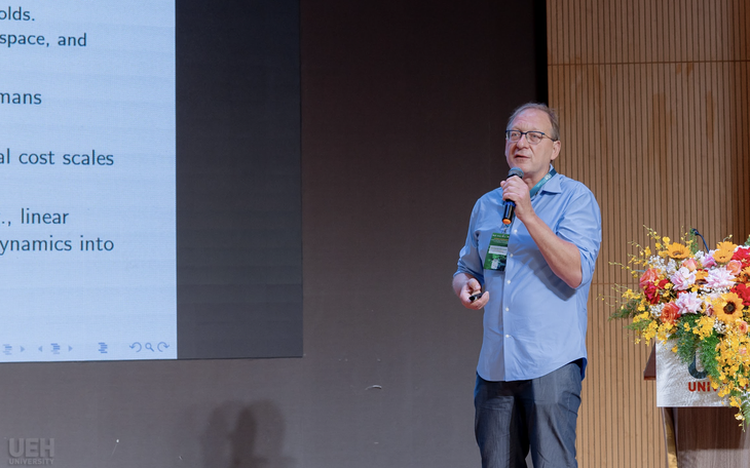
Professor Serguei Maliar of Santa Clara University in the U.S. and a visiting researcher at Stanford University said AI would change how experts and policymakers design economic policy at the 2026 International Conference on Economics, Law and Governance (ELG 2026) in Ho Chi Minh City, July 28, 2026. Photo: Courtesy of organizers
Maliar made the remarks at the 2026 International Conference on Economics, Law and Governance (ELG 2026) in Ho Chi Minh City on Tuesday.
Traditional models face growing limitations
The world is undergoing multiple major transformations, including climate change, digital transformation and institutional reforms, making economic forecasting, analysis and policymaking increasingly complicated, Maliar said.
To find solutions, researchers have often had to simplify their models, potentially leaving out important features of real-world economies. This is where AI could help bridge the gap.
Maliar said deep reinforcement learning, which has been used in areas such as chess, robotics and autonomous vehicles, could also serve as a powerful optimization tool for problems involving numerous variables and uncertainties.
“AI is particularly useful for models involving thousands of agents or dozens of state variables, allowing researchers to simulate consumption, savings and employment decisions, as well as support the design of pension and social welfare policies,” he said.
Algorithms and AI can be used to solve complex economic models and support policymaking in areas that traditional methods may struggle to handle. Photo: Quang Dinh / Tuoi Tre
AI can test millions of policy scenarios
According to Maliar, once trained using neural networks, AI can simulate a policy, model how the economy would evolve, assess the results and then test another option.
The process can be repeated thousands or even millions of times to identify an optimal solution.
He compared the process to playing a video game.
Maliar noted that unlike humans, who have only one chance to make decisions in real life, AI can run through countless simulated scenarios, evaluate different strategies, and choose the optimal one.
AI is not merely a tool for automation or content generation. It could also become a new computational platform that enables economists and policymakers to build models that more closely reflect real-world conditions, he said.
However, Maliar stressed that AI cannot make policy decisions on its own.
The ultimate goal of AI is not to replace policymakers, but to serve as a tool that helps forecast risks, evaluate multiple scenarios, and support people in making more effective decisions toward sustainable development, he said.
Held in Ho Chi Minh City on Tuesday and Wednesday, ELG 2026 was organized by the University of Economics Ho Chi Minh City in collaboration with its partners, with 177 research papers presented across 44 discussion sessions.
The conference focused on economic, legal and governance solutions to challenges arising from digital, green and energy transitions.








Max: 1500 characters
There are no comments yet. Be the first to comment.