


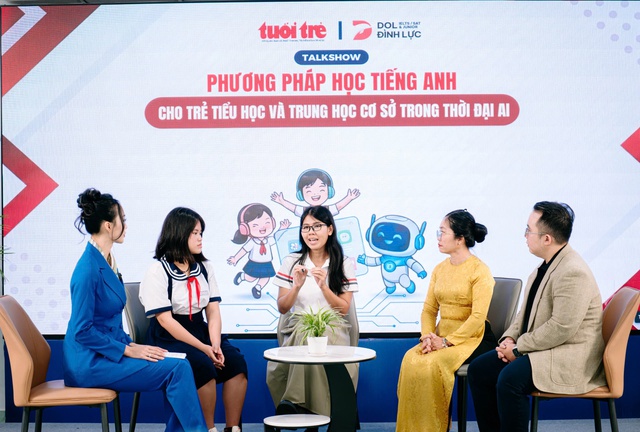
Experts participate in the 'Effective English Learning for Elementary and Middle School Students in the AI Era' discussion in Ho Chi Minh City, July 17, 2026. Photo: Thanh Hiep / Tuoi Tre
The 'Effective English Learning for Elementary and Middle School Students in the AI Era' discussion, jointly organized by Tuoi Tre (Youth) online newspaper and DOL English - IELTS Dinh Luc, brought together education administrators, academic experts, teachers, and students to discuss how AI is changing language education.
Shifting goals in language learning
Tran Thi Hong Thuy, principal of Tran Dai Nghia Middle and High School in Ho Chi Minh City, said English learning among elementary and middle school students in Vietnam has shifted from exam-focused grammar and vocabulary drills to real-life communication and application.
Students now use English in class discussions, extracurricular activities, and even subjects like math and science.
"Technology can support learning, but the core goal remains helping students develop language proficiency, critical thinking, and the ability to apply knowledge in real-life situations," she said.

Tran Thi Hong Thuy, principal of Tran Dai Nghia Middle and High School in Ho Chi Minh City. Photo: Thanh Hiep / Tuoi Tre
Ha Dang Nhu Quynh, academic director at DOL English, argued that a student with a high English certificate who is unwilling to speak at an international event has not fully achieved the purpose of language learning.
Quynh compared vocabulary to bricks and thinking skills to the ability to build a house.
"A student who knows 300 words but can connect them into meaningful sentences and tell a story is more effective than someone who memorizes 1,000 words without knowing how to use them," she said.
AI as learning assistant
Huynh Nguyen Xuan Phuc, a former student at Le Van Tam Middle School who achieved an IELTS score of 7.5 in eighth grade and was admitted to the gifted English program at the High School for the Gifted under Vietnam National University-Ho Chi Minh City, said she uses AI for about one hour each day.
Phuc relies on AI to explain difficult grammar points, prepare lessons before class and review knowledge afterward.
When she encounters difficult questions at night and cannot immediately ask teachers or classmates, she turns to AI for assistance.
The tool also generates multiple-choice questions, fill-in-the-blank exercises, and sentence-building tasks.
After completing the exercises, Phuc asked AI to help her identify mistakes, explain the reasons behind them, and suggest improvements.

Huynh Nguyen Xuan Phuc, a former Le Van Tam Middle School student who achieved an IELTS score of 7.5 in eighth grade. Photo: Thanh Hiep / Tuoi Tre
During her entrance exam preparation for high school, Phuc also used AI to organize her revision schedule by breaking study content into manageable sections.
"To avoid becoming dependent, I only ask AI for hints after trying several approaches myself," Phuc said.
"I don’t ask AI to solve exercises for me. I use it to find methods, then complete the work myself."
Tran Thien Minh, an IELTS and SAT instructor at DOL English who twice achieved a perfect IELTS 9.0 score, described AI as a learning assistant.
He warned that submitting an essay prompt to AI and copying the response is a poor learning strategy because students miss the chance to develop ideas, build arguments, and improve language skills.
Instead, Minh said AI works best as a source of guidance.

Tran Thien Minh, an IELTS and SAT instructor at DOL English who twice achieved a perfect IELTS 9.0 score. Photo: Thanh Hiep / Tuoi Tre
When students have already thought through a problem but struggle to organize ideas or express themselves naturally, AI can ask guiding questions, suggest new directions or explain why certain expressions sound unnatural.
"Students who are still developing their skills can ask AI to explain concepts more slowly, break knowledge into smaller parts, and provide additional examples," Minh said.
"Faster learners can increase the difficulty and explore topics more deeply."
"However, the more powerful the tool becomes, the more discipline students need to ensure AI does not think for them."
Role of teachers in AI era

Ha Dang Nhu Quynh, academic director at DOL English. Photo: Thanh Hiep / Tuoi Tre
Quynh said AI presents both opportunities and challenges for language teachers, adding that its impact depends on how educators and students choose to use it.
She suggested teachers should shift from delivering knowledge to guiding students on how to think, choose learning strategies, and verify information.
At DOL English, for example, the Linearthinking method helps students understand the structure of language and logical reasoning.
Students learn to group and connect vocabulary, break sentences into components when writing, and identify logical relationships between ideas while reading.
For elementary school children, Quynh suggested combining AI with games and interactive learning activities.
One example involved an AI-generated learning game inspired by Pokémon, in which English tasks become progressively more challenging as students advance.
For middle school students, AI can act as a debate opponent by presenting opposing viewpoints, identifying weaknesses in arguments, and pointing out logical fallacies.
Students must then evaluate the feedback, revise their reasoning, and strengthen their own positions.
Meanwhile, Minh emphasized that teachers become even more important as students gain access to unlimited educational resources.
Teachers should help learners set goals, identify reliable sources, verify AI-generated answers, and understand when technology should be used.
"AI can personalize exercises, learning speed and difficulty, but it cannot understand students' emotions, pressures or personal circumstances," Minh said.
"Technology expands learning opportunities, while teachers ensure those opportunities translate into genuine competence."








Max: 1500 characters
There are no comments yet. Be the first to comment.