


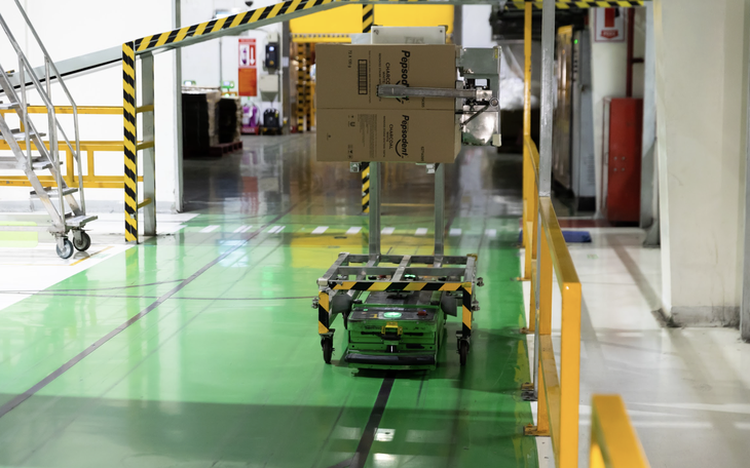
An autonomous guided vehicle transports materials along dedicated routes inside Unilever's factory in Ho Chi Minh City. Photo: N.X. / Tuoi Tre
AI-powered systems now inspect products, monitor equipment, improve workplace safety, and assist engineers in managing production lines, reflecting a broader shift toward increasingly autonomous manufacturing in Vietnam.
At Unilever's 12-hectare factory in the Tay Bac Cu Chi Industrial Park, more than 40 production lines operate with an automation rate exceeding 95 percent.
Engineers describe the facility as a "dark factory"—a highly automated factory capable of operating with minimal human intervention.
The most striking feature is not the number of robots or the advanced technology on display, but how the role of people has changed.
Rather than standing beside production lines to inspect products, workers now monitor operations from control rooms, where they analyze data, supervise automated systems, and respond to operational issues.
In the quality control area, cameras continuously capture images of products before sending them to an AI system known as DeOC (Digital Eyes of Consumer).
Within seconds, the AI examines each product's color, label, seal, shape, and surface to detect defects that could be missed by the human eye.
According to Unilever engineers, the system achieves an accuracy rate of up to 99 percent and has helped reduce product quality complaints by about 90 percent.
AI is also used to improve workplace safety through an AI-powered CCTV system that automatically detects violations of safety regulations and improper operating procedures.
At the factory's operations center, the OLE Insights platform continuously collects and analyzes data from across the facility.
AI monitors equipment conditions, production speeds, and product quality while identifying abnormalities in real time.
When a production line experiences lower efficiency or technical issues, the system helps engineers identify the causes and recommends improvements.
Engineers at the factory said AI has evolved beyond a support tool and is increasingly serving as a "digital colleague" that works alongside engineers to manage production operations.
Industry experts also shared the view that AI is becoming a new workplace partner for employees and is gradually transforming how factories operate.
Pham Van Hung, a representative of BAF Vietnam Agriculture JSC, said the company operates around 57 farms, including two high-tech farms that are piloting the integration of robots, AI, and automation systems.
At BAF's farms, AI functions like a doctor on duty around the clock. AI-enabled camera systems monitor individual pigs, tracking body temperature, eating behavior, and movement to detect potential health problems at an early stage.
Pham Van Viet, vice-chairman of the Ho Chi Minh City Association of Garment, Textile, Embroidery, and Knitting, said AI has also been applied in garment factories for pattern making, fabric layout design, and fabric cutting, helping optimize material use, shorten production time, and improve accuracy.
The transformation reflects a broader global trend highlighted in the 2025 report Frontier Technologies in Industrial Operations: The Rise of Artificial Intelligence Agents, published by the World Economic Forum in collaboration with Boston Consulting Group.
According to the report, global manufacturing is entering a new phase in which AI agents are evolving from performing individual tasks to analyzing data, and coordinating with robots and automated production lines, paving the way for near-autonomous operations.








Max: 1500 characters
There are no comments yet. Be the first to comment.