



Dao Duy Anh, deputy head of the Agency for Innovation, Green Transition and Industry Promotion, speaks at a press briefing in Hanoi, July 7, 2026. Photo: Nam Nguyen
Vietnam officially began the nationwide distribution of E10 biofuel gasoline on June 1.
E10 is a gasoline blend containing 10 percent ethanol, used as an alternative to conventional mineral fuels.
According to a recent report from the Ministry of Industry and Trade, air quality monitoring data provided by the Vietnam Environment Agency under the Ministry of Agriculture and Environment indicated an initial positive trend.
The monitoring covered three periods in early May, late May, and late June.
In Hanoi, concentrations of particulate matter declined significantly, with PM2.5 falling by 31 percent and PM10 by 29.6 percent, suggesting an improvement in airborne dust levels.
Ho Chi Minh City recorded improvements across both particulate matter and gaseous pollutants.
Compared with late May, measurements taken in late June showed PM2.5 down 15.7 percent, PM10 down 14.3 percent, carbon monoxide down 65.2 percent, nitrogen dioxide down 68.6 percent, nitrogen oxides down 57.6 percent, sulfur dioxide down 38.5 percent, and ozone down 14.4 percent.
More than one billion liters of biofuel gasoline, including E5 and E10, were consumed in June, with E10 accounting for nearly 95 percent of total biofuel sales and E5 making up the remaining five percent.
Total gasoline consumption was broadly unchanged from the period when conventional fossil-fuel gasoline was used.
Dao Duy Anh, deputy head of the Agency for Innovation, Green Transition and Industry Promotion, told the press conference that replacing conventional gasoline with E10 was aimed at reducing emissions and protecting the environment.
He cited scientific calculations as showing that every liter of fossil gasoline displaced can reduce carbon dioxide emissions by some 2.3 kilograms, based on combustion chemistry.
In addition to lowering greenhouse gas emissions, blending ethanol into gasoline increases the fuel's oxygen content, allowing for more complete combustion, improving fuel efficiency, reducing unburned fuel, and limiting the formation of certain harmful pollutants in vehicle exhaust.
To assess E10's real-world environmental impact, the Ministry of Industry and Trade requested monitoring data from the Vietnam Center for Environmental Monitoring.
Initial monitoring was conducted at multiple locations in Hanoi and Ho Chi Minh City during late May and late June, enabling comparisons before and after the nationwide introduction of E10.
While the preliminary results indicate that several environmental indicators have declined, the findings vary between the two cities and remain subject to numerous external influences, including traffic density, sampling times, weather conditions, wind speed, and other environmental factors.
“Although the initial data show encouraging signs, it is not yet possible to conclude that these results fully reflect the environmental impact of using biofuel gasoline,” Anh said.
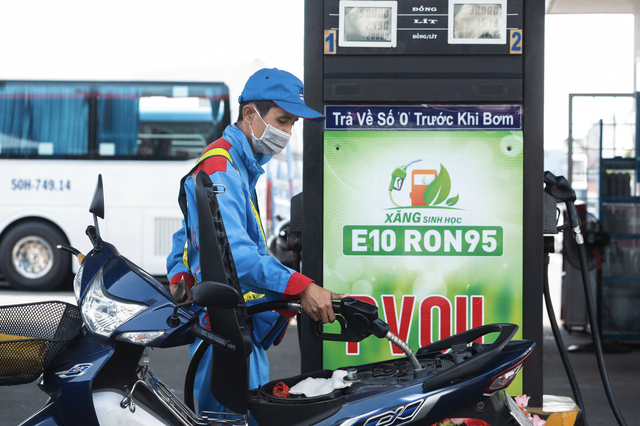
A fuel station worker refuels a vehicle with E10 biofuel at a petrol station in Vietnam. Photo: Huu Hanh / Tuoi Tre
The official emphasized that a more reliable assessment will require long-term monitoring, a broader network of monitoring stations and more frequent sampling.
As such, the Ministry of Industry and Trade has asked the Vietnam Center for Environmental Monitoring to continue tracking air quality not only in Hanoi and Ho Chi Minh City but also in additional localities nationwide.
Vietnam currently has more than 17,000 fuel retail stations, all of which have transitioned to selling biofuel gasoline.








Max: 1500 characters
There are no comments yet. Be the first to comment.