


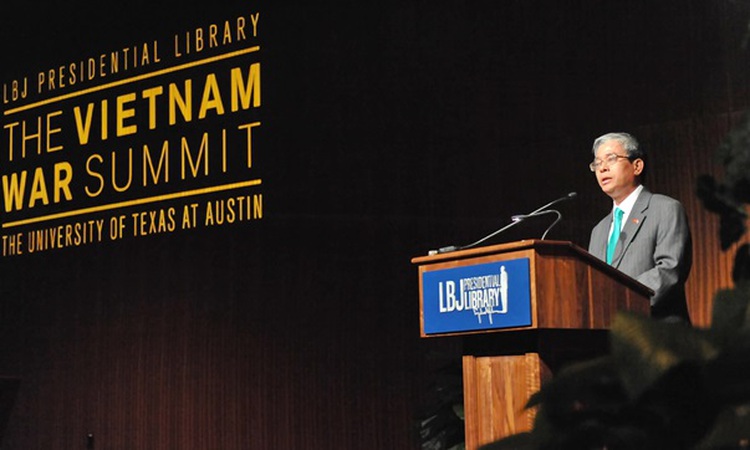
Vietnam’s Ambassador to the U.S. Pham Quang Vinh delivered a speech themed “Vietnam and the U.S. in the 21st century: A new beginning,” as he attended the Vietnam War Summit in the U.S. on Friday (Vietnam time).
The Vietnamese diplomat spoke to some 5,000 audiences at the summit, running from April 26 – 28 at the Lyndon Baines Johnson Presidential Library in Austin, Texas, intended to shed light on the war, its lessons and legacy.
The audience included politicians, war veterans, researchers, and representatives of anti-war organizations and movements, according to the Vietnam Embassy in the U.S.
In his speech, Ambassador Vinh reviewed the missing opportunities for a sound relationship between the two countries, hit by “a painful war with terrible consequences,” that ended in 1975.
Vinh however cited Party General Secretary Nguyen Phu Trong as saying during his historic visit to the U.S. in July 2015 that “a new era has begun,” with the two countries having overcome the war pains and developed their relationship strongly and actively.
The Ambassador also asked the U.S. to recognize Vietnam’s market economy status and fully lift the ban on weapon sales to his country, which will be a favorable background for the upcoming visit to Vietnam by President Barack Obama.
Below is the full text of his speech.
--
Introduction
I am privileged to be invited to this event and august audience. I thank you for the invitation, hospitality and arrangements, especially from the LBJ Presidential Library and LBJ Foundation.
Earlier today, I had a chance to talk with Mark K. Upegrove, Director, the LBJ Presidential Library; Larry Temple, Ben Barnes and Amy M. Barbee, Chairman, Vice-Chair and Executive Director, the LBJ Foundation. I did take a brief tour of the Library and had a working lunch with the Chamber of Commerce. And I am so much honored to meet and talk with President Johnson’s daughters, Luci Baines Johnson and Lynda Johnson Robb. I express my thanks to you for all that.
It seems that I've already had a tour of history, from decades ago to today’s event. I’ve been briefed of the schedule of this Summit and its panels, which would reflect a wide-range of perspectives and experiences, including from the veterans, of their war experience as well as the trauma that followed, the anti-war or ‘give peace a chance’ movements, the media and the Hollywood…
I knew, since the end of the war, there had been numerous discussions on this war, including those between America and Vietnam. All this will add to the facts and depths of our studies and reflections.
In this panel, I have been invited to share with you on the theme: “America and Vietnam in the 21st Century: A New Beginning”. I thank Admiral Bobby R. Inman for the gracious introduction. I share the belief that this panel will give us a chance to discuss how far our countries have come since the end of the war, and what we can do to further this ‘constructive and comprehensive partnership’.
A Little Bit of a Long History
Vietnam and the US had a long history of contacts. Nearly 230 years ago, Thomas Jefferson, who was one of the drafters of the US Declaration of Independence and would later become the 3rd US President, had been trying then to obtain rice seed from Vietnam to grow in his home state of Virginia. And he wrote: This dry rice from Vietnam ‘has the reputation of being whitest to the eye, best flavored to the taste, and most productive’.
More than 100 years ago, in 1911-12, President Ho Chi Minh came to Boston, the cradle of the American revolution for independence, to find ways for the liberation of his country, Vietnam. And, as early as 1941, during WW-II, the Vietnamese people stood by the Allies against fascism and sustained their struggle by national patriotism and by the promises made by the Allies at Yalta, San Francisco and Potsdam.
In September 1945, Vietnam got independence from French colonialism. The new Vietnam’s Declaration of Independence included the ideals of Jefferson: ‘All men are created equal. The Creator has given us certain inviolable rights – the right to life, the right to be free, the right to achieve happiness’.
Between 1945-46, President Ho Chi Minh wrote several letters to President Truman to seek a full cooperation with the US. Despite these, relationship was missed 70 years ago.
And on the war, known as the Vietnam War here, or the American War in our country, it was painful for everyone. For us Vietnam, we were forced to defend our national independence and freedom, with untold sufferings, and the painful legacies of war persisted until today (3 million dead, 4 million injured and handicapped, 4.8 million affected by dioxin/agent orange, hundreds of thousands missing).
President Clinton called it a ‘painful and haunting war’ and Secretary Kerry called it the ‘most profound failure of diplomatic insight and political vision’.
A New Chapter: From Foes to Friends
As we look back today, we thank all those who had played a part in ending the war and we thank the American people, from all walks of life, who had voiced opposition to the war and supported the Vietnamese people. In this regard, we pay tribute to such personalities as Martin Luther King.
We also thank those, on both sides, who have been working hard for the normalization and promotion of relations of our two countries. On our part, from the policy of ‘set aside the past and look to the future’ and humanitarian spirit, Vietnam has been cooperating fully and effectively with the American side on the war legacies, especially on the MIA issue, and working together to for a new future of our relations.
President Clinton, when he announced the normalization of diplomatic relations with Vietnam on July 11, 1995, made a special note of those who had helped make this difficult decision: Senators John McCain, John Kerry and Bob Kerrey, Chuck Robb and Representative Pete Peterson. And many others, Vietnamese and Americans, who had helped in efforts of healing and reconciliation, including the veterans.
As relationship grew, since 2013, the two countries have established the Comprehensive Partnership, outlining wide-ranging areas of cooperation. On such efforts of the two countries, General Secretary Nguyen Phu Trong has observed: 20 years ago, few people could imagine how Vietnam and the US could overcome the pains of war and build a relationship of positive and vigorous development as that of today. And now, when you hear the word Vietnam, it is no longer a conflict, but a country.
Vietnam: Dynamic Growth and Proactive Integration
I wish to brief on Vietnam, a country of dynamic development and proactive integration. We have worked hard to overcome the consequences of the war and undertook three decades of renovation to build our country in all areas. As a result, today, we have reduced the level of poverty from 50% three decades ago to now under 5% and achieved an average annual growth rate of 6 - 7% for many years. Vietnam has been a leading exporter in several areas such as rice, pepper, coffee, textile and other agricultural products and sea foods.
We will continue to strengthen further our market-based economic development, innovation and entrepreneurship. We also expect that the income per capita will be raised to 3,200 - 3,500 USD in the next five years. And we have a dynamic and industrious population, with more than 50% under 30 years of age. Digital coverage in the population is high, with 50% having access to the internet, 38% using social media, and 142% having mobile subscriptions.
On external relations, we have always advocated peace, friendship and cooperation based on mutual respect and benefit. We have now had diplomatic relations with more than 190 countries and have been active members of many regional and international organizations, including the UN, WTO, APEC and ASEAN. And we have become partner in many regional and bilateral Free Trade Agreements (FTA), such as the TPP and that with the EU. You will find Vietnam a reliable partner and a good place for business.
VN-US: Foundations for Stronger Partnership
Last year, 2015, we commemorated 20 years of our diplomatic relations. It was marked by the first-ever, historic visit by General Secretary Nguyen Phu Trong to the US, during which the General Secretary and President Obama met at the Oval Office and issued a Joint Vision Statement on strengthening further our two countries' comprehensive partnership.
On these two decades, we recognize the astounding achievements recorded so far in many areas of our cooperation, including in particular economic and trade relations, cooperation in addressing war legacy issues, as well as in science and technology, education, healthcare, environment, climate change, security and defense, and in regional and global issues of mutual concern. We have been able to talk also on issues of differences, such as human rights.
And this year, 2016, President Obama will be soon visiting Vietnam, also his first visit to Vietnam, next month, in May. The two sides are making every effort of preparations to ensure the visit a success, which will further strengthen our two countries' relations.
Today, Vietnam and the US have solid foundations for a strong partnership, as we look toward the future of our relations and build further upon our comprehensive partnership. We wish to highlight the following key areas:
Political Ties
We agree to continue to deepen relationship on the basis of mutual respect and benefit, including the respect of each other's political systems and sovereignty, and to advance further cooperation at both bilateral and multilateral levels, for the benefit of both peoples, contributing to peace, stability, cooperation and prosperity in the Asia-Pacific region and the world.
In this regard, we will increase, as a priority, exchange at high levels and expand consultations to build trust and promote cooperation in all areas.
Trade and Investment
Trade and economic cooperation has always been a key pillar in our relation. For the past two decades, our trade volume has increased 90 times, from just half a billion USD to now about 45 billion USD. The US ranks 7th among the largest investors in Vietnam, with about 11 billion USD. But more could still be done and potentials remain to be tapped, especially in the context of the TPP.
We believe that the TPP, a high-quality, balanced agreement, will help enhance trade and economic growth and job expansion for all participating countries and give impetus to Asia-wide regional cooperation. As a member, Vietnam is committed to the TPP and its implementation. We request the US therefore to early recognize Vietnam as a market economy and do away with technical barriers in our trade relations.
Defense and Security
We will continue our bilateral cooperation in defense and security areas, as outlined in the two countries' Joint Vision Statement on Defense Relations (June 2015) and the Defense Cooperation MOU (2011), including in the area of maritime security, search and rescue, disaster relief, and peace-keeping.
We will further our cooperation, as a priority, in addressing the war legacy issues and we expect the US to give more assistance to Vietnam, in terms of both funding and technology, in the clearance of UXO and dioxin remediation, including new projects such as at the Bien Hoa airport.
Vietnam calls on the US to totally lift the arms embargo on Vietnam and believe that this element of barrier of the past should be removed to reflect the full normalization of our relations started two decades ago and the current level of our comprehensive partnership.
Education, S&T, People to People Exchange and others
We will further advance our cooperation in education, S&T, healthcare, disaster relief and response to climate change as well as people to people exchange.
Vietnam appreciate the US continued assistance in these areas. Assistance in innovation and start-up could also be given priority. Since the achievement of the 123 Agreement, we are working to promote further cooperation in the area of civil nuclear energy. Vietnam expect that the US will further assistance in dealing with climate change and sea level rise in the Mekong delta.
Vietnam has now more than 19,000 students studying at universities in the US, ranking first among Southeast Asian countries and 8th across the world. We welcome the establishment of the Fulbright University Vietnam and other university partnerships to further accelerate our education cooperation. Today, more than 500,000 Americans visit Vietnam each year and we will continue to encourage greater numbers of tourists, students, and business visitors to both countries.
Vietnam always recognize the Vietnamese overseas, including those in the US, as part of the Vietnamese nation and facilitate their ties with the homeland and appreciate their role as bridges of relationships with the host countries. In the Joint Vision Statement of 2015, the two countries recognize the success of the Vietnamese community in the US and their many contributions both to the development of the US and Vietnam and to better US-Vietnam relations.
Regional and Global Issues
We will continue to increase our cooperation on sustainable development and addressing global and regional issues of mutual concern, including natural disaster, water security, pandemics and wildlife trafficking. The two countries are also to expand cooperation on the Global Health Security Agenda (GHSA) and the Lower Mekong Initiative (LMI).
We commend the recent successful convening of the ASEAN-US Summit in Sunnylands, which highlighted the ASEAN-US Strategic Partnership and ASEAN's central role in regional cooperation and architecture in East Asia. We will work with other ASEAN countries for the follow-up of its outcomes, including the initiatives to support the ASEAN Community and ASEAN Connect.
We support the maintenance of peace, maritime security, unimpeded commerce and freedoms of navigation in the East Vietnam Sea. We express concerns therefore over recent developments in the area. All countries concerned must abide by international law, especially the UN Convention on the Law of the Sea (UNCLOS), resort to peaceful resolution of disputes, refrain from actions that raise tensions, implement fully the DOC and work for the early conclusion of the COC.
Conclusion
Vietnam and the US are important partners. Within a span of just two decades of normalization of relations, the two countries have made a big stride and obtained astounding progress in their relationship. This is beyond expectations. And our partnership today has ranged from bilateral to multilateral cooperation.
We believe that the two countries have solid foundations to strengthen further our comprehensive partnership, especially in the context of the coming visit to Vietnam by President Obama. Thank you.









Max: 1500 characters
There are no comments yet. Be the first to comment.