



People jog for exercise in Ho Chi Minh City. Photo: Quang Dinh / Tuoi Tre
In Australia, this is not a new concern. It is a practice that the country has been following for more than fifty years, and the systems put in place as a result of that conversation are now paying dividends for an aging population approaching an average age of forty.
So how exactly do Australians prepare for old age? The answer is a combination of government policy, community awareness, personal responsibility, and a cultural attitude toward aging that has shifted significantly over the past few decades.
Financial foundation
Australia's most well-known retirement tool is superannuation, known simply as "super" by Australians. It is a compulsory savings scheme that requires every employed Australian to have a percentage of their salary paid into a dedicated retirement fund managed by a licensed financial institution.
Over 90 percent of working Australians participate in superannuation funds today, according to nine.com.au.
The age pension, which is means-tested, supports this. It serves as a government-funded safety net for those who reach retirement without sufficient private savings.
In addition to the pension, retirees gain access to free public healthcare through Medicare, heavily subsidised public transport, and significant reductions on government charges including property rates and vehicle licensing.
Community awareness and public campaigns
If superannuation is the financial foundation of aging in Australia, then public awareness is the window into the future.
Australia has invested heavily in community-level education and government-sponsored campaigns that normalise the conversation around aging and push people to take their health seriously before problems become life-threatening.
For decades, Australian television, radio, newspapers, and more recently the internet have carried consistent public health messaging around lifestyle choices and preventable illness. They are constant, funded campaigns designed to reach everyday Australians across all demographics. The message is consistent: the choices you make in your fifties and sixties directly determine the quality of your seventies and eighties.
Organisations such as the Senior Citizens Association of Australia provide older Australians with up-to-date information on health, lifestyle, and available services. They run programs that bring people together, reduce social isolation, and connect seniors with the support they may not even know they are entitled to.
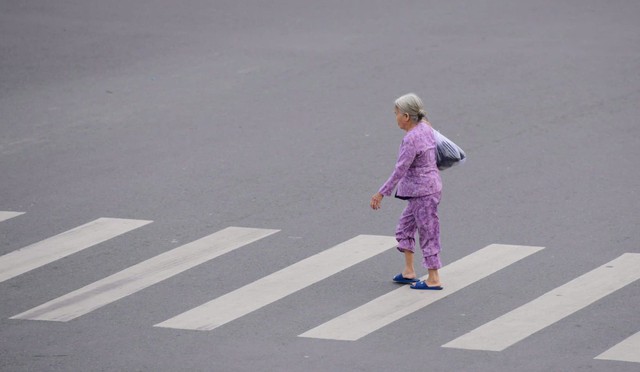
An elderly woman crosses the street in Ho Chi Minh City. Photo: Quang Dinh / Tuoi Tre
Free screening and early detection
One of the most popular public health projects is the national screening program.
All women over 40 are offered free breast examinations every two years. All Australians over 50 are eligible for free bowel cancer screening.
Additional programs cover skin cancer checks, heart health assessments, and diabetes screening, all conditions that, if caught early, are dramatically cheaper to treat and far less likely to be fatal in older people.
Culturally, how do Australians view old age?
Australians have a complicated relationship with aging. There is a deep-seated cultural value around independence, and many older Australians actively resist the idea of needing help.
And something that is the total opposite to Vietnam is that children of aged parents, generally, reject the notion of taking them in to live with them in old age.
The nursing home and retirement village industry in Australia is one of the biggest in the world with older Australians choosing to live in an aged facility rather than being supported by their children.
Whilst I can't see massive change in the culture in Vietnam, I have seen early steps toward aged care facilities becoming the future here due to families moving around the world and to the big cities to follow careers. This has been a big move from previous generations that were more likely to stay in their hometown and live close to parents.
What Vietnam can learn
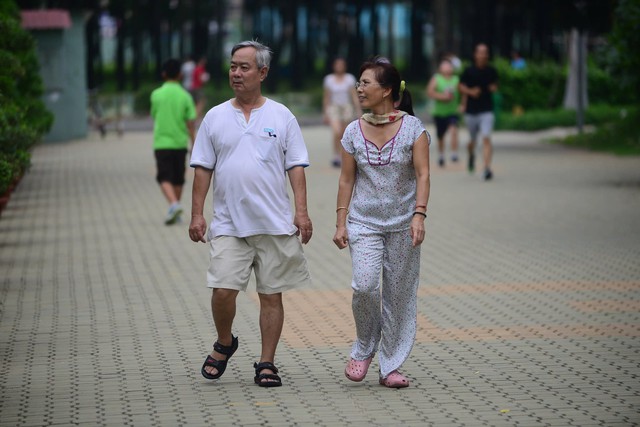
People take a walk in Ho Chi Minh City. Photo: Quang Dinh / Tuoi Tre
Housing, food, and medical care are the three pillars that any aging population needs in order to maintain dignity and quality of life. Australia has built policy around all three over the better part of a century.
With the median age standing at just over 33 in 2024, according to the Vietnam Population Projections 2024–74 released by the Statistics Office and the United Nations Population Fund (UNFPA) in December 2025, Vietnam is in a genuinely fortunate position.
It has time. It has neighbours like Japan, South Korea, and China whose experiences offer clear lessons on what works and what does not. And it has a government that appears increasingly aware that preparation needs to begin now, not when the problem is already at the door.
At the end of the day, two simple things are needed to keep a country strong as it ages. The population needs to work for as long as possible and support needs to be in place to give quality of life for those who can no longer work.
Stop thinking of people over 40 as old
People over 40 are not old. A 40-year-old person still has at least 30 years of working life to complete in most Western countries.
In Vietnam, there is a notion that if you are over forty you don't and can't understand the younger generation. This needs to change very quickly.
I have a particular example where I was employed at an IT company in Ho Chi Minh City and the HR manager advised me that I was not able to do a particular job because I was "too old" and would not understand the younger employees.
This attitude will kill productivity and growth in the country in future years if it is maintained.
- REFERENCE MORE










Max: 1500 characters
There are no comments yet. Be the first to comment.