


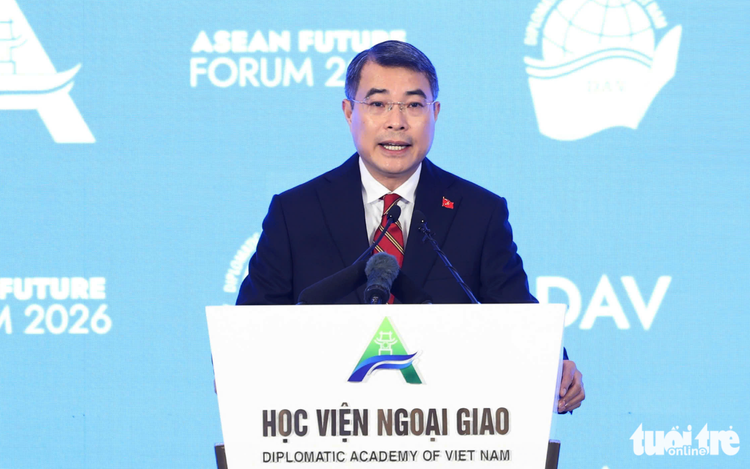
Vietnamese Prime Minister Le Minh Hung addresses the opening of the 2026 ASEAN Future Forum (AFF) in Hanoi on June 9, 2026. Photo: Nguyen Khanh / Tuoi Tre
The forum, themed ‘Shaping Our Future Together: Peace, Prosperity and People-Centered,’ brought together the prime ministers of Laos, Cambodia, Thailand, and Timor-Leste, along with ministers, senior officials, scholars, and experts from across ASEAN and beyond.
Addressing the event, the Vietnamese prime minister welcomed delegates and described their participation as a vivid demonstration of friendship, trust, and solidarity in pursuit of a peaceful, stable, and sustainably developed region.
He stressed that AFF 2026 carries special significance, with its theme reflecting the core values ASEAN has pursued throughout its development and the direction it seeks to take in the years ahead.
“I would like to begin with a familiar question about the future in a rapidly changing world,” he said.
“The challenge is not only how ASEAN will adapt, but also how ASEAN will shape its own future in the 21st century.”
ASEAN’s greatest achievement over its 59 years of development is not merely its population of nearly 700 million people or its status as one of the world’s most dynamic growth centers.
Rather, it lies in the bloc’s ability to overcome differences, build trust, and deepen cooperation to become a resilient and united community that embraces diversity, he underlined.
PM Hung said that ASEAN has built its identity over the past six decades, so in the coming decades, the bloc will focus on defining its future amid a world where the fundamental rules governing economics, technology, and global power are being rewritten.
Technology is redefining competitiveness, and artificial intelligence (AI) is transforming productivity, while data are reshaping power, and green transition is creating new development models, he said.
“At such a pivotal moment, advantages will not belong only to countries with abundant resources, but also to those capable of helping shape the new rules and standards of the era,” he noted.
“Vietnam strongly believes that ASEAN must become an active force in this process, not simply absorbing global trends but helping to create and guide them."
To realize the ambition, he called on ASEAN to continue promoting the values that have underpinned its success – solidarity, resilience, and unity in diversity – while adopting more innovative approaches.
He urged the bloc to remain united in values while acting dynamically, uphold principles while embracing new methods, and preserve its identity while proactively seizing opportunities created by global change.
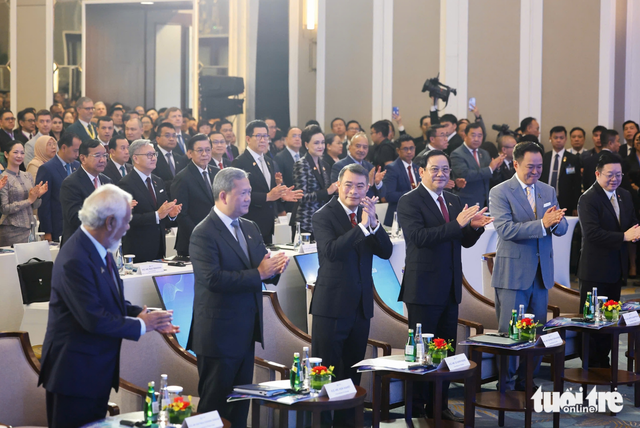
Delegates at the opening of the 2026 ASEAN Future Forum (AFF) 2026 in Hanoi on June 9, 2026. Photo: Nguyen Khanh / Tuoi Tre
Three strategic priorities
As ASEAN moves toward its Community Vision 2045, PM Hung proposed three strategic directions for the bloc.
First, ASEAN should not merely participate in global trends but contribute to shaping them.
For decades, ASEAN has benefited from peace, integration, and open trade.
However, in a fragmented and competitive world, the region must take on a stronger role in developing new standards, rules, and cooperative frameworks while addressing differences based on international law.
“ASEAN must become a center of dialogue, a focal point for cooperation, and an anchor of trust,” he said.
“This is ASEAN’s unique contribution to peace, stability, and development in the region and the wider world.”
Second, ASEAN should evolve from a manufacturing center into a hub of innovation.
The region’s strategic location and labor advantages have made it a key link in global supply chains.
However, in the digital era, success will belong not only to economies that manufacture but also to those that innovate.
He said that ASEAN should become a place where technology is created rather than merely consumed, and where value chains are shaped.
Achieving the goal will require stronger investment in science and technology, innovation, the digital economy, and high-quality human resources.
He also called for the development of an ASEAN technology and digital ecosystem that reflects the bloc’s own values while contributing to the establishment of global standards.
Third, ASEAN must become not only a community of nations but a genuine community of people.
PM Hung stressed that the true goal of any development strategy is not merely economic growth, but improving people’s quality of life.
“Innovation that widens inequality is not true progress, and growth that lacks inclusiveness cannot be sustainable,” he said.
A successful ASEAN should be measured not only by GDP but also by the opportunities it creates for young people, the roles it offers women, the protections it provides for vulnerable groups, and the extent to which every citizen feels a sense of belonging within the regional community.
He said ASEAN’s greatest achievement over the past six decades has been proving that differences do not inevitably lead to division, that unity does not eliminate diversity, and that integration does not erase identity.
The Vietnamese leader expressed confidence that in the decades to come, ASEAN can continue proving that a united and resilient community can play an active role in shaping peace, cooperation, and development at both regional and global levels.
“On this journey, Vietnam remains firmly committed to standing alongside fellow member states with the aspiration to help build the future through our collective efforts and determination," he said.
“Vietnam’s future is closely linked to ASEAN’s future, as well as to the peace, stability, and shared prosperity of the entire region.”








Max: 1500 characters
There are no comments yet. Be the first to comment.