


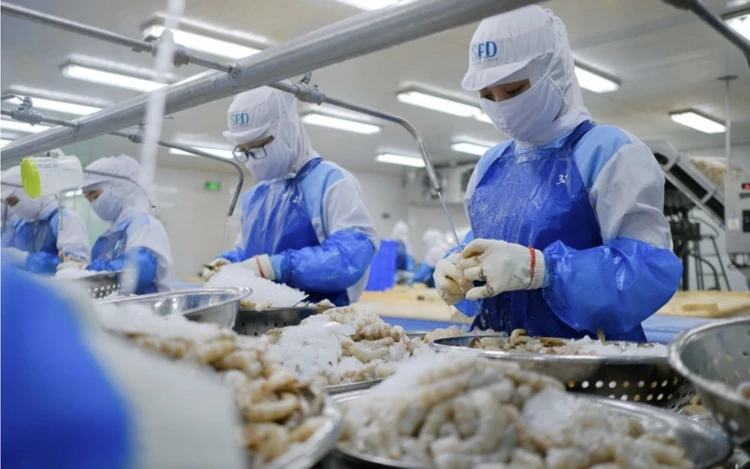
Workers processing seafood for export. Photo: C.QUOC - Tuoi Tre
These days, a container of frozen shrimp leaving a Ho Chi Minh City port is more likely to cross the East Vietnam Sea to Shanghai than the Pacific to Los Angeles.
In the first six months of 2026, China and Hong Kong alone bought $845 million worth of Vietnamese shrimp, more than a third of the country's total export value, while exports to the U.S. fell 15 percent year on year.
China and the lobster craze
If one market has defined Vietnam’s shrimp industry in the first half of 2026, it is China.
According to the Vietnam Association of Seafood Exporters and Producers (VASEP), in the first quarter of 2026, the country's shrimp exports reached $1.069 billion, up 17.5 percent year on year, with China and Hong Kong alone contributing $440.1 million, a jump of 57.2 percent, accounting for more than 41 percent of total export turnover.
By June, this growth momentum showed no signs of slowing: exports to China rose 47 percent over the six-month period, pushing the China - Hong Kong group's total to $845 million, equivalent to more than a third of the country's total shrimp exports.
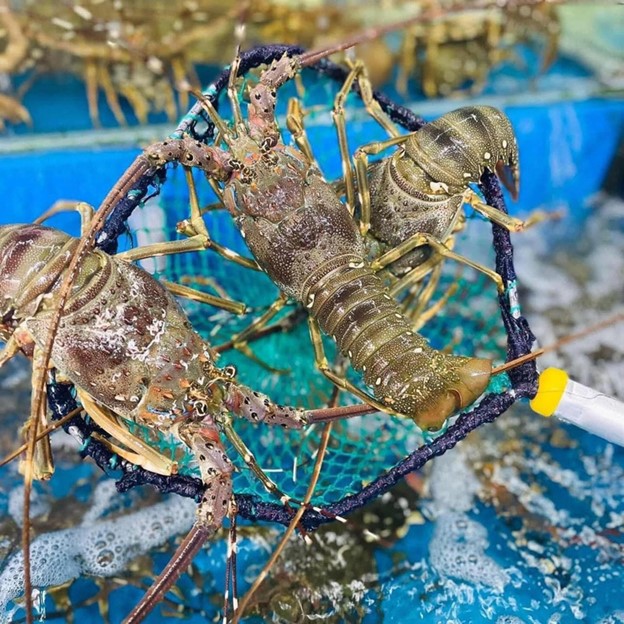
Surprisingly, the driving force behind this figure came not from familiar shrimp varieties but from lobster, a product long regarded as a ‘luxury item’ on the seafood table.
VASEP reported that in the first quarter, the ‘other shrimp’category, which mainly comprises lobster, reached nearly $415 million, up 39.3 percent.
Lobster alone accounted for $345.5 million, a 57.4-percent increase, making it the industry’s single biggest growth driver.
And nearly all of that lobster flowed in one direction: China and Hong Kong received $341.6 million worth of lobster, or 77.6 percent of the total shrimp export value to those two markets.
VASEP attributed the trend to strong demand in these markets for fresh, high-value products, particularly in the run-up to and aftermath of the Lunar New Year, when demand for gifts and festive banquets surges.
Logistics are also tilting the playing field in Asia’s favor.
Shipping to China, Japan, and South Korea is cheaper and faster, allowing businesses to turn over capital more quickly, an advantage the distant U.S. market cannot match.
US, EU barriers remain intact
If China represents opportunity, the U.S. and the EU remain markets where barriers continue to hold Vietnam’s shrimp exports back.
Although shrimp exports to the U.S. in June reached about $62 million, up 32 percent year on year, the cumulative six-month total still fell 15 percent to roughly $290 million.
VASEP even warned that June's growth alone may be no more than a temporary blip, as enterprises and importers rushed to speed up shipments ahead of unpredictable changes in tariff policy, rather than reflecting a genuine recovery.
VASEP had already identified the root cause of this slowdown earlier in the year.
The results of the 19th administrative review by the U.S. Department of Commerce on frozen warm-water shrimp from Vietnam imposed a tariff of 25.76 percent on the two mandatory respondents, while 22 other companies received a separate rate of 4.58 percent.
On top of that, on February 20, the White House announced an additional 10 percent tariff under Section 122, lasting 150 days, which officially took effect on February 24.
At the same time, technical control requirements on antibiotics, Hazard Analysis and Critical Control Points (HACCP) standards, and traceability were also tightened starting in early March.
All of this combined, according to VASEP, has made U.S. importers far more cautious about finalizing new orders.
Europe, meanwhile, presents a different picture: stable, but not yet booming.
Tuoi Tre (Youth) online newspaper noticed that Vietnam’s shrimp exports to the EU rose only slightly in the first six months of the year, suggesting that demand in the market has yet to show a clear recovery.
Competitive pressure is also sparing no market.
According to Asemconnect, a business and information bridge linking Asian and European enterprises under the ASEM network, Vietnam's shrimp industry is facing fierce competition from major rivals such as Ecuador, India, and Indonesia, at a time when conflict in the Middle East is also pushing ocean shipping costs back up.
A long-term bet
Amid a market landscape still marked by uncertainty, VASEP has released the Vietnam Shrimp Industry Report 2021-25, with Forecasts to 2030.
The report focuses on three key areas: production, price, and export trends in Vietnam’s shrimp industry over the past five years; the country’s competitive position relative to rivals Ecuador and India; and detailed forecasts for markets, products, and export value through 2030.
With the growth axis tilted so heavily toward a single market, the report may give businesses good reason to rethink diversification, rather than continuing to stake everything on one market alone.








Max: 1500 characters
There are no comments yet. Be the first to comment.