


Current global student flows and projections by 2030
According to the QS Global Student Flows report, global student demand for international education remains robust, continuing its historical trajectory with an estimated annual growth rate of approximately four percent over this decade.
By 2030, the total international student population is projected to reach approximately 8.5 million.
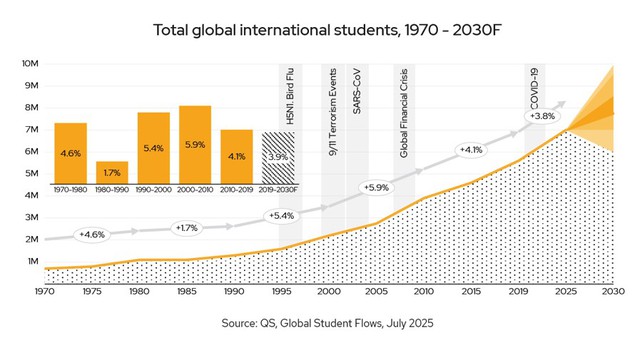
Despite this consistent upward trend, the global student mobility landscape is marked by considerable uncertainty driven by shifting geopolitical climates, evolving economic conditions, and changing student preferences.
Consequently, traditional market leaders now face heightened competition from emerging education destinations.
Now the question is not simply whether international student mobility will continue to grow, but where these students will choose to study.
One region deserves more attention: Asia.
Asia in a closer look
In the past, Asia has always been recognized as a region that sends students outward. It is now becoming an attractive destination in its own right.
South Korea reached its target of 300,000 international students two years ahead of schedule.
Japan also crossed its target of hosting 400,000 international students by 2033 eight years early.
China had 380,000 international students in the 2024-25 academic year, according to figures cited by Times Higher Education.
The shift is explained when we consider two stakeholders of the student mobility equation: institutions and students.
Asian institutions are becoming proactive players in international recruitment, while those in traditional markets get more selective.
Such changes are directly influenced by new immigration policies and education development strategies of their countries.
On the other hand, students themselves rethink what they want from overseas education.
Driving factors for international student mobility shift
First, there is a deliberate push in policy and strategic planning.
Governments and institutions across Asia have been carrying out initiatives to attract students from overseas.
China offers International Chinese Language Teachers Scholarship for international students intending to pursue studies in Chinese language, Chinese language teacher training, and related fields.
Education Malaysia Global Services plans to reach out to around seven to eight regions worldwide to promote Malaysian higher education institutions and enhance the country's ability to attract international students.
Significant changes to visa policies in traditional English-speaking study destinations are also a factor.
In 2026, students from Bangladesh, India, Nepal, Nigeria, and Pakistan, considered as the fastest-growing source markets for schools and universities in Australia, Canada, the UK, and the U.S., are increasingly likely to see their study visa applications rejected.
The third factor is a shift in what students actually want to gain from studying abroad.
The QS Global Student Flows report indicates that student preferences evolved considerably between 2020 and 2025, reflecting a deeper focus on outcomes and institutional reputation.
"The decisive factor for me is that the university can facilitate what I want to study, while living in Vietnam brings me opportunities to understand Asia and prepare for a future career in the region," said Hasancan Çağlayan, a Turkish student enrolling in Automotive Engineering at the Ho Chi Minh City University of Technology (HCMUT).
HCMUT, a leading STEM-focused institution in Vietnam, offers study programs that hold accreditations from respected organizations such as HCERES, FIBAA, ASIIN, and AUN-QA.
Internationally recognized programs, an open academic atmosphere, and diverse 60+ English-taught study programs across all levels result in an inviting setting for students from around the world, whether they stay for a term or a full degree.
For degree-seeking students, such qualities ensure their degrees are easily transferred globally even when they build a career beyond Vietnam.
Vietnam is building its place on the map
Internationalization and international recruitment specifically have become the country's key focus.
Resolution No. 71-NQ/TW on breakthroughs in education and training sets a goal to have at least two higher education institutions ranked among the world's top 100 universities by 2035.
Under Prime Minister Decision 1600/QD-TTg, a scheme on global integration in education and training sets a target for international students enrolled in Vietnam's degree programs to account for 1.5 percent of higher education students by 2030.
The document also calls for stronger international cooperation, more foreign-language teaching, greater international accreditation, and enhanced policies to attract foreign students to study and conduct research in Vietnam.
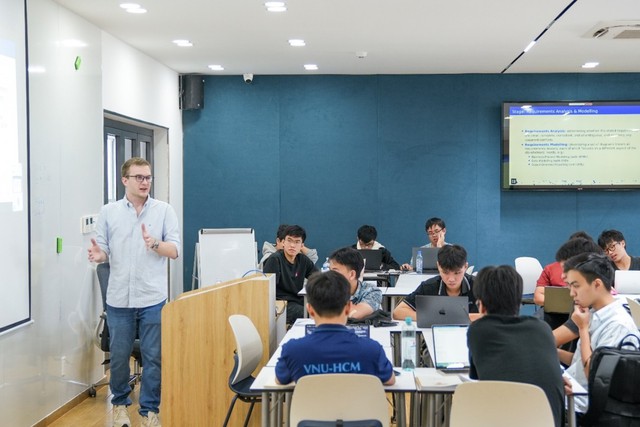
An international lecturer teaches students at the Ho Chi Minh City University of Technology (HCMUT).
According to the report 'Vietnam: Towards a New International Education Hub in Southeast Asia,' nearly 10,000 international students were studying at Vietnamese higher education institutions during the 2023-24 academic year, marking the highest since 2019.
The map of international student mobility is constantly changing.
For students looking beyond the traditional destinations, Asia is opening a new route. And Vietnam could be one of the places worth looking at.
An overlooked factor: The destination international students settle in and settle down
Lastly, a factor that many international students may neglect is where they settle in upcoming years.
The attractiveness of a destination in terms of culture and lifestyle has grown in importance, indicating a rising significance placed on comprehensive student experiences beyond academics alone.
Aaditri Atrey, an Indian student admitted to several Vietnamese universities, chose Ho Chi Minh City and enrolled in HCMUT as a Biotechnology undergraduate, shared: “The city has its unique charms. The lecturers, staff, seniors, and peers here are warm and supportive. I have never been away from my parents or my hometown in my life of 18 years, but I am pretty sure the environment made it so easy for me to adapt and flourish."
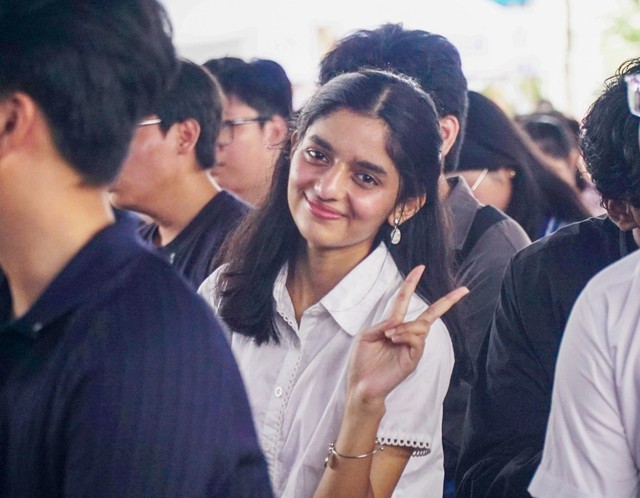
An international student attends ‘Welcome Day’ at the Ho Chi Minh City University of Technology (HCMUT).
The metropolis offers easy access to modern healthcare, diverse culinary options, and a high level of safety, reflected in the country's 38th-place ranking in the 2025 Global Peace Index.
About Ho Chi Minh City University of Technology (HCMUT)
Established in 1957, HCMUT is a key member of the Vietnam National University Ho Chi Minh City (VNU-HCM) and the country's leading institution for engineering, technology, and management.
With its extensive range of English-taught programs accredited by prestigious global organizations, HCMUT serves as a hub for foreign talent, researchers, and international exchange students in Southeast Asia.
- Website: https://hcmut.edu.vn/en
- Email: isp_admission@hcmut.edu.vn
- Phone number/ WhatsApp: (+84) 89916 9961
- Facebook page: https://www.facebook.com/bkquocte
- Address: 268 Ly Thuong Kiet Street, Dien Hong Ward, Ho Chi Minh city, Vietnam








Max: 1500 characters
There are no comments yet. Be the first to comment.