


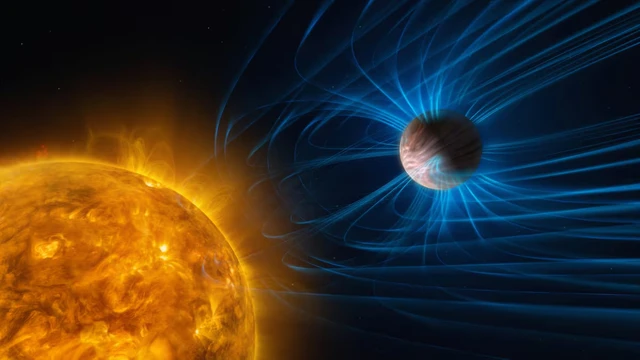
This illustration shows magnetic activity in an exoplanet that is a gas giant like Jupiter but orbits very close to its host star and is tidally locked. The image was released on June 2, 2026. Photo: ESO/M. Kornmesser, L. Calcada/Handout via Reuters
The finding, based on observations by telescopes in Chile and Hawaii, deepens the understanding of exoplanets by showing that at least some share an important characteristic present in all but two of the solar system's eight planets. A magnetic field is an invisible force field generated by the movement of electrically conducting material deep inside a planet - a molten metal core - combined with the planet's rotation.
While none of the gaseous exoplanets in this study are candidates for hosting life, a magnetic field could be one of the factors that helps make a rocky planet like Earth habitable.
These exoplanets each orbit very close to a large and hot star, with one side permanently facing the star and the other side perpetually facing away, as the moon does with Earth.
This type of planet is called a "hot Jupiter" because of a comparable size and composition to our solar system's largest planet, though with a much higher temperature. The seven planets ranged in mass from roughly the same as Jupiter to more than three times as massive.
Strong winds blow from the hot "dayside" to the cold "nightside" on these planets. The orbital proximity of the planets to their host stars leaves them with scorching atmospheric temperatures on the dayside. All are closer to their host star than the solar system's innermost planet Mercury is to the sun.
"What you would expect is that the planets with hotter temperatures would have stronger winds. The more energy you put into the system, the more violent the winds become. But we see the opposite," said astronomer Julia Seidel of the Observatoire de la Côte d'Azur's Lagrange Laboratory in Nice, France, lead author of the study published on Tuesday in the journal Nature Astronomy.
"It's the hottest planets that have the least strong winds mixing the atmosphere. And that's really strange from what we know of how atmospheres behave," Seidel said. "That means all that energy that the star puts into the planet's atmosphere has to be dissipated in a different way. And the only possibility to brake the atmosphere that much that fast is via the magnetic field and its interaction with the moving charged particles of the atmosphere."
A magnetic field is one of the factors behind whether a planet is able to maintain its atmosphere over long periods of time. For instance, Mars once had a magnetic field, but lost it billions of years ago after its interior cooled, and now has only a tenuous atmosphere and an inhospitable landscape.
"Although it's a common misconception that magnetic fields directly determine whether a planet is habitable, they can play an important role in how a planet evolves over time," said astronomer and study co-author Bibiana Prinoth of the European Southern Observatory in Germany. "Life as we know it relies on having an atmosphere. An atmosphere helps maintain surface pressure, regulate temperature and, on Earth, allows liquid water to exist at the surface."









Max: 1500 characters
There are no comments yet. Be the first to comment.