


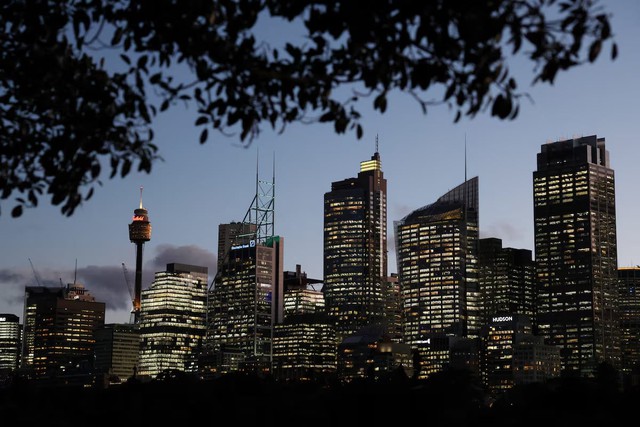
A view shows the Central Business District (CBD) skyline at sunset in Sydney, Australia, July 10, 2025. REUTERS/Hollie Adams
The outlook, however, has been darkened by the Middle East conflict, which has effectively halted oil flows through the Strait of Hormuz and pushed prices up more than 10%. Australia is a net energy exporter but sustained oil rises act as a tax on consumers and businesses.
"While stronger growth may seem like positive news," the result "will be a concern" for the Reserve Bank of Australia, said Stephen Smith, partner at Deloitte Access Economics.
"The RBA is already of the view that the economy is operating above its potential. Combined with elevated inflation, today's data will keep the RBA on high alert and increase the likelihood of a rate hike in May."
Data from the Australian Bureau of Statistics showed real gross domestic product (GDP) rose 0.8% in the fourth quarter, above an upwardly revised 0.5% the previous quarter. Analysts this week had upgraded their forecasts to around 1.0%.
Annual growth accelerated to 2.6%, the fastest pace since early 2023 when post-pandemic stimulus was still being felt.
The RBA judges the economy cannot grow more than 2% without generating inflationary pressures. That is why it raised interest rates last month by a quarter-point to 3.85% as inflation reaccelerated after three cuts last year.
However, with the quarterly pace of growth lagging forecasts, the three-year government bond futures recovered some of the earlier losses to be up 3 ticks to 95.69. The Australian dollar fell 0.6% to $0.6994 as Asian stocks slid on fears of a widening conflict in the Middle East.
Investors maintained bets of a March rate hike at about 30%, while fully pricing in a tightening for May.
Consumers still cautious
The upbeat data underscored the economy's strength in the final quarter of the year, bumping up against its capacity constraints. Inflation picked up to 3.8% in January and the unemployment rate stayed at a historically low level of 4.1%, though the RBA's latest hike in February is likely to temper demand.
For the quarter, inventories made the biggest contribution to growth, adding 0.4 percentage points. Government spending, mostly on defence, also added 0.2 points, while household consumption contributed a meagre 0.1 point.
The household savings ratio, on the other hand, climbed to 6.9%, from 6.1%, suggesting consumers still had plenty of spending power left.
Tony Sycamore, analyst at IG, said the upbeat report masked some subdued household spending that supported the case for rates staying on hold at the RBA's March 16-17 meeting.
"This is an indication that cost-of-living pressures are still biting — Aussies are channelling extra income into savings rather than spending," said Sycamore.
Inflation measures remained high but one closely watched gauge of labour costs slowed to the lowest annual pace since early 2021.
In nominal terms, GDP expanded a whopping 6% for 2025, amounting to A$2.85 trillion ($2.00 trillion).
($1 = 1.4233 Australian dollars)








Max: 1500 characters
There are no comments yet. Be the first to comment.