


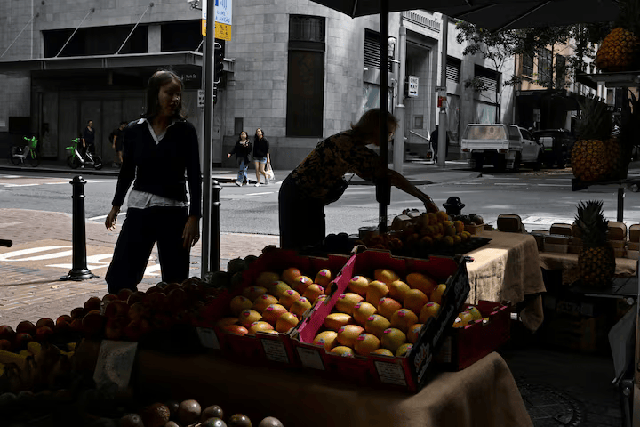
A woman selects fruits at a street market stall in Sydney’s central business district, Australia, February 3, 2026. Photo: REUTERS/Flavio Brancaleone/File Photo
Data from the Australian Bureau of Statistics out on Wednesday showed its monthly consumer price index (CPI) was unchanged in February from the previous month, while the annual pace slowed to 3.7%, from 3.8%, still above the central bank's target band of 2% to 3%.
Median forecasts had been for a flat outcome in February and an annual rise of 3.8%.
The trimmed mean measure of core inflation increased by 0.2% in the month, under forecasts of 0.3%, keeping the annual pace steady at 3.3%.
January's increase was revised down to 3.3%, from 3.4%.
Russel Chesler, head of investments and capital markets at VanEck, said inflation behaved in February but the data was largely irrelevant now.
"With the outbreak of conflict in the Gulf, uncertainty and volatility are in the front seats, with higher energy costs likely flowing on to impact transport, goods and services," he said.
The Australian dollar initially dipped on the figures but later rebounded to 70 cents along with the recovery in global equity markets.
Three-year government bond futures extended an earlier rally to be up 11 ticks to 95.34.
Investors still see a rate hike in May as a toss-up, after the Reserve Bank of Australia delivered two rate rises this year to 4.1% as the U.S.-Israeli attack on Iran disrupted global oil trade and sent fuel prices surging across the country.
Wednesday's report showed automotive fuel prices fell 3.4% in February before the conflict broke out, after a drop of 3.2% in January.
Costs for domestic holiday travel and accommodation fell by a sharp 7.4% due to school holidays ending.
Goods inflation ran at an annual rate of 3.5% in February, while services inflation slowed a little to 3.9%.








Max: 1500 characters
There are no comments yet. Be the first to comment.