


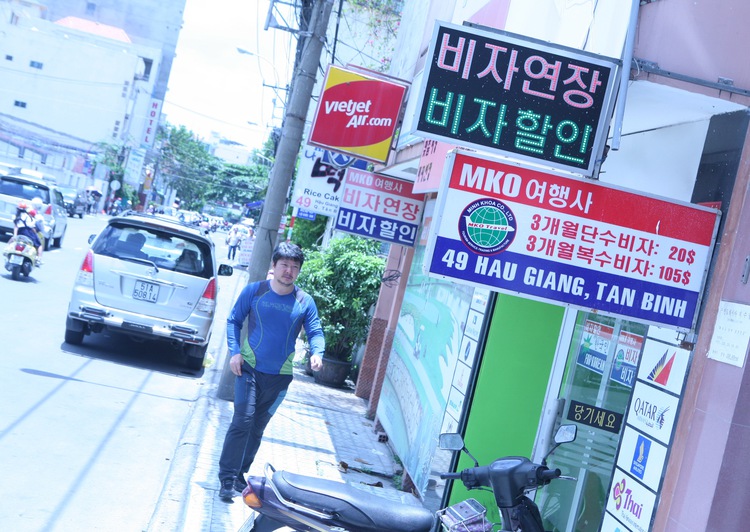
The Ministry of Culture, Sports and Tourism recently requested cultural departments nationwide to step up control over the alarmingly common shop signs featuring only foreign languages, or signs where Vietnamese is not the focus.
In recent years major tourism cities and attractions have seen an explosion of shop signs in only foreign languages, such as Chinese, Korean and Japanese, which violates the Vietnamese Advertisement Law. This has brought about a negative local reaction, and reflects a lack of respect for the national tongue and culture, the ministry pointed out.
The Advertisement Law, launched last year, stipulates that advertisment content, whether spoken or written, must be in Vietnamese. Foreign languages can only be adopted when representing foreign brands, trademarks, proper names or internationalized words which can’t be replaced with Vietnamese. In such cases, the signs must use both Vietnamese and a foreign language, and the foreign words must be no less than one-third of the Vietnamese words’ font size, and placed beneath the Vietnamese words.
However, in reality, this is rarely the case. Many shops and service providers have long displayed signs which feature foreign words only, or both Vietnamese and foreign languages, but the Vietnamese words are dominated by the foreign ones in size, color and position.
“As stipulated by the Advertisement Law, established names or trademarks like Panasonic aren’t required to be translated into Vietnamese. The shop owners are only required to inform local customers in Vietnamese of what kinds of goods they trade in. However, it is the signs featuring prices and miscellaneous information in only Chinese, Korean and Japanese, not the signs of established brand names, that trigger most reactions from locals,” elaborated Ninh Thi Thu Huong, from the ministry.
Similarly, shop signs in Russian abound in Nha Trang, as the city is usually packed with Russian tourists, she added.
A number of shops or restaurants located in the Chinese, Japanese or Korean areas of cities are owned by foreign nationals and mostly or exclusively receive clients of their nationality. They hang signs featuring only their language.
However, Huong affirmed that such signs are also a breach of the Advertisement Law, and their owners will be fined.
Signs on streets where few foreigners live or frequent are also often written in English, which baffles many locals. These shops offer mostly local goods and mostly serve local customers. Though the owners or staff of these businesses often speak little English, they say that writing signs in the language is cool and trendy.
Many shops, restaurants and hotels which have been in business for many years also hang signs only in English or French.
“We find these signs, which are historical remnants, most difficult to deal with. Though they violate the law, most locals are familiar with their goods and services,” said To Van Dong, head of Hanoi Department of Culture, Sports and Tourism, adding that his department has assigned the district culture departments to inventory them.
Many beer halls and shops on Ta Hien, Hanoi’s “international intersection”, also hang signs in English and other languages. One shop owner in the area even caused a stir when he refused to serve local customers.
However, a handful of inns or shops which are usually packed with foreign customers do have signs in Vietnamese only.
Huong, from the ministry, put the loose management of violating shop signs down to a serious shortage of culture staff. She added that while Da Nang culture authorities have managed to put the situation in check to a certain extent, those in Hanoi and Ho Chi Minh City have failed to do so.
| According to Article 33 of Decree 75, the owners of violating sign may be fined from VND1-5 million (up to US$238), and the signs will be removed. |









Max: 1500 characters
There are no comments yet. Be the first to comment.