


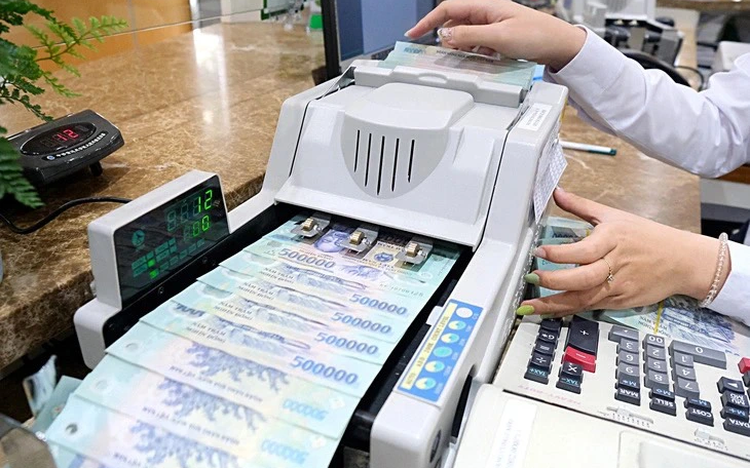
From July 1, 2026, banks, payment service providers, and international card organizations in Vietnam are required to provide customer account information for tax authorities. Photo: Ngoc Phuong / Tuoi Tre
The requirement is among the key provisions of the government’s Decree No. 252, which details several articles of the Law on Tax Administration and took effect on July 1.
Under the decree, credit institutions, foreign bank branches, payment service providers, payment intermediary service providers, online payment service providers, and international card organizations have to provide tax authorities with information on taxpayers' payment accounts.
These organizations are also required to coordinate with tax authorities when unusual transactions are detected and require verification of tax compliance.
The information to be provided includes the account holder's name, account number associated with the tax identification number issued by the tax authority, the bank and branch where the account is opened, the account opening date, and the account closing date.
This information must be submitted electronically on a monthly basis, no later than the 10th day of the following month.
In addition to account information, these organizations have to provide transaction-related data, including the number and value of transactions, transaction descriptions, information on senders and recipients, domestic and cross-border transactions, account balances, end-of-period balances, and generated incomes.
They also have to provide information on beneficial owners, authorized representatives, joint account holders, beneficiaries, and related parties, as well as unusual or suspicious transactions in accordance with anti-money laundering regulations.
The information and data must be provided on a periodic basis under information-sharing agreements or at the request of the tax authorities.
Previously, commercial banks were only required to provide account holders' names and account numbers upon request from tax authorities.
Transaction records, account balances, and transaction data were requested only for tax inspections and audits.
Under the new regulations, however, from July 1, credit institutions, foreign bank branches, payment intermediaries, online payment service providers, and international card organizations must provide a broader range of detailed information on a monthly basis.
Media organizations also required to share information
In addition to banks and financial institutions, media organizations are now required to provide information upon request by tax authorities regarding the production, business, advertising, promotional activities, selling prices, and market activities of organizations and individuals.
Media organizations must also provide information on suspected tax law violations reported through the media, as well as tax management risks identified through journalistic activities and public feedback.
This is a completely new provision compared with previous regulations.
The requested information must be provided within five working days after a request has been received.
For more complex cases, the deadline may be extended to no more than 10 working days, provided that the organization gives written notice explaining the reason for the delay.
Information concerning suspected tax law violations must be provided on the same day they are detected or no later than the following working day.
According to the General Department of Taxation, tax authorities are gradually implementing a tax management system based on cash flow analysis.
This requires regular, automated, and real-time information sharing between tax authorities, the State Bank of Vietnam, commercial banks, payment intermediaries, logistics providers, and other relevant organizations.
The department said it currently has information on about 250 million bank accounts, including approximately 200 million personal accounts.
Where significant risks, unusual transactions, or suspected tax evasion or money laundering are identified, banks will provide information to tax authorities in accordance with regulations.
Invoice data combined with cash flow information from various sources will help create a comprehensive taxpayer data ecosystem, enabling tax authorities to accurately determine actual tax liabilities, reduce tax revenue losses, improve transparency, and promote a fair and healthy business environment.
According to the General Department of Taxation, the data will be analyzed using technological tools, including artificial intelligence, to identify high-risk cases rather than monitor every transaction of individual account holders.








Max: 1500 characters
There are no comments yet. Be the first to comment.