


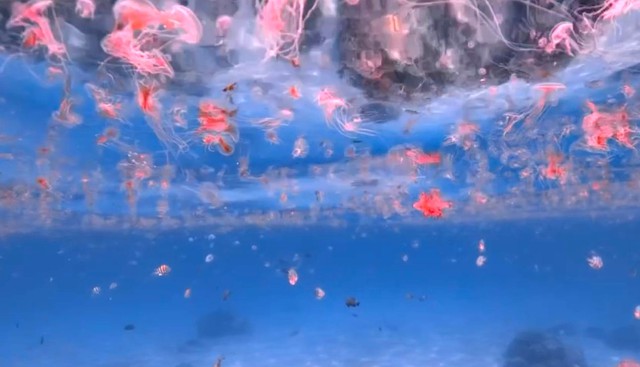
Portuguese man-of-wars appear densely in Nha Trang Bay waters in Khanh Hoa Province, south-central Vietnam. Photo: Ngan Tran
Known scientifically as Physalia physalis, Portuguese man-of-wars typically appear in Vietnamese waters during summer.
Dam Hai Van, head of the Nha Trang Bay Management Board, told Tuoi Tre (Youth) online newspaper on Monday that Portuguese man-of-wars are surfacing due to ocean currents and water temperatures.
In recent days, residents and visitors have posted videos showing dense clusters of these creatures near Hon Mun Island and other areas in the bay.
Tran Nguyen Ngan, who offers diving services in the bay, explained that Portuguese man-of-wars are currently abundant around islands like Hon Mun and Hon Bac.
“We absolutely do not allow tourists to swim or dive in areas with Portuguese man-of-wars because stings can seriously affect health,” Ngan said.
Dermatologist Tran Thi Vinh of Nha Trang’s 22-12 Hospital warned that Portuguese man-of-wars have numerous tentacles containing toxins.
Contact with Portuguese man-of-wars’ tentacles can cause painful stings, swelling, and red streaks on the skin.
In severe cases, blisters may form with yellowish fluid.
First aid steps include leaving the water immediately, avoiding scratching, and rinsing the affected area gently with seawater.
Vinh stressed that fresh water, medicated oils, and sand should not be used to wash or scrub the wound immediately after a sting.
Any tentacles should be removed with a clean cloth.
If blisters appear, victims should immediately seek medical treatment rather than self-care.
Children, the elderly, or those with allergies may suffer systemic reactions such as nausea, dizziness, chest pain, low blood pressure, or even anaphylactic shock, Vinh added, urging immediate emergency care in such cases.
The doctor also cautioned that contact with dead Portuguese man-of-wars washed ashore can still cause skin reactions.








Max: 1500 characters
There are no comments yet. Be the first to comment.