


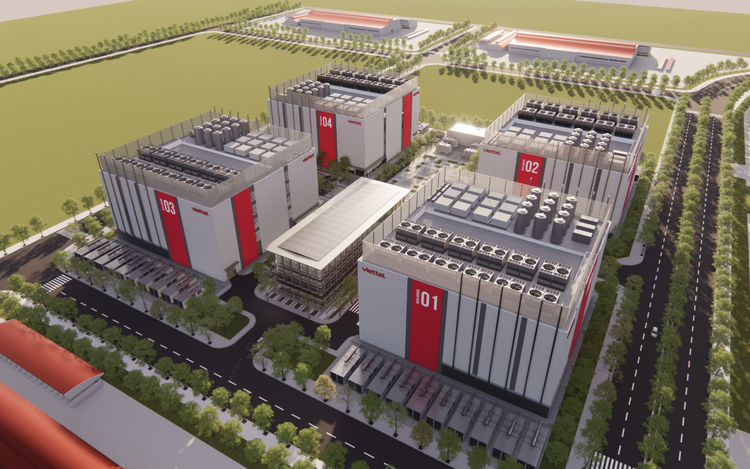
A data center model at Tan Phu Trung Industrial Park in Ho Chi Minh City. Photo: Viettel
Among the large-scale data center projects is a US$2 billion AI-enabled data center complex at Tan Phu Trung Industrial Park, spanning roughly 10 hectares.
In addition, Viettel is developing a data center with a designed capacity of up to 140 MW, while CMC has been investing in a hyperscale data center project with a total investment of nearly VND6.3 trillion ($239 million) and an IT load of 30 MW.
Meanwhile, Evolution Data Centers has revealed a plan to pour $500 million into a data center at the Saigon Hi-Tech Park.
These projects highlighted that Vietnam’s data center market has moved well beyond the idea stage and into a phase of heavy capital commitment.
The sector is accelerating in step with the global surge in artificial intelligence (AI) and cloud computing.
However, Vietnam’s data center market remains relatively modest in scale.
According to commercial real estate services and investment firm CBRE, Vietnam’s total operational data center capacity stands at around 104 MW, roughly one-tenth of that of China, the Asia-Pacific region’s leading market.
The market is also highly concentrated, with the five largest operators constituting 97 percent of the total capacity.
Viettel IDC leads with about 41 percent, followed by VNPT at 24 percent, while the remainder is shared among CMC, FPT Telecom, VNG, and other players.
This ‘small but concentrated’ structure gives rise to two contrasting perspectives.
On one hand, the limited scale points to significant room for growth.
On the other, it underscores the barriers to entry: data centers require massive upfront capital, stable power and telecommunications infrastructure, and sophisticated operational capabilities.
This is not a market that can be expanded casually or en masse.
In its Global Data Center Outlook 2026, JLL forecast that worldwide data center capacity will nearly double, from 103 GW to about 200 GW by 2030.
Notably, AI-related workloads are expected to make up as much as 50 percent of the total global data center capacity by the end of the decade.
JLL estimated that over the next five years, the data center industry could require as much as $3 trillion in investment.
Of the total, around $1.2 trillion would create new real estate asset value, while nearly $870 billion would be raised through new capital structures.
These figures help explain why data centers are increasingly viewed as a ‘new core asset’ in the portfolios of global investment funds.
JLL noted that while demand is rising rapidly, operational indicators for data center real estate remain relatively stable, with no clear signs of speculation or bubble-like behavior.
The implication is clear that it is a long-term game, unsuited to investors chasing quick returns.
For Vietnam, one of the most significant competitive advantages lies in cost.
CBRE estimated that the average construction cost for data centers in Vietnam is around $7 per watt, among the lowest in Asia.
This cost advantage is a powerful magnet for international capital at a time when regional competition for data center investment is intensifying.
However, low construction costs do not automatically translate into investment efficiency or long-term success.
Without reliable power supply, coherent planning, and strong connectivity infrastructure, cost advantages can quickly be eroded.
The influx of billion-dollar investments into data centers is therefore not merely a real estate story.
It is a stress test of Vietnam’s readiness to build and sustain a digital infrastructure ecosystem.
Data centers cannot simply be built and left idle; they must be integrated with AI ecosystems, cloud service providers, technology enterprises and real, growing demand from the economy.
The growth potential is real, but the path ahead will not be smooth.
The bigger question is not how much money is waiting to be deployed, but whether Vietnam in general and Ho Chi Minh City in particular can harness this wave to build a sustainable digital infrastructure industry, or they remain largely a landlord leasing server space in the midst of a rapidly accelerating global investment cycle.








Max: 1500 characters
There are no comments yet. Be the first to comment.