


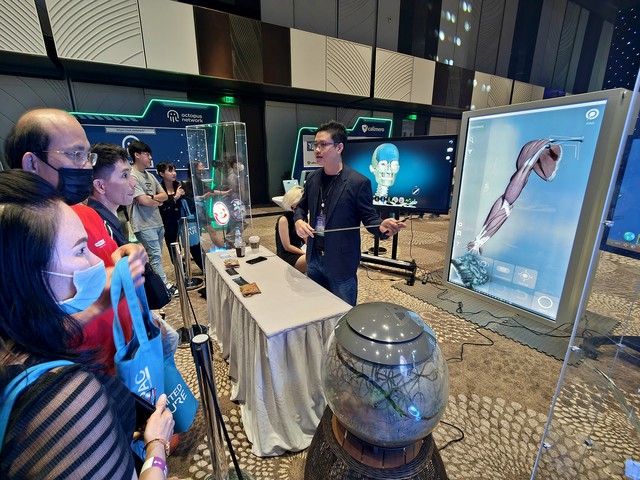
New business models and emerging technologies should be given room for pilot testing. Photo: Duc Thien / Tuoi Tre
When the law cannot keep pace with technology
In mid-2021, the game Axie Infinity sparked a global craze and brought its developer Sky Mavis into the ranks of the region's rare billion-dollar tech unicorns.
Much of the team of founders, software engineers and talent behind the game is Vietnamese.
But legally, Sky Mavis is incorporated in Singapore.
The paradox of companies being 'born in Vietnam but incorporated in the city-state' is not an isolated case.
From Web3 platforms such as Kyber Network to artificial intelligence and fintech startups, a familiar pattern has emerged: founders establish a parent company overseas to raise international capital and register intellectual property, while the Vietnamese entity mainly handles contract work or research and development.
For startups operating in the age of artificial intelligence, products can change within weeks.
However, the gap between regulators, support agencies and the startup community remains a concern.
Business models already operating in other markets may not be recognized or addressed quickly enough in Vietnam, turning the journey from an idea to a marketable product into a legal minefield.
Nguyen The Vinh, chairman of the Ho Chi Minh City Blockchain Association, said the biggest cost for businesses is not necessarily being rejected, but not knowing when they will receive an answer or what standards will apply.
"A product development cycle may last only a few months, while determining the legal framework can take longer than an entire technology cycle," he said.
As a result, businesses may have to scale back product features, operate through foreign partners, or move their legal entities and fundraising activities overseas.
The consequences can include lost market opportunities, lower valuations from investors and greater difficulty retaining skilled engineers.
"A high but clearly defined standard is still better than an undefined gray area," Vinh said.
From 'banning what cannot be managed' to smart post-market supervision
To unlock resources for innovation, state management needs to move decisively away from a 'pre-approval and banning what is unclear' approach toward smart post-market supervision based on data and safety standards.
Vinh proposed creating a flexible regulatory sandbox and identified five key elements.
First, regulators should define a legal safe zone in advance so businesses that comply with the approved testing scope are not subject to retrospective penalties.
Second, regulation should be risk-based.
A non-fungible token (NFT) ticket should not be regulated like an investment product, while a non-custodial wallet, which allows users to control their own assets, should not be regulated like a custodial institution that holds customers' assets.
Third, regulators should enable near-real-time monitoring through application programming interfaces (APIs) or dashboards that track users, transactions, complaints and security incidents.
Fourth, the framework should establish warning thresholds, automatic suspension mechanisms and procedures for handling incidents.
Fifth, there should be a single regulatory point of contact with clear deadlines for decisions on approving, extending or terminating a pilot.
Tran Viet Quan, founder and chairman of Tanca, also called for a more open approach from public agencies toward innovation.
He said that the government's first priority should be to implement the policies it has already announced to support startups and innovation.
When technology companies need assistance, there should be mechanisms for rapid responses on policies and procedures, he said, adding that authorities should be willing to allow new business models without precedent to be tested.
Regular dialogue between government agencies and the startup community should also be maintained, Quan said, arguing that innovative businesses should not be viewed primarily as potential lawbreakers.
The hidden costs of 'banning what cannot be maânged'
Several founders told Tuoi Tre (Youth) online newspaper that establishing companies overseas is not a matter of lacking national pride, but a question of legal certainty and business survival.
When technology develops at lightning speed while regulations can take years to formulate, excessive caution and delays by regulators can unintentionally close off opportunities.
The 'banning what cannot be maânged' mindset can also have several unintended consequences.
Capital and revenue outflows: Million-dollar fundraising rounds, exit proceeds and potentially substantial corporate income tax revenues may end up benefiting neighboring countries where companies are incorporated.
Vietnam may capture only personal income tax from engineers' salaries.
Brain drain: Talented engineers and other skilled workers can become discouraged when innovative products are forced to limit their features or remain stalled by regulatory uncertainty.
Losing on home turf: When domestic companies are constrained by regulatory procedures, multinational corporations and cross-border platforms can gain market share more easily after developing their business models and data in markets with more flexible regulatory environments.
Resolution No. 19/NQ-TW calls for "making institutional and national governance reform a breakthrough priority; shifting from a mindset of management and control to one of enabling and guiding development; governing based on objectives and development space, with coordinated and interconnected policies, data-driven decision-making, responsive policymaking, and performance measured by development outcomes and impact; and making coordination effectiveness, the quality of services provided to people and businesses, and the capacity to address real-world problems the ultimate measures of performance."
The longer regulatory thinking remains tied to the principle of 'if it cannot be managed, ban it,' the greater the risk that million-dollar investments and some of Vietnam's most capable technology talent will quietly move abroad to build their businesses elsewhere.








Max: 1500 characters
There are no comments yet. Be the first to comment.