


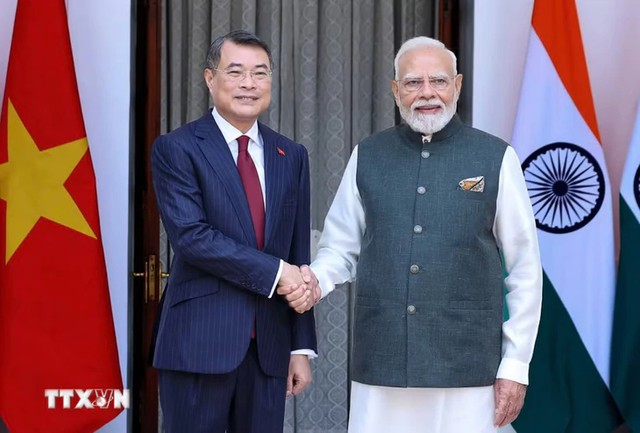
Prime Minister Le Minh Hung (L) meets Indian Prime Minister Narendra Modi. Photo: Vietnam News Agency
Dr. George, dean of the faculty of economics at the Ho Chi Minh City University of Economics and Finance (UEF), shared his views with Tuoi Tre (Youth) online newspaper during Prime Minister Le Minh Hung’s visit to India this weekend for the 18th BRICS Summit.
Opportunities for Vietnam
Prime Minister Hung’s visit is particularly significant as it comes at a time when Vietnam-India relations are moving beyond political goodwill toward a much more substantive economic and strategic partnership, Dr. George said.
Vietnam’s presence at a BRICS summit, he argued, fits into the country’s long-standing approach of openness, diversification, and engagement with different global economic centers.
“Vietnam’s economic success over several decades has been built on openness, diversification, international integration, manufacturing, exports, and the ability to maintain constructive economic relationships with different centres of global power,” he stressed.
“Participation in BRICS as a partner country should therefore be viewed within that broader economic philosophy.”
He sees five major opportunities for Vietnam: diversifying markets, supply chains, finance and digital systems, while expanding cooperation in infrastructure and strategic technologies.
“The economic value of BRICS will ultimately be measured by how many additional choices Vietnam creates – for markets, technology, capital, infrastructure, payment systems, supply chains, and human resources,” he said.
Dr. George added that this is becoming increasingly important as tariffs, sanctions, technology restrictions, supply-chain concentration, and geopolitical competition reshape global trade.
But he cautioned that diversification cannot be achieved through political declarations alone.
Businesses will only shift suppliers, production locations or markets when the alternatives are commercially competitive, logistically reliable, and less risky.
Vietnam, he said, therefore needs to turn diplomatic momentum into measurable economic outcomes.
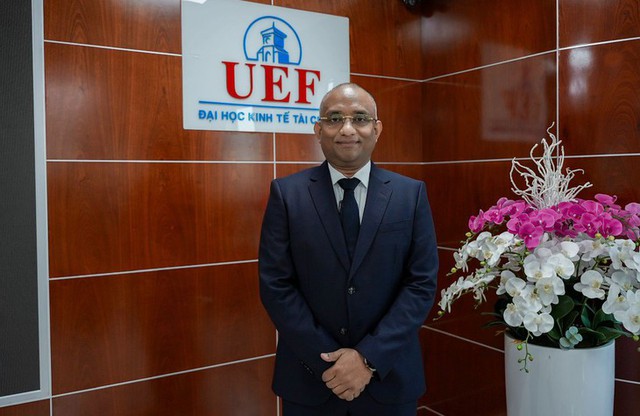
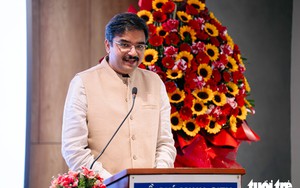
Dr. Majo George, dean of the faculty of economics at the Ho Chi Minh City University of Economics and Finance. Photo: Courtesy of Dr. Majo George
From BRICS dialogue to Vietnam-India deals
To explain how multilateral mechanisms can complement bilateral cooperation, Dr. George drew a clear distinction: “Bilateral relationships execute business. Multilateral platforms can improve the environment in which that business takes place.”
A Vietnamese coffee exporter, for example, does not sell to BRICS, but to a buyer in India, China, Brazil or another individual market.
Likewise, companies invest in specific countries, not in BRICS as a bloc.
What BRICS can add, he said, is a wider platform for cooperation on issues such as trade facilitation, financial connectivity, development finance, standards, logistics, critical minerals, and supply-chain resilience.
India could be one of the clearest examples of how that works.
The two economies are highly complementary, but much of that potential has yet to be translated into actual trade and investment.
In the first six months of 2026, bilateral trade exceeded US$10 billion, equivalent to nearly 60 percent of the total for all of 2025 – a sign that demand is already there, while what is still missing is a much stronger economic architecture around it.
That, he said, is where multilateral mechanisms can add value: BRICS can broaden the agenda, while bilateral ties are where agreements are signed and implemented.
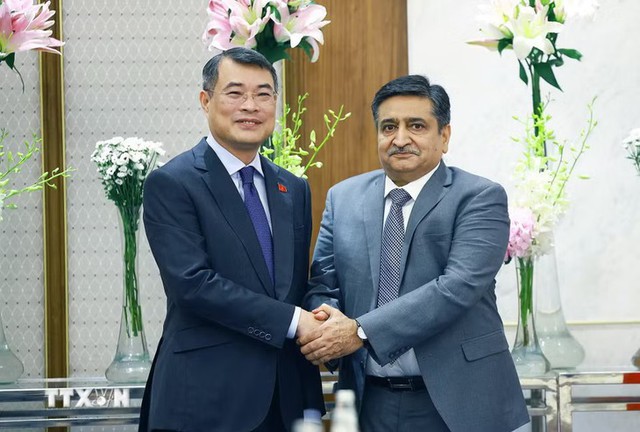
Prime Minister Le Minh Hung (L) meets Sanjay Dhawan, vice-chairman of ACME Group. Photo: Vietnam News Agency
Payments are one area where cooperation is already taking shape.
The State Bank of Vietnam and the Reserve Bank of India have signed an agreement covering financial innovation and digital payments, while institutions from both countries are also working on cross-border QR payment interoperability.
The economist said Vietnam should use its growing ties with India to turn broader BRICS discussions into concrete projects in ports, railways, urban metros, renewable energy, and digital infrastructure.
He also pointed to semiconductors, artificial intelligence, and critical minerals as areas with strong potential for deeper cooperation.
Beyond $25-billion trade target
Vietnam and India are aiming to raise bilateral trade to $25 billion by 2030, a target that Dr. George believes is achievable.
But he said trade value should not be the only measure of success.
“$25 billion matters. But the more transformative question is: What capabilities will Vietnam and India have built together by 2030 and 2040?” he questioned.
Rather than simply selling more of today’s products, the two countries should create new areas of trade and investment, he added.
He proposed building the relationship around five connected pillars: digital cooperation, manufacturing, logistics connectivity, green development, and knowledge, with people linking all five.
Among those areas, he repeatedly highlighted logistics as both a major bottleneck and a key opportunity.
Trade barriers, he said, are not always about tariffs. They can also result from delays, paperwork, transshipment, warehousing, and uncertainty.
Vietnam and India should therefore develop more direct shipping routes, stronger port connectivity, cold chains, agricultural and seafood logistics, and more digital customs procedures.
For Dr. George, that is ultimately the real test of BRICS for Vietnam.
The question is not how many meetings the country attends, he said, but whether it can turn greater diplomatic space into new markets, investment, technology, skills, infrastructure, and sustainable economic opportunities.
BRICS is a grouping of major emerging economies that began with Brazil, Russia, India and China, with South Africa joining in 2010.
The group has since expanded to include Egypt, Ethiopia, Iran, the United Arab Emirates, Indonesia and Saudi Arabia, and also has partner countries.
Vietnam is not a full BRICS member. It became a BRICS partner country in June 2025, making it the 10th country to receive that status.


Max: 1500 characters
There are no comments yet. Be the first to comment.