


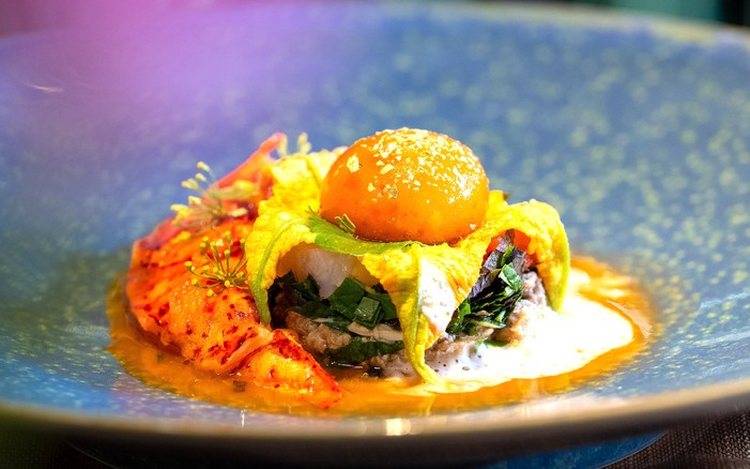
Chef Peter Cuong Franklin's lobster ‘bun rieu.’ Photo: Organizing committee
The humble bun rieu, traditionally served as a steaming bowl of noodles in a savory crab broth, is inspiring some unusual culinary twists.
‘Bun rieu’ rice paper rolls tucked away in small alley
Ho Chi Minh City has no shortage of bun rieu eateries, but bun rieu rice paper rolls remain a rare find.
Hidden in Alley 63 on Nghia Phat Street, an unnamed eatery has been serving this distinctive variation for more than 20 years, attracting diners by presenting familiar ingredients in an unconventional way.
The ingredients are largely the same as those found in a traditional bowl of bun rieu, including blanched water spinach, crab meatballs, tofu, Vietnamese pork sausage, and fried shallots.
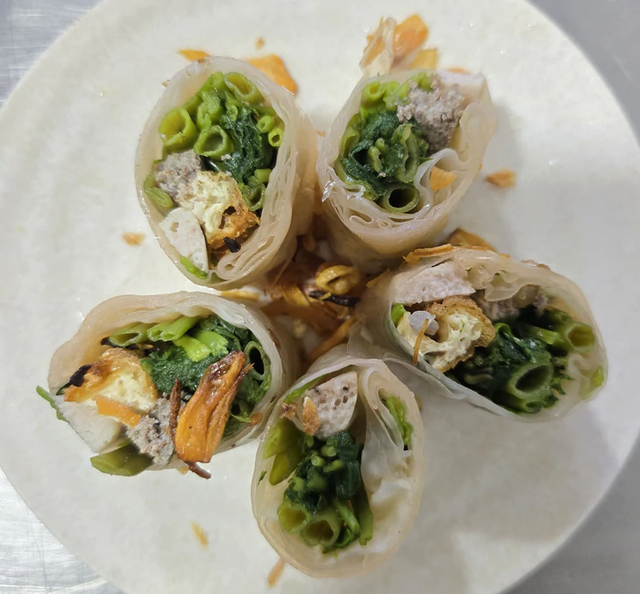
‘Bun rieu’ rice paper rolls made with ingredients from the traditional noodle soup. Photo: Hoang Le / Tuoi Tre
They are wrapped in rice paper that has been dipped in bun rieu broth and served with fermented shrimp paste or tamarind fish sauce.
The rich crab flavor, chewy tofu, tangy tamarind fish sauce or distinctive fermented shrimp paste, and a touch of chili combine to awaken the taste buds.
Beyond bun rieu, the eatery also serves canh bun (Vietnamese crab noodle soup made with thick rice vermicelli and water spinach) and banh da (Vietnamese crab soup with flat rice noodles), as well as rice paper soaked in bun rieu broth.
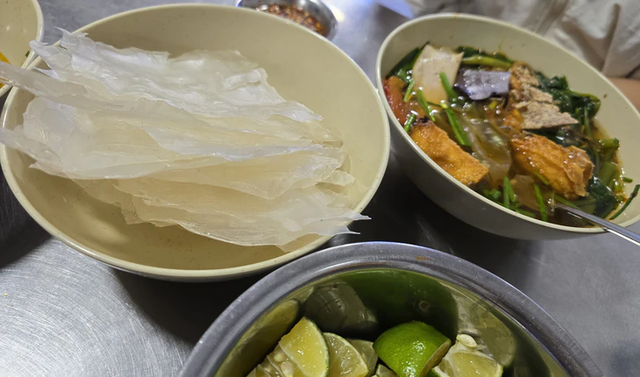
Rice paper served with ‘bun rieu’ broth. Photo: Hoang Le
The thick, white rice paper softens as it absorbs the broth, taking on a mildly rich flavor and offering another intriguing way to enjoy the familiar soup.
With its approachable flavors and affordable prices, bun rieu rice paper rolls embody the diversity of Vietnamese street food. Each roll costs around VND5,000 ($0.2), while a bowl of bun rieu, canh bun, or banh da starts at VND25,000 ($0.97).
Lobster 'bun rieu' in fine dining
At the other end of the culinary spectrum, chef Franklin presented his fine-dining interpretation of bun rieu on Top Chef 2026.
Instead of retaining the traditional presentation, he used Alaskan lobster and modern cooking techniques to create an elevated interpretation of the Vietnamese dish.
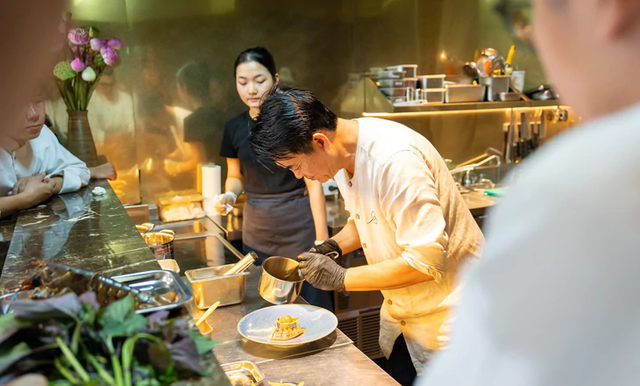
Chef Peter Cuong Franklin guides fellow chefs in preparing lobster ‘bun rieu.' Photo: Organizing committee
Franklin is one of the pioneering chefs promoting Vietnamese cuisine to international audiences.
He founded Anan Saigon in Ho Chi Minh City. The restaurant earned one Michelin star for three consecutive years and has also appeared on the Asia's 50 Best Restaurants list.
For his version of bun rieu, Franklin made lobster the centerpiece. The lobster was cooked slowly with butter to preserve its tender, sweet flesh. Its head and shell were used to make a sauce, extracting as much flavor from the ingredient as possible.
He also incorporated Ca Mau crab, tomatoes, and coconut milk to build additional layers of flavor.
Notably, the bun rieu broth was transformed using molecular gastronomy techniques into small spheres rather than being served as a conventional liquid.
Franklin explained that following a traditional cooking method might not produce a sufficiently intense flavor.
Finishing the lobster also required precision. It was briefly immersed in butter to absorb the aroma without becoming overly rich, then carefully reheated to prevent overcooking.
The individual components were prepared separately before being combined to create multiple layers of flavor on the plate.
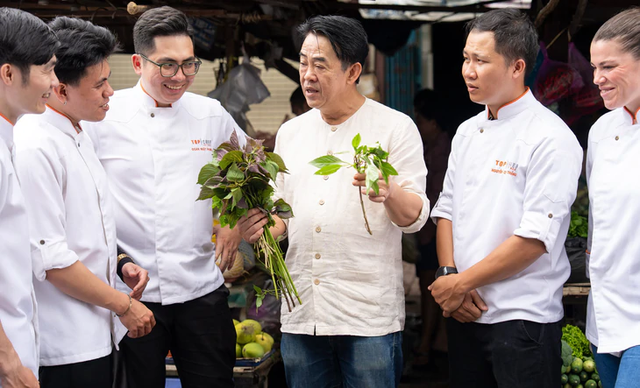
Chef Peter Cuong Franklin guides fellow chefs in selecting ingredients. Perilla and Vietnamese balm are two herbs commonly used in ‘bun rieu.' Photo: Organizing committee
Franklin retained two familiar herbs associated with bun rieu: perilla and Vietnamese balm.
Most of the other ingredients, along with the cooking techniques and presentation, were substantially reworked, resulting in a dish that looked very different from the traditional bun rieu.
Some viewers watching the show questioned whether the dish resembled traditional bun rieu, while others asked, "Where are the noodles in bun rieu?"
According to Franklin, chefs need to understand their position between tradition and modernity. Flavor and ingredient quality remain the most important considerations, while other elements can be changed to make a dish more visually appealing and interesting.
From bun rieu rice paper rolls in a small alley to a lobster-based interpretation prepared with modern techniques, these contrasting takes on the Vietnamese dish have drawn mixed reactions but demonstrate the diversity and creativity of the country's cuisine.








Max: 1500 characters
There are no comments yet. Be the first to comment.