


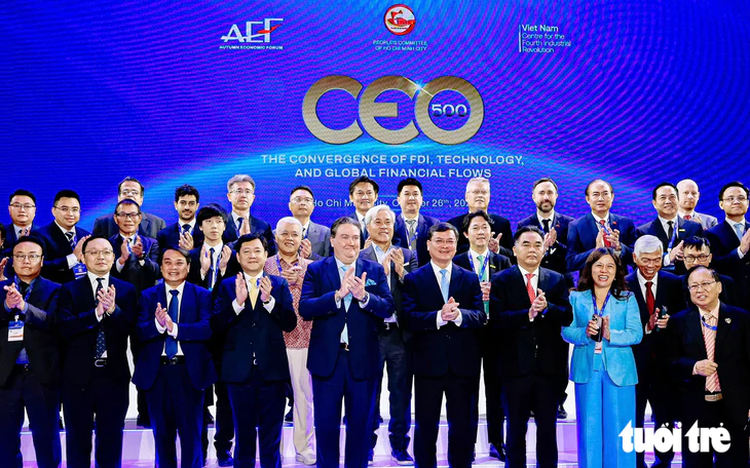
Leaders of Ho Chi Minh City pose for a group photo with delegates and business representatives at the CEO 500 program on October 26, 2026. Photo: Thanh Hiep / Tuoi Tre
Artificial intelligence (AI) is opening up a range of new applications, from drones and autonomous vehicles to data-driven factory operations.
However, for many businesses, acquiring new technology is only the first step.
The greater challenge is finding suitable places to test these technologies, demonstrate their effectiveness and then scale them up.
The question is therefore not just how to attract more investment, but also how to turn technology investment into practical applications and strengthen the capabilities of domestic businesses.
At the CEO 500 program, held on Monday in Ho Chi Minh City as part of the Autumn Economic Forum 2026, business leaders expressed their desire for the city to become a testing ground for new technological applications, provided that clear pilot mechanisms are established and infrastructure is prepared in advance.
Jesse Choi, regional director of Sunwah Group in ASEAN, said the company is exploring various applications that could be deployed in Ho Chi Minh City.
These include AI technology to help wastewater treatment plants reduce energy consumption, drones for infrastructure inspections, and autonomous electric vehicles to transport goods in ports and mining areas.
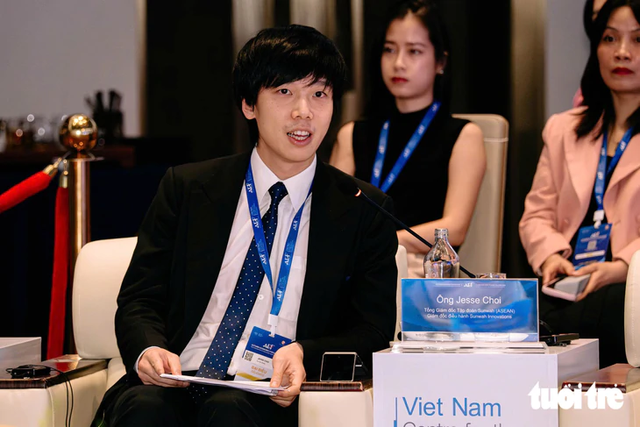
Jesse Choi, regional director of Sunwah Group in ASEAN. Photo: Thanh Hiep / Tuoi Tre
According to Choi, these technologies need to be tested under real operating conditions and carefully evaluated before being widely adopted.
Some fields, such as drones, are subject to strict regulations, making it difficult for businesses to conduct trials independently without government support.
He proposed that the city help businesses access suitable pilot sites and coordinate with relevant departments to clarify technical requirements and safety standards, while establishing a clear roadmap from testing to deployment.
He also noted that AI is giving rise to a growing number of one-person companies, which need support alongside major technology projects.
"We believe this approach will help Vietnam gain access to international technologies while building domestic capabilities, creating opportunities for technology transfer and long-term investment," Choi said.
"With suitable testing environments and coordination mechanisms, Ho Chi Minh City could become an important testing ground for practical technological applications, which could then be scaled up nationwide and in other markets."
Infrastructure must come first
To scale up projects beyond the pilot stage, businesses said, the necessary infrastructure must be prepared in advance.
Bill Giannikos, data center director at Aurecon Vietnam, said computing capacity is important but could not generate prosperity on its own.
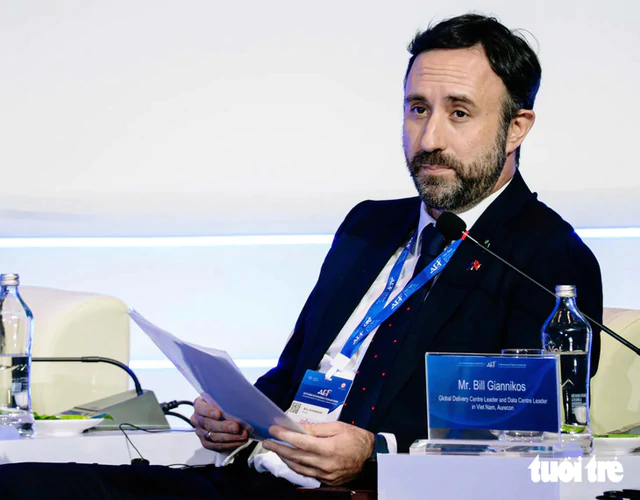
Bill Giannikos, data center director at Aurecon Vietnam, speaks at the event. Photo: Thanh Hiep / Tuoi Tre
AI infrastructure needs to be connected with universities, startups, and the healthcare, education and manufacturing sectors, while its success should be measured by the extent of its practical applications.
According to him, investors need confidence that land, electricity supplies, and infrastructure will be available in a coordinated manner according to a predictable timeline.
Citing the experience of Australia's state of Victoria, he suggested that Ho Chi Minh City plan dedicated digital infrastructure zones before large investment flows arrive.
"Electricity, connectivity, AI, investment, human resources, and infrastructure planning cannot be separated. When combined, they create something more powerful: not just digital infrastructure, but sustainable digital capability," Giannikos said.
Jian Lu, vice-president of China's Windey International Energy, said a system combining wind power, solar power, and battery storage could meet up to 70 percent of the electricity demand of an AI data center.
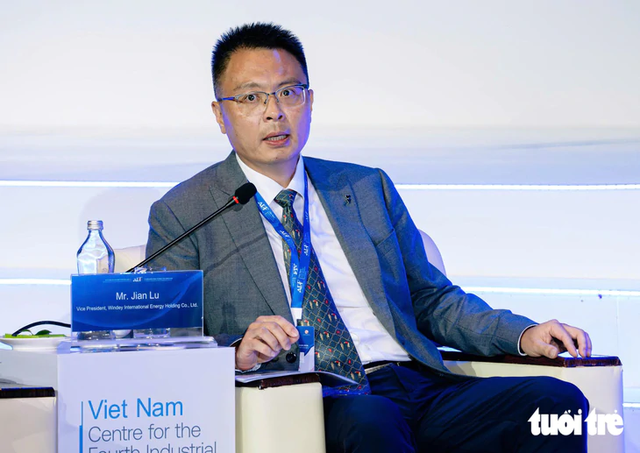
Jian Lu, vice- president of Windey International Energy. Photo: Thanh Hiep / Tuoi Tre
Meanwhile, Pham Quoc Anh, executive chairman of Pacifico Energy Vietnam, pointed out a dilemma.
Investors in industrial parks, high-tech factories, and data centers need to know that reliable electricity supplies will be available before committing to investment.
Meanwhile, power developers need customers and long-term contracts to secure financing.
"As a result, the two sides often have to wait for each other," Anh said.
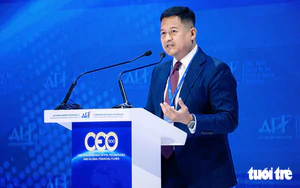

He proposed that the city trial a mechanism to consolidate electricity demand from strategic projects and connect these projects with energy suppliers to prepare framework agreements in advance.
Once projects move forward, the agreements could be finalized as direct power purchase agreements.
"Preparing infrastructure and energy supplies today lays the foundation for attracting investment projects tomorrow," Anh stressed.
CEO 500 brings together domestic, international business leaders
The CEO 500 program, themed 'The Convergence of FDI, Technology and Global Financial Flows,' brought together domestic and international business leaders, representatives of financial institutions, economic experts, and investors to discuss trends in foreign direct investment (FDI) flows, technological development, and the role of finance in economic growth.
Discussions focused on improving the quality of investment attraction, developing infrastructure and supply chains, promoting innovation, and strengthening connections between Vietnamese businesses and international corporations and investors.
The Autumn Economic Forum 2026 opened in Ho Chi Minh City on Monday, kicking off four days of discussions on technology, innovation, and new growth drivers.
The forum attracts more than 1,500 delegates, including senior officials, representatives of international organizations, experts, and business leaders from Vietnam and abroad.
Its two main days, Tuesday and Wednesday, will be co-branded with the World Economic Forum for the first time.


Max: 1500 characters
There are no comments yet. Be the first to comment.