


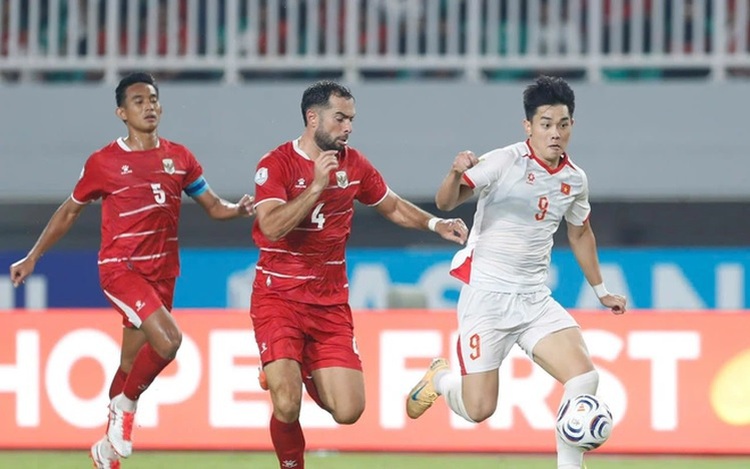
Vietnam (white) delivered one of their most impressive performances of the tournament with a commanding 3-0 victory over Indonesia at Pakansari Stadium. Photo: Anh Khoa
When Ilhan Fandi's 65th-minute equaliser hit the back of the net in Singapore, it did more than secure a 1–1 draw for the hosts.
It ended Indonesia's hopes of reaching the semifinals of the 2026 ASEAN Hyundai Cup and exposed an uncomfortable question about the country's football revolution.
2 faces of Indonesian team
For the past two years, Indonesia have pursued an aggressive strategy, using overseas-developed and diaspora talent to raise the national team's level as quickly as possible, while hoping domestic football will eventually catch up.
The results have been spectacular at times. In World Cup qualifying, Indonesia assembled a squad featuring European-based players such as Jay Idzes, Thom Haye and Maarten Paes.
The team became more competitive against Asia's established powers, and the expansion of the World Cup to 48 teams created a rare sense that Indonesia could finally return to the global stage.
FIFA itself highlighted Indonesia's extensive use of diaspora talent as a major factor behind the team's rise.
But the ASEAN Championship exposed the other side of the strategy.
Unlike FIFA's international windows, the regional championship does not automatically guarantee the release of every overseas-based player.
When Indonesia entered the tournament without much of its European-based core, the depth underneath was tested.
A 0-3 defeat to Vietnam was followed by a disjointed 1-1 draw with Singapore, a result that sent Garuda home before the knockout stage.
The lesson, however, is not that Indonesia's naturalisation and diaspora strategy has failed. It is that the strategy has raised the ceiling faster than it has raised the floor.
That distinction matters.
A national team can improve dramatically by adding players developed in stronger footballing environments.
European academies can provide tactical education, higher match intensity and exposure to sophisticated coaching. Heritage players can bring those experiences into an emerging football system almost immediately.
But those players cannot be available for every match. And when they are absent, the strength of the domestic ecosystem becomes visible.
Indonesia is not alone in confronting that problem. Across the Causeway, Malaysia provides a far more damaging warning about what happens when the search for a shortcut outruns institutional safeguards.
In 2025, FIFA sanctioned seven foreign-born Malaysian players and the Football Association of Malaysia after determining that falsified or doctored documentation had been used in the players' eligibility process.
The players received 12-month suspensions and FAM was fined CHF350,000. FIFA's investigation centred on documents purporting to establish Malaysian ancestry.
The episode demonstrated an important distinction that is often lost in the naturalisation debate.
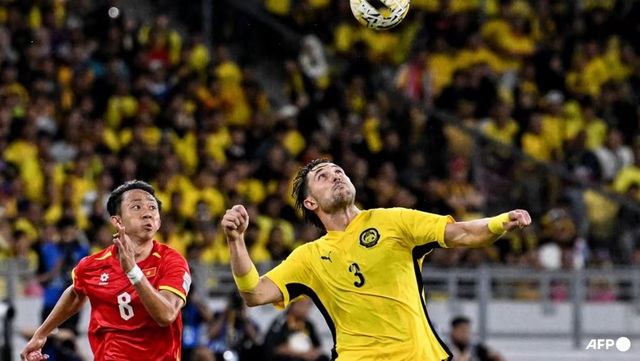
Vietnam's Chau Ngoc Quang (left) fights for the ball with Malaysia's Facundo Tomas Garces during the AFC Asian Cup qualifier Group F football match between Malaysia and Vietnam at the National Stadium Bukit Jalil in Kuala Lumpur on Jun 10, 2025. Argentina-born Facundo is one of seven players who have been suspended by FIFA. Photo: AFP
Naturalisation itself is not the problem
There is nothing inherently illegitimate about a country selecting a player who has lived there for years, developed a genuine connection to the country or has legitimate family heritage.
The problem begins when citizenship and sporting eligibility become transactional, and when the administrative system is willing to bend the rules in pursuit of immediate results.
Vietnam offers a different version of the same phenomenon.
The defending ASEAN champions have increasingly incorporated naturalised players who have spent substantial periods playing in the domestic league.
Brazilian-born Rafaelson became Nguyen Xuan Son after acquiring Vietnamese citizenship following five years of residence and subsequently played a starring role in Vietnam's 2024 ASEAN Championship triumph.
In 2026, another Brazilian-born V.League veteran, Geovane Magno, received Vietnamese citizenship and adopted the name Nguyen Tai Loc.
His naturalisation followed years of playing in Vietnam and was therefore fundamentally different from a player being imported immediately for competitive purposes.
These examples reveal that "foreign player" is becoming an increasingly inadequate description of how national teams are assembled.
There is a spectrum.
At one end are purely homegrown players: footballers developed almost entirely within their country's academies and domestic competitions.
Then come diaspora and mixed-heritage players: footballers raised overseas who possess legitimate family connections to the country they represent. They may have little developmental history in the domestic system, but they can bring elite training and tactical education.
Next are residency-based naturalised players: foreigners who have lived and worked in the country long enough to establish a genuine connection and satisfy eligibility requirements.
At the far end lies expedient naturalisation: the acquisition of eligibility primarily as a competitive shortcut, with weak links to the country's footballing ecosystem and, in the worst cases, inadequate administrative scrutiny.
The distinction matters because external talent can solve one problem without solving another.
It can raise a team's ceiling. It cannot, by itself, raise the floor.
That floor is built domestically: academies, coaching, refereeing, sports science, youth competition, facilities and the quality of the local league. It is also built by exporting the best young players early enough that they learn to compete in stronger environments.
This is where Southeast Asian football needs to shift its thinking. The objective should not be to choose between "homegrown" and "foreign."
It should be to create a system in which homegrown players become internationally competitive, while overseas talent accelerates the process rather than replacing it.
For Southeast Asian football, the real question is therefore not whether a national team should use foreign-born players. It is whether those players are being used to build a bridge or to avoid building a road.
Indonesia's diaspora strategy has shown how quickly a national team can climb when it connects itself to a global talent pool.
Vietnam's naturalisation of long-term domestic-based players shows another route.
Malaysia's eligibility scandal demonstrates the institutional danger when the pursuit of results overwhelms governance.
But none of these approaches eliminates the underlying challenge. Eventually, a national team must have enough depth that losing its overseas stars does not cause the entire structure to collapse.
So can a purely homegrown Southeast Asian team reach the World Cup? Perhaps. But that may be the wrong question.
The more realistic ambition is to build a Southeast Asian football system in which the distinction between "homegrown" and "foreign" becomes less important than where players were developed, how good their training was, and how effectively the domestic system can reproduce that quality.
The countries most likely to reach the World Cup will not necessarily be those that reject foreign influence - or those that embrace it most aggressively. They will be the ones that understand the difference between a shortcut and a bridge.
Use overseas talent to raise the ceiling. Build the domestic game to raise the floor. Eventually, the two have to meet.








Max: 1500 characters
There are no comments yet. Be the first to comment.