


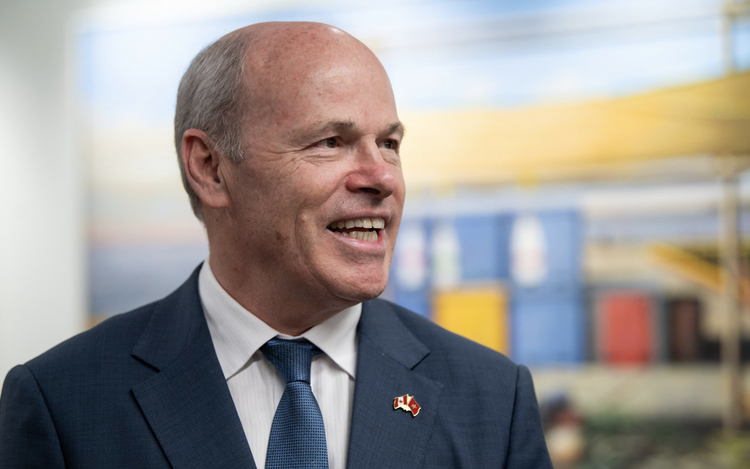
Canadian Ambassador to Vietnam Jim Nickel. Photo: Nam Tran / Tuoi Tre
In an interview with the media ahead of the top Vietnamese leader’s visit to Canada, Ambassador Nickel outlined Ottawa’s expectations for the occasion -- further strengthening the bilateral relationship in line with its substantive nature and the two countries’ vast potential.
“For Canada, this is a historic visit,” Ambassador Nickel said.
“We have never hosted Vietnam’s Party chief and president, so this is the first time in more than 50 years of Vietnam-Canada diplomatic relations.
“That in itself is already a milestone.”
The 2017 comprehensive partnership framework has provided a broad foundation for bilateral cooperation.
The partnership spans a wide range of areas, including trade, investment, defense and security, culture, education, science and technology, and innovation.
Ambassador Nickel described the framework as ‘very effective and very practical,’ while stressing that significant room for further cooperation remains.
In his view, the visit will provide additional political momentum to turn existing areas of cooperation into concrete projects, investment flows, and tangible results.
Asked about specific agreements or breakthroughs expected during the visit, Ambassador Nickel did not disclose a list of documents.
Instead, he highlighted opportunities in agriculture, energy, innovation, defense and security, law enforcement, multilateral and regional cooperation, as well as cultural, people-to-people and academic exchanges.
Vietnam as key partner in Southeast Asia
From Canada’s perspective, Vietnam’s importance extends beyond bilateral ties.
Ambassador Nickel repeatedly described Vietnam as a leading partner in Southeast Asia, Canada’s most important trade partner within ASEAN, and a ‘gateway’ for Canada to expand its presence in the region.
This assessment is closely linked to Vietnam’s increasingly prominent role in global supply chains.
With its rapidly developing manufacturing sector, strong growth, and ambition to move into high-technology industries, Vietnam is viewed by Canada as a key link in its strategy to diversify markets, reduce dependence on any single economy, and strengthen resilience against international disruptions.
“Diversifying economic partners and building economic resilience are shared goals. Canada sees Vietnam as a like-minded partner in building a resilient economy,” he said.
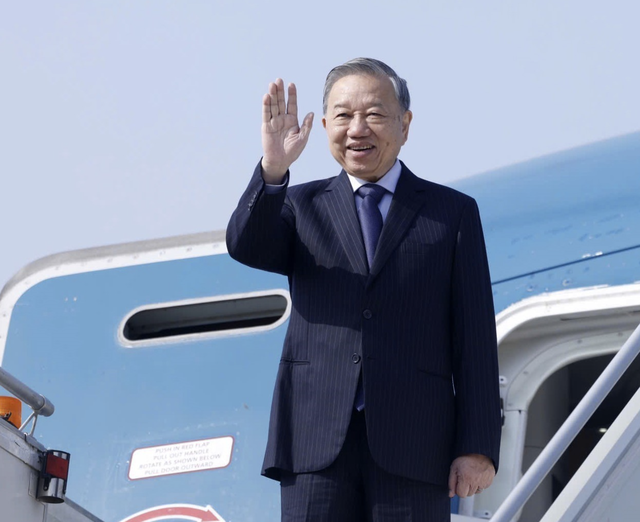
Vietnam’s Party chief and President To Lam. Photo: Vietnam News Agency
Expectations go beyond trade
Economic cooperation is currently one of the most visible strengths of Vietnam-Canada relations.
According to figures cited by Ambassador Nickel, two-way trade doubled over five years, rising to US$14.7 billion from $11.2 billion between 2024 and 2025.
Building on this momentum, Canada aims to double bilateral trade and investment again over the next five years or longer.
Achieving that goal will require not only expanding the range of traded goods but also creating a transparent and predictable investment environment, supported by a robust legal framework and a judicial system capable of giving investors confidence, the diplomat said.
Canada hopes to see more Canadian companies participate in infrastructure, energy, and agricultural projects, as well as in international financial centers in Ho Chi Minh City and Da Nang.
Besides, Ottawa would welcome greater Vietnamese investment in Canada.
“Canada is ready to share its experience in regulatory reform, in building strong legal frameworks for financial institutions, and in developing judicial systems,” Ambassador Nickel said.
Vietnam’s political stability, together with greater transparency in governance and institutional reform, could help attract high-quality investment from Canada and around the world.
With both countries committed to achieving net-zero emissions, energy transition is another area where Canada sees substantial potential for cooperation.
Ambassador Nickel said Canada is currently a clean-energy power, with 82 percent of its electricity generated from green energy sources, while some provinces use 100 percent renewable energy.
He said Canada is prepared to share expertise and technology in electricity grids, renewable energy and, in particular, nuclear technology to support Vietnam’s energy transition.
“We would welcome and encourage Vietnam to invest in Canada’s energy sector to secure its own energy supply,” he said.
“If Vietnam takes stakes in Canadian energy projects or signs long-term agreements with Canada, that would be a very good way to secure Vietnam’s energy supply and its energy future.”
Science and technology, as well as aerospace, are areas that Ambassador Nickel believes could help transform the two economies.
Canada has strengths in artificial intelligence, quantum computing, and semiconductors that Vietnam has identified as priorities.
In addition, the rapid expansion of Vietnam’s aviation industry is creating opportunities for Canadian aerospace and satellite-manufacturing companies to deepen cooperation with Vietnamese partners.
Vietnam’s hosting of APEC 2027 on Phu Quoc Island is also viewed by Ambassador Nickel as an ‘excellent opportunity’ for the country to demonstrate leadership on key issues such as digital transformation and food security.
Canada fully supports Vietnam’s hosting of APEC 2027 and plans to draw on the Vietnamese experience as it prepares for its own APEC year in 2029.
Party General Secretary and State President Lam, along with a high-ranking Vietnamese delegation, departed Hanoi on Sunday morning to attend the high-level general debate of the 81st session of the United Nations General Assembly (UNGA 81), engage in bilateral activities in the U.S., and pay a state visit to Canada at the invitation of Canadian Governor General Louise Arbour.
The trip will take place until September 25.


Max: 1500 characters
There are no comments yet. Be the first to comment.