


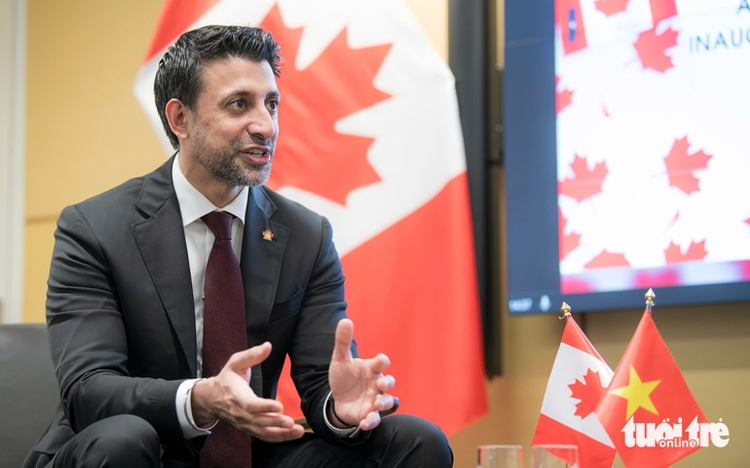
Canadian Minister of International Trade Maninder Sidhu. Photo: Nam Tran / Tuoi Tre
During his recent working visit to Vietnam, Sidhu identified agriculture, energy, infrastructure, and aerospace as key areas for expanded collaboration and reaffirmed Canada's commitment to creating favorable conditions for Vietnamese investors.
Vietnam is an increasingly important partner for Canada, with bilateral ties strengthening steadily in recent years, he added.
CPTPP gains, defending rules-based trade
When the Comprehensive and Progressive Agreement for Trans-Pacific Partnership (CPTPP) took effect in 2018, two-way trade stood at CA$6.5 billion (US$4.8 billion).
It has since more than doubled to over CA$15 billion ($11 billion), reflecting strong growth in bilateral commerce.
Despite the momentum, Sidhu said significant room remains for further expansion, particularly in agriculture.
Amid mounting pressure on the global free trade order, he congratulated Vietnam on serving as CPTPP chair this year and stressed shared priorities in upholding rules-based trade.
He noted that Canada's prime minister had underscored at the World Economic Forum in Davos the need for countries to work together to safeguard the multilateral trading system.
Concluding the ASEAN–Canada Free Trade Agreement would be a concrete step forward, he said. As a key ASEAN member, Vietnam plays an important role in advancing negotiations, and Canada hopes to work closely with Hanoi to finalize the pact.
Expanding the network of free trade agreements is essential as rules-based trade faces growing challenges, he added.
Seeking greater investment from Vietnam
Sidhu highlighted Canada's Major Projects Office initiative, launched in June 2025 to accelerate approvals and construction of large-scale projects.
Under the plan, permits for major energy, mining, and port infrastructure projects — worth an estimated CA$150 billion ($110 billion) — are expected within two years, shortening procedures and bringing projects online more quickly.
The move would boost supplies of energy and critical minerals to global markets while reinforcing infrastructure that supports trade with partners such as Vietnam.
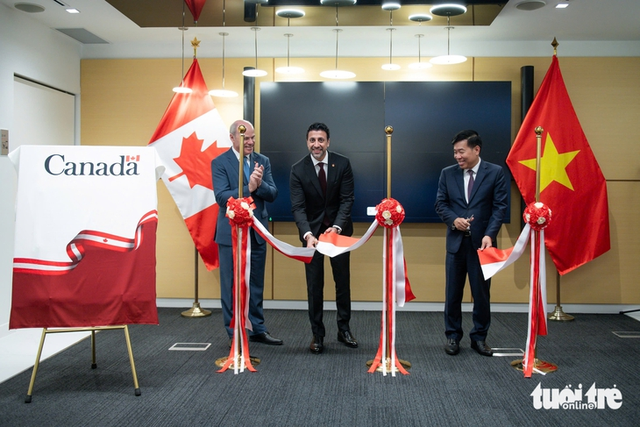
Deputy Minister of Foreign Affairs Nguyen Manh Cuong (R) and Minister Maninder Sidhu (C) cut the ribbon to inaugurate the Embassy of Canada’s office in Vietnam at Capital Place, 29 Lieu Giai Street, Hanoi. Photo: Nam Tran / Tuoi Tre
Canada is promoting competitive tax incentives, with an effective rate of 13.2 percent — the lowest in the G7 — to enhance its appeal to foreign investors, including those from Vietnam.
During his visit, Sidhu met leaders of Petrovietnam to discuss potential investment in liquefied natural gas projects and cooperation in nuclear energy, affirming that Canada stands ready to welcome Vietnamese capital with supportive tax and policy measures.
He said Canada aims to attract trillions of Canadian dollars in foreign direct investment to drive growth and encouraged more business and investment delegations between the two countries.
Drawing on his 13 years in the private sector before entering politics, Sidhu said stronger enterprise-to-enterprise exchanges would unlock new avenues of cooperation.
Complementary sectors from agriculture to aerospace
Sidhu said the two economies are largely complementary rather than directly competitive.
In agriculture, Canada can supply products such as beef, maple syrup, and apples to meet rising demand in Vietnam as incomes increase and the middle class expands.
As Vietnam's economy grows, rising incomes and an expanding middle class are driving stronger demand for business and leisure travel, creating opportunities for cooperation in the aerospace sector.
He noted that Montréal-based CAE Inc., a global leader in civil aviation simulation and training technology, partners with aircraft manufacturers including Bombardier.
De Havilland Canada also produces DHC aircraft models that are already familiar in Vietnam.
In wrapping up the interview, Sidhu extended Lunar New Year (Tet) wishes to the Vietnamese people ahead of the holiday, which lasts a week from Tuesday.








Max: 1500 characters
There are no comments yet. Be the first to comment.