


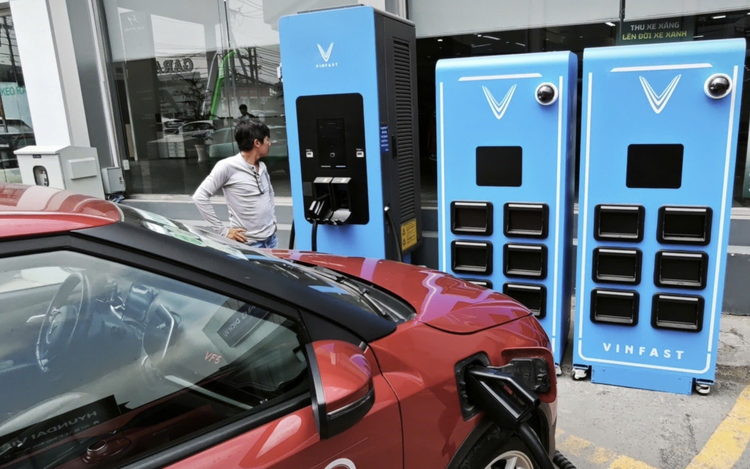
Many firms are making strong investments in charging infrastructure in Vietnam. Photo: Cong Trung / Tuoi Tre
Automakers, infrastructure developers, and property owners are all rushing to stake a claim in what is quickly becoming one of the most dynamic infrastructure segments in the Southeast Asian country’s green transition.
Battery swapping is emerging as a particularly attractive model.
Unlike conventional charging, which requires users to wait for batteries to recharge, swapping allows a fully charged battery to be replaced in just a few minutes, significantly improving convenience and uptime.
Leading the charge is VinFast, currently the largest player in Vietnam’s electric motorcycle market.
The company offers three models compatible with its swapping ecosystem: Evo, Feliz II, and Viper.
Customers can either purchase vehicles with batteries included or opt for a subscription model.
Battery rental is priced at VND175,000 (US$6.7) per month for one battery and VND300,000 ($11.4) per month for two batteries, while each swap at a station costs VND9,000 ($0.34).
VinFast’s infrastructure arm V-Green is rapidly scaling its network.
The company was set to deploy 45,000 battery-swapping cabinets across 34 provinces and cities in the first quarter of 2026.
As of mid-January, about 4,500 swapping stations had already been installed nationwide.
This pace signals a shift in strategy among manufacturers, who are increasingly treating charging infrastructure not as a secondary service but as a core component in customer retention and ecosystem control.
Meanwhile, Selex Motors is carving out a niche in high-utilization segments such as delivery, logistics, and urban services.
The company currently operates around 118 swapping stations in Hanoi, Ho Chi Minh City, and Hue, with plans to expand to 1,000 stations in 2026.
The firm is also partnering with fuel giant Petrolimex to integrate battery-swapping cabinets into petrol stations, paving the way for multi-energy service hubs that cater to both traditional and electric vehicles.
The participation of Japanese vehicle makers is also heating the market up.
Honda has launched its ICON e: model and is preparing to roll out the Honda e: Swap Battery Station system from April.
By June, the company also plans to introduce centralized charging stations at dealerships with 1,200W charging capacity.
Yamaha, meanwhile, is developing its own battery-swapping network, piloting operations in Hanoi and Ho Chi Minh City through Yamaha Town outlets and local partner ZuttoRide Vietnam.
Charging demand surges
Infrastructure providers are reporting a sharp increase in demand as rising fuel costs push consumers and businesses toward electrification.
An Dinh Nha, CEO of An Gia Green Energy JSC, said requests for charging pole installations have surged fivefold compared to previous periods, prompting the company to expand partnerships to keep up with demand.
Fast+ Charging Station JSC also reported staffing increases and round-the-clock construction schedules to meet installation deadlines.
Huynh Tien Dat, CEO at EV One Charging Equipment and Solutions JSC, noted that tightening environmental regulations in cities will further accelerate the shift toward electric mobility, driving sustained demand for charging infrastructure.
Adding to the momentum, Gogoro, Taiwan’s leading battery-swapping operator, has confirmed plans to enter Ho Chi Minh City this year, with pilot operations expected in the second quarter.
The company brings extensive experience, operating more than 2,700 GoStation swap stations and serving over 650,000 users in Taiwan, supported by a fleet of around 1.4 million smart batteries and some 370,000 daily swaps.
The boom is no longer limited to automotive companies.
Not only major automakers, but many other businesses are also joining the race.
Recently, TNG Investment and Trading Joint Stock Company submitted a plan to its 2026 annual general meeting of shareholders to add solar energy and electric vehicle charging station services to its business lines.
This growing participation signals a broader transformation: electric vehicle infrastructure is evolving into a standalone investment sector, attracting capital from diverse industries seeking early positions in the green mobility supply chain.
Ho Chi Minh City accelerates roll-out
At an early April press briefing, Luu Van Tan, head of the waterway management division under the Ho Chi Minh City Department of Construction, reported that the city now has over 9,730 electric vehicle charging stations, including bus charging facilities with 153 fast-charging poles and four CNG refueling stations.
The city also counts around 300 fast-charging stations and 2,459 battery-swapping points for electric motorcycles.
Expansion is ongoing, with 1,005 sidewalk locations already hosting 1,539 battery cabinets.
Rising demand has also prompted several residents and businesses in Ho Chi Minh City to reach out to install car charging stations or electric motorcycle battery-swapping cabinets.
Military tensions involving the United States, Israel, and Iran in the Middle East since late February have disrupted global fuel supplies, as about 20 percent of the world's oil passes through the Strait of Hormuz between Iran and Oman.
Gasoline and diesel prices have risen sharply worldwide.








Max: 1500 characters
There are no comments yet. Be the first to comment.