


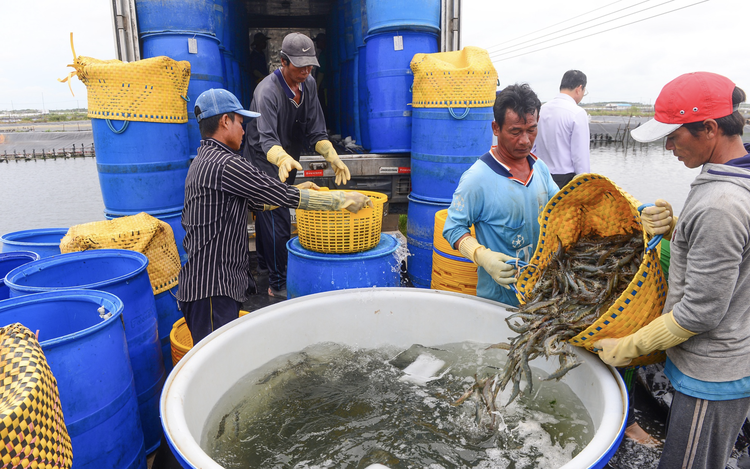
Farmers harvest shrimp in Vietnam’s Mekong Delta region. Photo: Quang Dinh / Tuoi Tre
The Vietnam Association of Seafood Exporters and Producers (VASEP) cited data from China's customs authorities as reporting that China imported nearly 85,460 metric tons of shrimp in May alone, a 15-percent year-on-year increase.
During the first five months of 2026, China's shrimp imports reached over 429,070 metric tons, up 25 percent year on year.
Its import value climbed 21 percent to US$2.207 billion.
Ecuador remained China's largest shrimp supplier, exporting 328,740 metric tons during the January-May period, a 29-percent increase from a year earlier.
India ranked second with 62,100 metric tons, up 31 percent, followed by Thailand, Indonesia, and Argentina.
Although Ecuador and India dominated the Chinese market in terms of volume, VASEP said China's expanding import demand represented a positive signal for other exporters, including Vietnam, particularly in higher-value shrimp products.
Vietnam's shrimp exports rose 12 percent in January-May.
Exports to mainland China and Hong Kong generated more than $711 million, up 46 percent from the same period last year, accounting for nearly 38 percent of the country's total shrimp export revenue.
Steady demand for frozen shrimp, combined with strong growth in lobster exports, has been a major driver of Vietnam's seafood sales to the Chinese market.
According to VASEP, China has mainly imported lobsters, black tiger shrimps, and other high-end shrimp products from Vietnam.
Vietnam’s exports of live, fresh, and frozen shrimp surged 97.2 percent in 2025, underscoring China's growing appetite for premium seafood.
China was Vietnam's largest shrimp buyer last year, with imports valued at $1.23 billion, up 60.8 percent from 2024.
US market still poses challenges
Vietnam's shrimp industry achieved a record export turnover of $4.6 billion in 2025, an increase of 19 percent compared with 2024, according to Vietnam Customs data.
Exports to the United States reached $796 million, rising 5.4 percent year on year and accounting for 17.2 percent of total shrimp export earnings.
However, VASEP said that Vietnamese exporters continued to face significant challenges in the U.S. market, including reciprocal tariffs, countervailing duties, and the ongoing risk of anti-dumping measures.
Also, U.S. importers are likely to reduce purchases toward the end of the year as they adjust inventories and refine business strategies, adding further uncertainty to export prospects.
Therefore, China, the European Union, and member countries of the Comprehensive and Progressive Agreement for Trans-Pacific Partnership are expected to remain the primary growth engine for Vietnam's shrimp industry in 2026.
According to VASEP, Vietnamese exporters are unlikely to compete successfully on price alone.
Instead, the industry should capitalize on its strengths in product quality, traceability, advanced processing, and value-added seafood products that are expected to offer substantial growth potential in the Chinese market over the coming years.








Max: 1500 characters
There are no comments yet. Be the first to comment.