


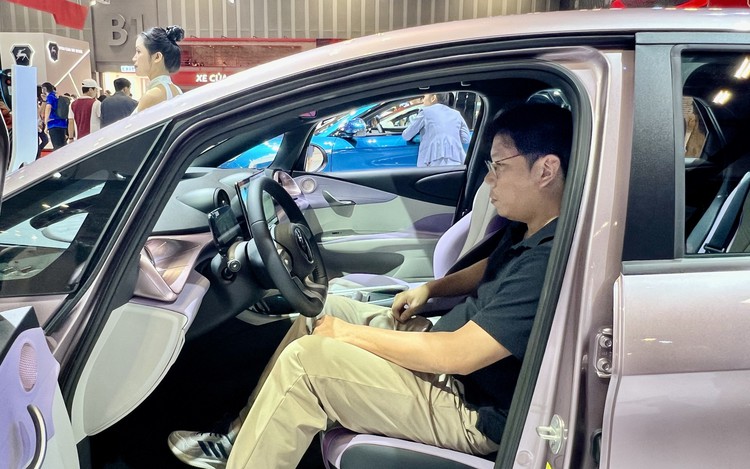
A visitor sits inside a Chinese car at an auto exhibition in Vietnam. Photo: T.N.
An automotive expert said the composition of Chinese imports reflects the domestic market's growing shift toward electrified vehicles.
From January to October, Vietnam imported 212,339 completely built-up cars, up 26.6 percent from a year earlier, according to Vietnam Customs data.
Indonesia, China, and Thailand remained the country's three largest sources of imported cars, accounting for 95 percent of the total imports.
Shipments from Indonesia totaled 89,362 units, up 37.1 percent year on year, while China ranked second with 56,299 units, up 44.2 percent, followed by Thailand with 54,532 units, down 5.1 percent.
In October alone, Vietnam imported 19,187 completely built-up cars, down 6,108 units from the previous month.
Of the total imports during the 10-month period, passenger cars with up to nine seats accounted for 148,841 units, up 14.5 percent year on year, while trucks totaled 37,517 units, up 66.9 percent.
Imports of other types of vehicles increased by 28.5 percent.
Import mix reflects growing shift toward electrification
Assoc. Prof. Dr. Do Van Dung, chairman of the Ho Chi Minh City Society of Automotive Engineers, told Tuoi Tre (Youth) online newspaper that Indonesia remains Vietnam's leading source of imported cars by volume, thanks to affordable mass-market models such as the Toyota Yaris Cross, Mitsubishi Xpander, and Mitsubishi Xforce, which are mainly gasoline-powered or mild hybrids.
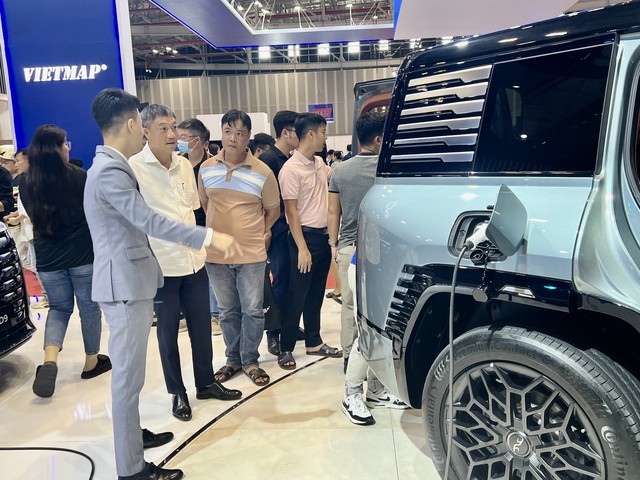
Visitors look at an electric car at an auto exhibition in Vietnam. Photo: T.N.
Chinese vehicles, however, have a higher average import value than those from Indonesia and Thailand, reflecting a greater share of commercial vehicles and more technologically advanced electrified models rather than just traditional low-cost cars.
Dung also pointed out that Chinese car imports rose sharply in the January-October period while imports from Thailand edged down.
He said all these developments reflect the rapid growth of vehicle electrification in Vietnam.
This is a clear sign of China's expanding global exports of new energy vehicles (NEVs), as Chinese automakers, including MG, Wuling, BYD, Chery and Zeekr, continue to introduce new electric and hybrid models in Vietnam.
Vietnam's domestic market is also undergoing rapid electrification, led by local EV maker VinFast, which delivered more than 200,000 electric cars in the first 10 months of 2026.
Dung noted that Chinese imports are adding more hybrid and higher-end electric vehicle options, increasing competition and diversifying the market.
Consumers are increasingly paying attention to technology, performance, and operating costs rather than simply low prices, particularly as incentives for electric vehicles have been extended through 2030, he noted.
Vietnam's auto market is therefore moving toward electrification along two parallel paths: domestic electric vehicle production led by VinFast and imports of new energy vehicles and hybrids from China, Dung said.




Max: 1500 characters
There are no comments yet. Be the first to comment.