


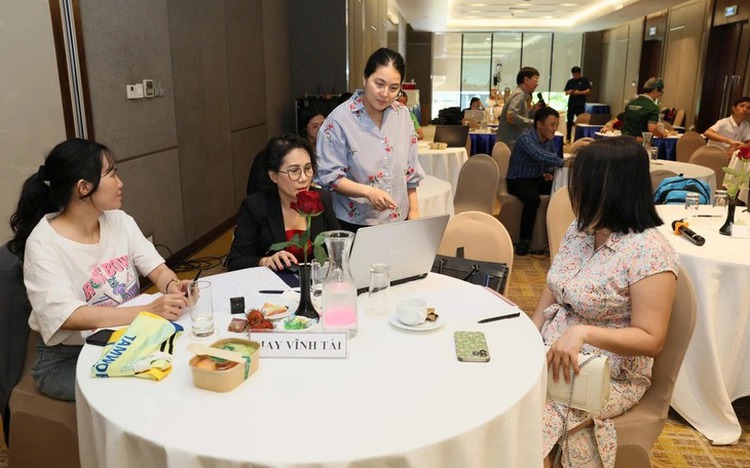
Participants engage in a circular economy class organized by Yunus Environment Hub Vietnam for Vietnamese enterprises. Photo: Supplied
The program is delivered through Yunus Environment Hub Vietnam, which partners with the Germany-based Yunus Global Social Business Network and operates as a mission-driven social enterprise focused on innovative solutions to social and environmental challenges.
Classes under the program are underway in Ho Chi Minh City to help Vietnamese companies meet sustainability requirements and extended producer responsibility obligations.
With support from the German and Dutch governments, the initiative also aims to help businesses comply with evolving regulations while generating positive environmental and social impacts.
About 90 percent of the program’s funding comes from the German government through the German Corporation for International Cooperation, which represents the German Federal Ministry for Economic Cooperation and Development.
Experts say Vietnam is entering a period of accelerated transition toward a green growth model and a circular economy.
Phan Hanh Tam, director of Yunus Environment Hub Vietnam and the program’s coordinator, asserted that the circular economy should be viewed not only as an environmental solution but also as a business opportunity.
She noted that redesigning products and value chains according to circular principles can help companies reduce costs and risks while opening up new markets.
“This model does not focus solely on the end of a product’s life when it becomes waste," Tam said.
"Instead, it encourages businesses to rethink design from the outset to optimize costs, extend product life cycles, and reduce resource use."
She added that the initiative also promotes a more inclusive circular economy, particularly for vulnerable groups.
One example is the 'Accompanying Environmental Ambassadors’ project, which has trained more than 300 informal waste collectors and supplied them with protective equipment, helping boost their incomes.
Meanwhile, circular economy activities by Vietnamese businesses have already delivered tangible environmental and social benefits.
Refill store models have prevented more than 165,000 single-use plastic items from becoming waste, while generating employment opportunities for low-income workers.
NaNi Fashion recycles around 100 kilograms of leftover fabric each month into new accessories, providing jobs for 20 women and raising their incomes by 10–20 percent.
C2T Media Tourism, a circular eco-tourism model in Vinh Long Province, has reduced plastic waste by 90 percent and carbon emissions by 60–80 percent, while creating additional livelihoods for local communities.
Biti’s, a leading Vietnamese footwear brand, has launched a post-consumer collection system for shoes and fashion products, collecting 24.7 metric tons of waste in just six months.
Vietnam’s 2020 Law on Environmental Protection formally introduced the concepts of a circular economy and extended producer responsibility into the national legal framework.
This was followed by Government Decree No. 8 in 2022, which provides guidance for implementing the law, along with other regulations requiring businesses to collect and recycle packaging, plastics, electronics, and various post-consumer products.









Max: 1500 characters
There are no comments yet. Be the first to comment.