


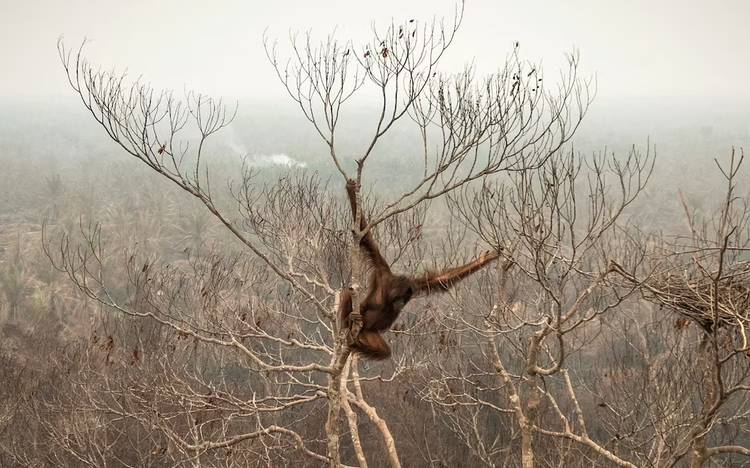
A drone view shows an orangutan hanging from a tree in a palm-oil plantation affected by wildfires before being rescued in Laman Satong village, Ketapang Regency, West Kalimantan, Indonesia, September 30, 2026. The intense wildfires, burning mainly on Borneo and Sumatra islands, began in July and could continue until November, aggravated by a severe El Nino weather pattern, the government has warned. Photo: Reuters
While a very strong El Niño was the dominant factor in determining the extremely low levels of rainfall across Indonesia from July, human-induced climate change contributed around 1.6 degrees Celsius of additional heat during the fire season, said a report by climate research group World Weather Attribution.
"The conditions that we saw this year would simply just not have happened in a world without the human contribution to climate change, even with the very strong El Niño that we're seeing," said Theodore Keeping, a researcher into wildfires and extreme weather at Imperial College London who contributed to the report.
"You have multiple different drivers changing in different ways, but what we can say with very high confidence is that the driving weather conditions of these fires are getting more severe," he told a briefing.

Pramudhian Firdaus, a wildfire researcher at Melbourne University, said September 2026 was Indonesia's fifth-driest September since 1991, with rainfall below normal levels across 84% of the country.
Decades of land-use change, involving extensive deforestation and the draining of flammable peatland to make way for industry and agriculture, also compounded this year's fire outbreaks.
"Indonesian landscapes have changed dramatically over the last 30 years, with extensive peatland drainage and deforestation creating a landscape that is extremely vulnerable to ignition," Firdaus said.
According to data released on Thursday by the independent geo-monitoring platform Nusantara Atlas, almost 2.88 million hectares of Indonesian territory was affected by fire from January to October 2026, rising nearly 1 million hectares in October alone.
The amount of fire-damaged land in the first three quarters of this year was 35% higher than in the same period of 2019, the last year Indonesia faced strong "super-El Nino" conditions, Nusantara Atlas said.


Max: 1500 characters
There are no comments yet. Be the first to comment.