


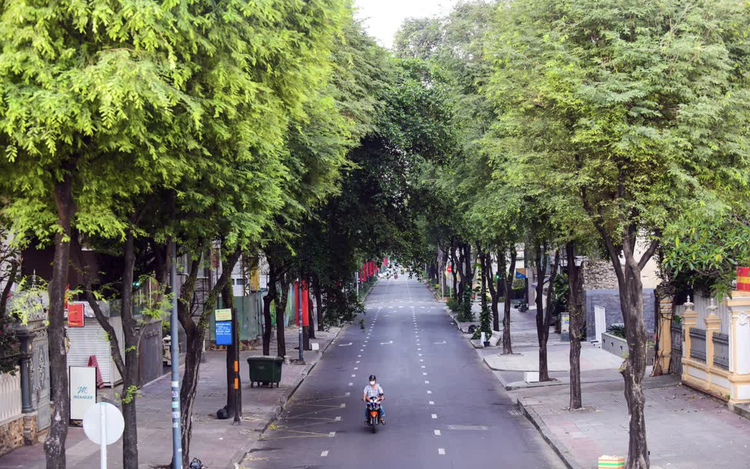
A street in Ho Chi Minh City. Photo: Quang Dinh / Tuoi Tre
Wealth, in its simplest sense, is the accumulation of assets, meaning more money, greater property, and broader consumption choices.
Yet within a family, prosperity – what might loosely be called affluence with dignity – is not merely about having more, but about how wealth is acquired and how it is lived with.
True prosperity seems to carry its own quiet radiance.
It emerges when material sufficiency opens up a richer inner life: an ability to appreciate beauty, to share, and to empathize.
A prosperous family is not defined solely by spacious homes or luxury vehicles, but by laughter, by decency in how they treat employees, neighbors, and those less fortunate.
There is no need for ostentation or waste, but consumption is mindful, and life is lived with a sense of responsibility.
Wealth, in this sense, is not an end but a means – a way to make life fuller, kinder, and more meaningful.
From the scale of the household, the reflection extends naturally to the nation.
A country may grow rapidly, with GDP growth expanding, buildings mushrooming, infrastructure multiplying, and goods becoming abundant.
However, growth pursued at any cost risks becoming a collective form of mere wealth – an enormous accumulation of material output.
When growth is paired with widening inequality, environmental degradation, corruption, and entrenched interest groups, national wealth begins to resemble the fortune of an individual lacking grace.
It may be impressive on paper, even dazzling in its figures, but beneath the surface lie accumulated instabilities.
Citizens may feel insecure, uncertain about the future.
Such a society risks falling into the trap of ‘quick wealth’ – rising fast without a sustainable foundation.
Experience from some countries in East Asia offers a telling glimpse: periods of rapid economic expansion are often accompanied – sooner or later – by institutional reforms that broaden public participation, enhance transparency, and strengthen accountability.
These elements help transform wealth into genuine prosperity, shifting from material accumulation toward a stable, livable, and respected social order.
A prosperous nation does not necessarily grow the fastest.
Instead, it knows how to balance growth with other essential values: equity, democratic participation, respect for human dignity, and environmental protection.
In such a context, civilization is not a slogan but a lived quality embedded in both institutions and everyday life.
Like a truly refined family, a prosperous country is not preoccupied solely with how much it possesses.
It is equally concerned with sustainability, with how resources are distributed, how people treat one another and their communities, and what legacy is left for future generations.
In such a society, citizens may not be extraordinarily rich, but they enjoy a sense of security, with confidence in the rule of law, in the quality of their environment, and in the opportunities available to their children.
That sense of assurance is itself a form of intangible wealth, one not easily purchased.
Vietnam has made great strides in achieving high economic growth over recent decades.
Growth-oriented policies have helped mobilize resources and improve material living standards.
Now, as the country enters a new phase, the central challenge is how to gain high growth while ensuring that it is meaningful, durable, and sustainable.
It is clear that Vietnam is pursuing growth without sacrificing substance, meaning that growth must be sustainable and oriented toward prosperity.
Perhaps the same principle applies at the individual level.
A person or a family may not be the wealthiest, but if they live with decency, know how to share, appreciate life, and understand sufficiency, their life can still be full, resilient, and at ease.
Similarly, nations may not grow the fastest, but if they place people, fairness, and sustainability at the center, they move closer to true prosperity – a form of wealth with depth, and with a future.
* This article was originally written in Vietnamese by Dr. Le Vinh Trien and translated by Tuoi Tre News.








Max: 1500 characters
There are no comments yet. Be the first to comment.