


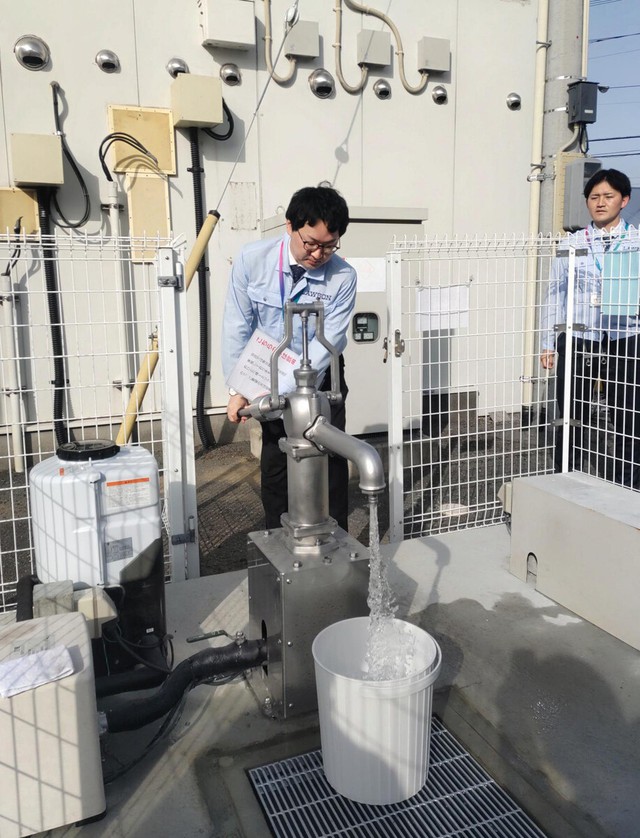
A well set up outside a Lawson disaster support store in Futtsu, Chiba Prefecture, Japan pictured on February 24, 2026. Photo: Jiji Press
By leveraging their nationwide store networks, convenience store operators aim to provide free access to communications services and electricity in emergencies.
They also plan to use in-store electronic displays to share the latest disaster information and urge people to evacuate if necessary.
Reliable presence
In February, Lawson Inc. renovated an existing store in Futtsu, Chiba Prefecture, eastern Japan, and reopened it as a "disaster support convenience store."
In normal circumstances, the outlet operates like any other convenience store. But in the event of a disaster-related power outage, it can use solar panels and storage batteries to provide visitors with free communications services and electricity.
If the water supply is disrupted, the store can distribute stockpiled drinking water and offer water drawn from a well next to the building for household use.
With Japan preparing for a potential megaquake in the Nankai Trough off its central and western Pacific coast, along with other possible disasters, Lawson plans to expand the number of stores equipped with similar capabilities to 100 by fiscal 2030.
"We want to be a presence people can rely on, a place where they feel, 'If you go to Lawson, somehow things will work out,'" company President Sadanobu Takemasu said.
During disasters, FamilyMart Co. plans to make use of the electronic displays installed in about 11,000 stores nationwide.
Normally used to advertise new products and promotions, the screens will instead encourage customers to stockpile food and beverages when a typhoon is approaching and provide emergency information, including evacuation instructions, immediately after an earthquake or tsunami.
In addition, the company plans a demonstration test in which vehicles selling products will be equipped with communication functions provided by major telecommunications operator NTT Docomo Inc., in preparation for situations in which disaster-related disruptions make radio signals difficult to receive.
Monitoring damage
Convenience stores themselves can suffer significant damage during disasters, making it essential for chain headquarters to establish systems that ensure business continuity.
Seven-Eleven Japan Co. operates an in-house system that monitors damage at individual stores, including power outages, in real time, 24 hours a day.
Since the system's launch about a decade ago, the company has continuously upgraded and refined it.
New functions now allow store owners to use smartphones to photograph conditions around their stores, such as heavy rain or snowfall, and share the images with headquarters.
The system enables stores to notify headquarters when they are unable to receive deliveries.
Decisions about whether to keep stores open during a disaster must be made with great care.
All major convenience store operators place top priority on human life, urging store owners to suspend operations and evacuate immediately if they sense danger.
Drawing lessons from the powerful earthquake that struck the Noto Peninsula in central Japan in January 2024, Seven-Eleven Japan is also strengthening support for franchisees by dispatching headquarters staff to confirm with store employees how they should respond in the event of a disaster.
To prepare for the possibility that its Tokyo headquarters could be damaged and rendered inoperable, FamilyMart established an alternative operations base in Osaka, western Japan, in fiscal 2025. The backup arrangement is intended to disperse risk and help ensure business continuity even during emergencies.
Nobuo Fukuwa, a professor emeritus at Nagoya University and an expert in disaster management and mitigation, said: "In rural areas, municipal mergers have reduced the number of administrative offices, while many banks and post offices have also disappeared. As a result, convenience stores have been left to address all kinds of local needs."
"Convenience store operators need to think more seriously about what is required to maintain community-wide services in ways that reflect the characteristics of each region," he added.









Max: 1500 characters
There are no comments yet. Be the first to comment.