


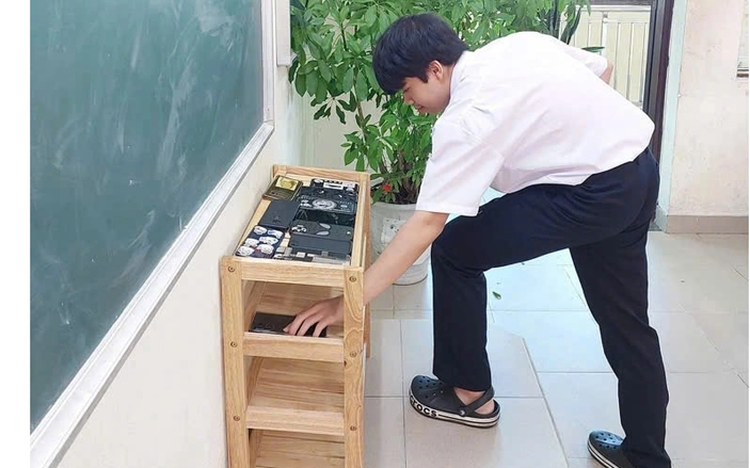
A student places his mobile phone on a shelf during class at Tran Phu High School in Da Nang City, central Vietnam. Under new regulations, classrooms in Hoa Vang Commune will be equipped with locked cabinets for storing students' phones. Photo: Dinh Hoa
The rules do not impose an outright ban but they are meant to ensure phones are used safely, appropriately, and primarily for educational purposes through coordinated supervision by schools and parents.
The temporary regulations, issued by the Hoa Vang Commune People's Committee on Monday, apply to students under 16 studying in the locality.
Pursuant to the new rules, students who bring mobile phones to school must switch them off or set them to silent mode and store them in cabinets provided in each classroom.
Phones may only be used with a teacher's permission for learning activities.
Each classroom will be equipped with a phone storage cabinet placed in a convenient and easily supervised location.
Schools are encouraged to install surveillance cameras to monitor the cabinets and incorporate the measures into their internal regulations.
Schools are prohibited from requiring students to own mobile phones for learning and must provide appropriate alternatives for those students who do not have digital devices.
Educational institutions are encouraged to use dedicated education-sector platforms for learning instead of social media.
They are also required to strengthen digital literacy and online safety education while gradually introducing digital citizenship and artificial intelligence education.
The regulations also require parents to supervise their children's phone use according to age, refrain from providing elementary school students with smartphones, monitor the online content their children access, encourage reading, sports, and face-to-face interaction, and work closely with schools in managing their students' phone use.
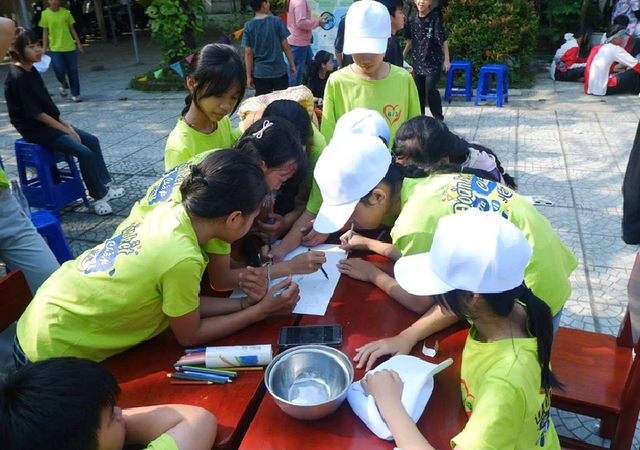
Teachers will notify parents in advance if mobile phones are needed for extracurricular or skills-based lessons. Photo: Ong Ich Duong Middle School
Le Phu Nguyen, chairman of the Hoa Vang Commune People's Committee, said the commune had found no other locality in Vietnam that had issued such detailed regulations.
He said early access to mobile phones and social media is increasingly unavoidable for children, but without proper guidance and supervision it can negatively affect learning, mental health, communication skills, while exposing the children to online risks.
"Our view is not to separate children from the digital world or completely ban the use of mobile phones and social media," Nguyen said.
"The important thing is to ensure they are used for the right purposes, at the right time, in ways appropriate to the children's ages, with support from both families and schools so that the digital environment becomes a tool for their development."
Le Dinh Minh Hai, head of Hoa Vang Commune's culture and social affairs office, said the commune sought feedback from more than 2,700 parents, school representatives, and relevant organizations before finalizing the regulations.
Hai said some parents initially worried that stricter phone management would make it difficult to contact their children in emergencies.
However, after officials explained that students would still be allowed to bring phones to school but their use would be managed rather than prohibited, most parents supported the policy.
He added that many parents had long wanted similar measures but they found them difficult to implement on their own. The regulations were designed to reduce excessive phone use while remaining practical, reasonable, and legally compliant.
Cap Phi Ha, principal of Tran Quoc Tuan Middle School in Hoa Vang Commune, welcomed the new rules, saying many incidents involving student conflicts inside and outside school had originated from social media groups.
He said the school had previously prohibited students from using phones on campus and required parents to sign written commitments, but it lacked a clear legal basis for consistent enforcement.

Le Phu Nguyen, chairman of the Hoa Vang Commune People's Committee, presents textbooks to students. Hoa Vang Commune becomes the first locality in Vietnam to provide free textbooks to all students from 2026, three years ahead of the target set by the Politburo. Photo: Chau Sa / Tuoi Tre
With the new regulations, the school will incorporate the measures into its internal rules, strengthen communication with parents, and implement them more effectively, Ha added.
Ha added that the school already has sufficient computers and teaching equipment, making it unnecessary for students to bring phones for classroom learning.
For extracurricular activities or skills lessons requiring mobile phones, teachers will notify parents in advance.
Tran Thi Xanh, whose child attends a middle school in Hoa Vang Commune, said the new regulations had eased the concerns of many parents.
She said her family had previously allowed their child to bring a phone to school for communication but worried the device might be used without permission, distract her child from learning, or expose the child to risks on social media.
Under the new rules, parents can still contact their children through the school in urgent situations, giving her greater peace of mind.








Max: 1500 characters
There are no comments yet. Be the first to comment.