


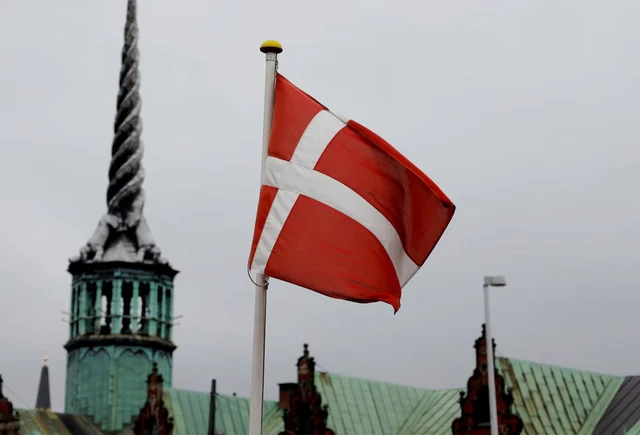
Denmark's national flag flutters in Copenhagen, Denmark, October 22, 2019. Photo: Reuters
Denmark has one of the world's most ambitious greenhouse gas reduction goals, aiming to slash emissions by 70% from 1990 levels, and the CCS project is seen as key to cut CO2 from hard-to-abate sectors such as cement.
"We can now take the decisive step toward realising a project that is not only significant in a Danish context, but is also among the largest industrial CO2 (carbon dioxide) capture projects in Europe," Aalborg Portland CEO Soren Holm Christensen said in a statement.
Traditional cement production is responsible for around 8% of global industry CO2, generating huge emission volumes not only from the coal used to heat kilns, but also during the process of converting limestone into clinker.
Aalborg Portland will receive 875 crowns per captured ton of CO2, corresponding to up to 1.1 billion crowns annually for 15 years, with the subsidies covering the capture, transport and storage of up to 1.25 million tons of CO2 annually, it said.
The company added it expects the project to account for more than half of the Danish CCS subsidy pool's overall target of capturing 2.3 million tons of CO2 annually from 2029.
Air Liquide will provide the capture technology for the project, while Harbour Energy will provide the transport infrastructure and storage, Aalborg Portland said.
The International Energy Agency says CCS technology can play a vital role in achieving global climate goals, but critics are questioning its commercial viability and say it can prolong the use of fossil fuels.
($1 = 6.4795 Danish crowns)
- REFERENCE MORE








Max: 1500 characters
There are no comments yet. Be the first to comment.