


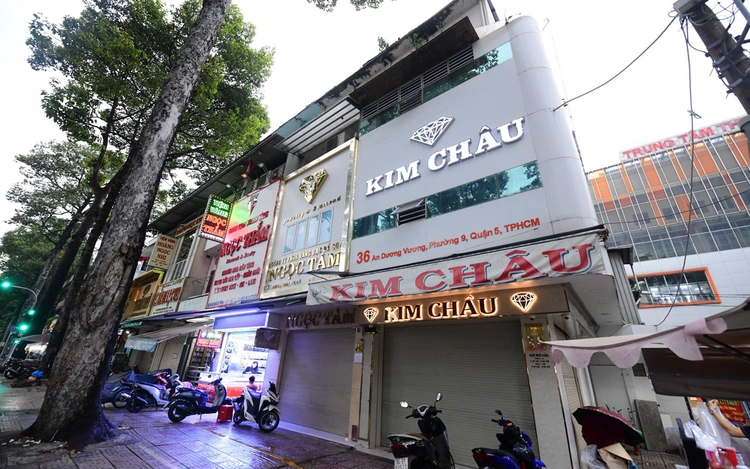
Multiple diamond stores shut down at the same time. Photo: Quang Dinh / Tuoi Tre
But the bigger question is not just about the smuggled gemstones themselves. It is whether Vietnam's high-value asset market is operating on a genuinely transparent foundation at all.
When diamonds, gold and other precious assets can be assigned values that appear strikingly out of step with their market worth, the issue goes beyond one smuggling case or one company's accounting practices. It raises broader questions about valuation, disclosure, oversight and whether the market's reported numbers can be trusted.
The latest developments therefore represent more than a crackdown on illicit trade. They are also a test of whether Vietnam can build a high-value asset market in which prices, ownership and transactions are transparent enough to command public confidence.
Systemic loophole in transparency
In less than a month, Vietnamese consumers have watched a domino effect unfold: a former director of an appraisal lab was charged with helping legitimize smuggled goods, three owners of well-known gold shops were charged, and one of the country's largest jewelry brands was forced to announce deferred customer payments of up to 120 days.
Behind figures running into the trillions of dong lies a fundamental question: When trust, the most valuable intangible asset of all, hangs in the balance, is the diamond market exposing loopholes that state oversight mechanisms never anticipated?
Speaking to Tuoi Tre (Youth) online newspaper, Deputy Minister of Industry and Trade Nguyen Sinh Nhat Tan confirmed the ministry had drawn up a plan for thematic inspections in the precious metals and gemstones sector.
Tran Viet Hung, head of the Market Management Division under the Department of Domestic Market Management and Development, said the department had finalized the plan and would initially apply it to five businesses, on the direction of the Anti-Money Laundering Department.
The inspections, mandated under Circular 27, cover everything from the origin of goods to price listing.
Yet Hung himself revealed a notable detail: Businesses under inspection are given at least seven days' advance notice of what the inspection will cover.
That's a lawful requirement. But in an industry that has just witnessed sophisticated schemes to 'legitimize' the origin of goods, advance notice of inspections inadvertently raises an uncomfortable question: can scheduled inspections really catch what organized criminals have gone to such lengths to conceal?
The investigation reveals just how wide the gap is between a routine administrative check and a well-organized criminal operation.

Investigative police execute an order to prosecute 4 defendants linked to the smuggling of more than 3,400 diamonds. Photo: Thanh Hoa Provincial Police
According to Thanh Hoa Provincial Police, from 2022 to 2024, Le Thuy Hang, then general director of Saigon Jewelry Company Limited (SJC), directed Pham Thi Hong Duyen, then head of the company's sales department, to order smuggled diamonds from Hong Kong and illegally transport them into the country.
To conceal their origin, Duyen used the personal information of numerous customers, entering it into the management system under the guise of "buying back from individual customers," turning smuggled goods into goods with valid paperwork before sending them to SJC Golden Dragon Company, SJC's own certification unit, to complete the warehousing procedures.
The suspects even split the diamonds into smaller batches for each round of certification to avoid drawing attention.
Through this series of schemes, the ring smuggled more than 3,400 diamonds, estimated to be worth over VND500 billion (US$18.9 million), straight into the retail system of one of Vietnam's oldest jewelry brands.
That wasn't the only ring.
Also according to Thanh Hoa Provincial Police, an earlier case saw Le Thi Ngoc My, owner of Kim Ly gold shop; Nguyen Thi Lien, owner of Ngoc Tam gold shop; and Hoang Thi Thanh Nga, owner of Ngoc Chau Au gold shop, along with a certification staff member at PNJ-LAP, charged with colluding with contacts in India to organize illegal diamond shipments through Tan Son Nhat, Da Nang, Noi Bai and Phu Quoc airports.
The group allegedly traded through WhatsApp groups using self-deleting messages and agreed to confirm payments by citing serial numbers on U.S. dollar bills.

Selling pressure has surged sharply for gold brands, including SJC and PNJ, in recent days. Photo: Thanh Hiep / Tuoi Tre
Trust collapses faster than gemstone value
If the loophole lies within the certification system, the immediate fallout could be a crisis of confidence spreading across the retail market, one in which thousands of ordinary customers, not just a handful of large businesses, bear the brunt.
In just a few weeks, a wave of diamond stores in Ho Chi Minh City has shut down or posted notices of temporary suspension lasting anywhere from two weeks to a month, particularly along An Duong Vuong, Tran Hung Dao, and Le Thanh Ton Streets, where many long-standing jewelry shops are concentrated.
PJA Kim Cuong - Diamond and Jewelry, a well-known brand, announced it was suspending operations from July 17, admitting it had tried to maintain liquidity for 45 days but couldn't turn the situation around in the face of a surge in resale customers.
In My Tho, southern Dong Thap Province, Hong Phuc gold shop also suspended operations to 'restructure' amid the unforeseen disruption.
Even Phu Nhuan Jewelry Company (PNJ), Vietnam's largest jewelry manufacturer and retailer with 431 stores as of the end of 2025, was not spared from the upheaval.
Phan Quoc Cong, PNJ's general director, admitted at a press conference on July 21 that the company was under liquidity pressure, despite having set aside tens of millions of U.S. dollars for its buyback program.
According to him, since July 3, when the P-Lab certification controversy came to light, PNJ's total buyback volume has run five times higher than sales of new products.
"At first we thought this was an isolated incident. But by now, we have to admit this is an industry-wide problem," Cong said.
Starting July 21, PNJ rolled out a deferred payment policy of 120 days, split into five installments, for both gold and diamond buyback transactions nationwide.
For customers, the change came as a shock.
One customer in Bay Hien Ward, Ho Chi Minh City, brought a diamond ring she'd bought for VND196 million ($7,400) to sell back at a PNJ store on Hai Ba Trung Street.
It was appraised for buyback at VND180 million ($6,800), but she'd have had to wait to be paid under the new schedule.
In the end, she chose to exchange it for blister-packed gold rings instead, so she could get the asset immediately rather than wait four months.
Meanwhile, another customer in Binh Thanh, who had no intention of selling, still brought a diamond ring she'd bought years earlier to a PNJ store on Nguyen Xi Street to cross-check the serial number on the GIA certificate against the laser inscription on the stone.
That skepticism is well-founded.
Nguyen Thi Thu Huong, a financial advisor, recommended that diamond owners not rush into decisions based on herd mentality, and instead proactively review their documentation, cross-check certificates, and communicate directly with the seller about after-sales policy.
Tran Nguyen Dan, a lecturer at the University of Economics Ho Chi Minh City, said the P-Lab incident has damaged not only the reputation of a single entity but also raised questions about oversight of the country's entire gemstone certification system.
Online verification currently confirms only that a certificate number exists; it does not establish that the stone accompanying the certificate is actually the one for which the certificate was issued.
On the stock market, PNJ shares have fallen about 46 percent in just a month, down to around VND35,500 ($1.34) per share.
According to KB Securities Company, the immediate risk to PNJ lies mainly in brand reputation and consumer sentiment rather than direct financial impact, given that PNJ has affirmed the diamonds in question never entered the company's system.
3 things to keep in mind when buying diamonds
According to Tran Nguyen Dan, a lecturer at the University of Economics Ho Chi Minh City, while the management and oversight mechanism remains incomplete, consumers need to proactively protect themselves in diamond transactions.
For diamonds valued at hundreds of millions of dong or more, he recommended prioritizing reputable international certificates such as GIA or IGI.
Certification and shipping costs for a one-carat natural diamond sent to GIA run around $150-300, only 1.5-5 percent of the stone's value, but enough to significantly reduce the risk of buying a diamond that's been swapped out or is synthetic.
In the tens-of-millions-of-dong price segment, many buyers are still reluctant to pay this cost, leaving the risk of misrepresentation higher.
He also noted the need to distinguish between an appraisal certificate, the result of a technical assessment by a third party, and a seller's commercial commitment. The two cannot substitute for one another.
Before a transaction, buyers should ask directly whether the certifying organization has any relationship with the seller.
Although the P-Lab incident has dented trust in the short term, Dan believes it's also a chance for Vietnam's diamond market to build a more transparent and reliable certification system.









Max: 1500 characters
There are no comments yet. Be the first to comment.