


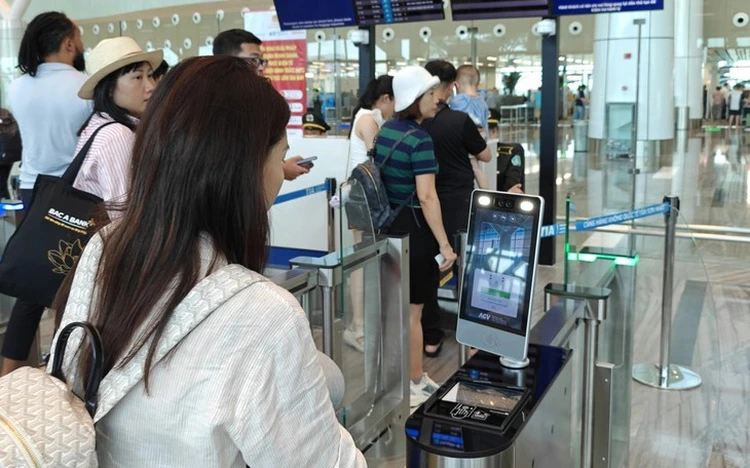
Passengers undergo facial authentication to board a flight at Tan Son Nhat International Airport in Ho Chi Minh City instead of presenting paper documents and tickets as before. Photo: Duc Thien / Tuoi Tre
Across airports and government offices, tasks once slowed by paperwork and long queues can now be completed in minutes on a smartphone, marking a decisive step in the country’s modernization drive.
From 5-minute check-ins to cashless society
In late January 2026, Thu Huyen of Ho Chi Minh City arrived at Terminal T3 at Tan Son Nhat International Airport and headed straight to security without presenting paper documents.
Using facial authentication linked to her chip-based citizen ID card and the VNeID application, she cleared security in under two minutes, while baggage screening took less than three.
“It now takes just five minutes to reach the departure lounge, the fastest in nearly a decade of flying,” she said.
Digital ID integration has enabled automated check-in and security at many airports, with self-service baggage drop at major terminals.
The shift mirrors a broader move toward cashless payments.
According to the State Bank of Vietnam, non-cash transactions accounted for more than 95 percent of total payments by the end of 2025, with QR code and mobile banking transfers making up over 80 percent.
VNeID-integrated solutions have expanded rapidly.
“For most of us, everything from money to identification is stored on a smartphone,” said Ha Tram, a communications executive in Ho Chi Minh City.
Public administration has undergone a similar transformation.
Through the national population database, the VNeID app, and the National Public Service Portal, most procedures related to residence, business registration, and social insurance can now be completed entirely online, with electronic verification replacing notarized photocopies and interconnected databases eliminating redundant paperwork.
The Government Office estimates each citizen saved an average of 10 hours on administrative procedures in 2025.
Hanoi and Ho Chi Minh City have also introduced AI-powered traffic systems in which smart cameras issue automated fines and adjust traffic lights in real time based on vehicle density, easing congestion and improving transparency.
Digital platforms redefine public services
Zalo Official Accounts and Zalo Mini Apps have become key channels linking authorities and citizens.
As of September 2025, nearly 16,500 Zalo Official Accounts run by state agencies and public service units had attracted over 41 million followers nationwide.

A man uses a public kiosk to look up online administrative procedures in Vietnam. Photo: Duc Thien / Tuoi Tre
Of the accounts, 14,700 were operated by government bodies and 1,788 by service providers in sectors such as education and healthcare.
Another 967 Zalo Mini Apps were active, serving millions of users.
Beyond delivering official information, the platforms allow residents to submit images and videos when reporting violations, enabling faster responses from authorities.
Local governments also use them to promote tourism, attract investment, and guide visitors to attractions, restaurants, and hotels.
In healthcare, hospitals, and clinics send test results and appointment reminders via Zalo, reducing waiting times and administrative pressure.
The ‘Doctor for Every Home’ initiative developed for the Ministry of Health has further expanded remote consultations, activating 1.9 million user accounts by the end of October 2025.
More than 73,500 people booked 119,118 telehealth appointments, with 23,696 video calls conducted, including 15,683 for remote medical support.
Ryohei Oda, managing director of Ho Chi Minh City-based ABeam Consulting (Vietnam) Co., Ltd., a Japanese-owned consulting firm, said Vietnam remains in a formative stage of economic development, adding that its eagerness to learn and strong growth ambitions provide a solid foundation for continued digital advancement.
Cyber threats escalate amid digital expansion
Rapid digital adoption has also exposed vulnerabilities.
Simon Tung, general manager for ASEAN and Asia Emerging Countries at Kaspersky, a Russia-based cybersecurity firm, warned that the growth of e-commerce and social media is creating digital footprints that cybercriminals can exploit.
In the first half of 2025, Vietnam recorded 191,976 spyware attacks, up from 107,363 a year earlier, or an average of 1,520 incidents per day, according to Kaspersky.
Login credentials, financial data, phone numbers, and purchase histories remain prime targets for fraud and asset theft, Tung said, urging businesses to strengthen threat intelligence capabilities.
Milko Radotic, vice-president for Asia Pacific at iProov, cautioned that identity theft, account takeovers, and large-scale fraud could erode trust in digital finance, stressing that public confidence underpins inclusive financial development and sustained digital growth.
Spyware incidents rose 78.8 percent year on year, placing Vietnam among the top three in Southeast Asia by growth rate, behind Singapore and Malaysia.
In absolute terms, Vietnam recorded the highest number of cases in the region, exceeding the second-ranked country by roughly 95,000 attacks.
The figures underscore a stark reality: while digital transformation is delivering unprecedented convenience and efficiency, strengthening cybersecurity has become an urgent priority.








Max: 1500 characters
There are no comments yet. Be the first to comment.