


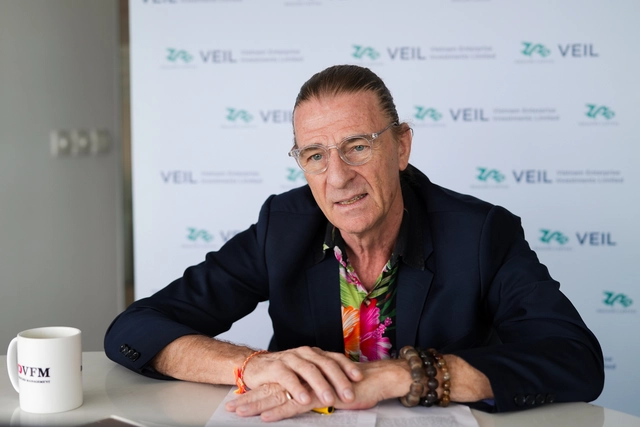
Dominic Scriven, chairman at Dragon Capital, in an interview with Tuoi Tre (Youth) newspaper. Photo: Huu Hanh / Tuoi Tre
Scriven, who has spent more than 30 years working in Vietnam, recently shared his views with Tuoi Tre (Youth) newspaper on foreign capital flows, bond markets, investor behavior, and the long-term path toward a more sustainable financial system.
He said foreign direct investment remained resilient over the past year despite global volatility and geopolitical shocks.
Vietnam continues to attract strong interest in manufacturing, particularly in high-tech sectors aligned with its digital transformation goals.
However, foreign indirect investment in the stock market told a different story, with overseas investors net selling more than US$4 billion in 2025, a record compared with over $3 billion in 2024 and around $1-2 billion in earlier years.
He attributed the sell-off partly to improved corporate earnings in 2024, which gave investors opportunities to take profits, and to withdrawal pressures from foreign funds’ own investors.
Scriven expressed hope that foreign capital would return by 2026, citing efforts by the Vietnamese Ministry of Finance and the State Securities Commission to improve the investment environment.
He added that Vietnam has met FTSE Russell upgrade criteria, with the official process expected to begin in September.
Long-term market prospects, he said, depend on an upgrade from frontier to emerging market status and the growth of institutional investors with long-term horizons.
On financing mega infrastructure projects such as high-speed rail and metro systems, Scriven warned that Vietnam faces a major capital challenge.
With credit-to-GDP already high and lending rates around 9-10 percent, relying on bank loans is unsustainable for infrastructure projects with thin margins.
He cited Ho Chi Minh City’s metro line No. 1, which generated about VND104 billion ($4 million) in the first half of 2025 but incurred costs exceeding VND150 billion ($5.8 million).
He argued that Vietnam must develop capital markets, especially bond and equity markets, to fund large projects.
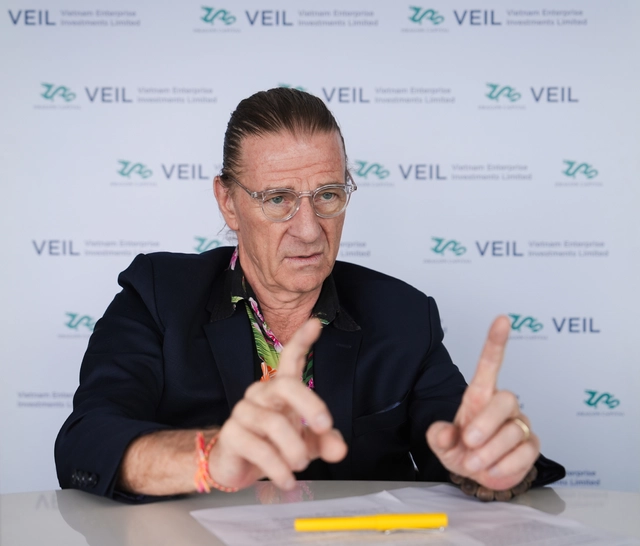
Dominic Scriven, chairman at Dragon Capital, gestures during an interview with Tuoi Tre (Youth) newspaper. Photo: Huu Hanh / Tuoi Tre
Scriven highlighted cultural barriers to capital market development, noting Vietnamese households prefer gold or real estate and often refer to stock investing as 'playing.'
He said the large gap between government bond yields of about three percent and corporate bond yields of around 10 percent reflects mismatched supply and demand and excessive risk pricing.
He called for stronger institutional investors and pension funds to lead the market, instead of leaving individuals to navigate alone.
Current pension fund policies, he added, are too restrictive, with portfolios tied mainly to low-yield government bonds.
While acknowledging policy progress, Scriven pointed to persistent implementation gaps, citing Dragon Capital’s unresolved land-use certification for a Phu Quoc resort despite paying a 50-year land lease two years ago.
Beyond finance, Scriven discussed his involvement in cultural projects, including films such as ‘Dia Dao’ (The Tunnel) and ‘Quan Ky Nam,’ describing them as cultural and historical initiatives rather than purely commercial investments.
He said Vietnam has significant potential in the cultural industry, similar to South Korea, despite high risks and slow returns.
Asked to describe Vietnam’s current spirit, Scriven chose the word ‘courageous,’ praising the country’s determination while stressing the need for strong execution and financial literacy.
He advised Vietnamese households to leverage compound interest for long-term wealth building instead of relying on short-term trading strategies.








Max: 1500 characters
There are no comments yet. Be the first to comment.