


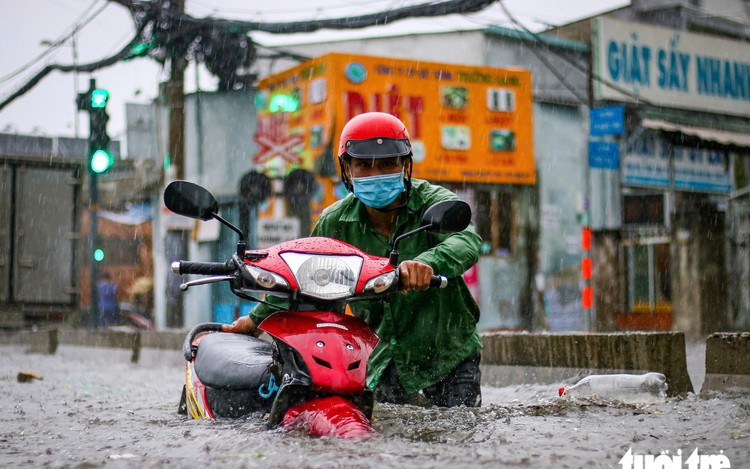
A man struggles to push his motorbike through a severely flooded street in Ho Chi Minh City. Photo: Chau Tuan / Tuoi Tre
Marteaux made the recommendation at a workshop on urban drainage, flood prevention, and wastewater collection and treatment held in Ho Chi Minh City on Tuesday, which brought together representatives of the city's Department of Construction, experts, and relevant agencies from Vietnam and the Netherlands, according to the department.
She said the city should adopt a strategy for flood resilience and wastewater management, particularly in response to heavy rain and high tides.
Marteaux stressed that the question is not only how to build infrastructure, but also how to manage and use water effectively.
She noted that infrastructure was only part of the solution, adding that what truly mattered was establishing water flows, making more room for rivers and canals, and finding ways to retain water before it became a problem.
The Netherlands has shifted from trying to fight water to learning to live with it through adaptation, water storage, and flood management, Marteaux said.

Consul General of the Netherlands in Ho Chi Minh City Raissa Marteaux speaks at a workshop on urban drainage, flood prevention, and wastewater collection and treatment in Ho Chi Minh City, September 15, 2026.
Ho Chi Minh City would also need support from urban planners and businesses to improve its resilience to flooding, she added.
Le Ngoc Linh, deputy director of the municipal Department of Construction, said that following its merger with the former Binh Duong and Ba Ria - Vung Tau Provinces, the city now covers 6,778 square kilometers and has diverse terrain and hydrological conditions.
The city has an extensive network of drainage and flood-control infrastructure but is facing increasingly extreme weather, high tides, sea-level rise, and land subsidence, Linh said.
Existing plans are no longer fully suitable, while canals, drainage outlets, and pumping stations remain uncoordinated, limiting the space available for drainage, according to the department.
Under its 2026-30 plan, Ho Chi Minh City expects to complete 87 projects with total investment of VND140 trillion (US$5.3 billion), aiming to basically resolve flooding at 50 locations, Linh said.

Le Ngoc Linh, deputy director of the Ho Chi Minh City Department of Construction, speaks at a workshop on urban drainage, flood prevention, and wastewater collection and treatment in Ho Chi Minh City, September 15, 2026.
The city will combine traditional drainage infrastructure with green infrastructure, retention ponds, water-storage spaces, and nature-based solutions, while using digital data for forecasting and early warnings to improve operations, he said.
By 2030, the city aims to collect at least 80 percent of urban wastewater and treat 40-45 percent of it to required standards, Linh said, adding that current wastewater collection and treatment rates remain modest.
The Department of Construction is also seeking proposals from experts, scientists, and businesses, including pilot models, to study and develop suitable solutions, Linh said.
An expert from Belgium-based Omgeving, an international multidisciplinary design office, said the city needs a long-term approach to flooding, citing water-management projects in the Netherlands, Australia, and Singapore.
He referred to Singapore's ABC Waters Program, which takes a comprehensive approach to managing stormwater rather than simply expanding drainage systems.
For the Thu Duc area, the expert proposed applying the principles of delaying, storing, and draining water, which he said could improve effectiveness while saving costs.
Nguyen Phu Quynh, deputy director of the Southern Institute of Irrigation Science under the Ministry of Agriculture and Environment, said long-term planning through 2050-2100 should incorporate forecasts of sea-level rise, water levels at the Phu An and Nha Be monitoring stations, and land subsidence.

Nguyen Phu Quynh, deputy director of the Southern Institute of Irrigation Science under the Ministry of Agriculture and Environment, speaks at a workshop on urban drainage, flood prevention, and wastewater collection and treatment in Ho Chi Minh City, September 15, 2026.
Quynh warned that along the Saigon River, most areas are below an elevation of plus 2 meters and that land subsidence of around 2 centimeters a year could reduce the elevation by about 1 meter over 50 years.
He questioned whether the city would eventually have to build dikes along both banks of the Saigon River if it followed a strategy of delaying, storing, and draining water, saying such an approach could significantly alter the city's riverfront.
The workshop came as heavy rain lashed several parts of Ho Chi Minh City over the past several days, causing flooding on numerous streets, particularly in low-lying areas, and disrupting traffic.
On September 13, heavy rain combined with a high tide caused severe flooding, with water rising above knee level on numerous streets across the city, including Tran Xuan Soan, Doan Tran Nghiep and To Ngoc Van, among others.
More severe flooding occurred at the An Phu Interchange underpass in Binh Trung Ward, where inundation lasted from late afternoon on September 10 until early afternoon the following day, with water reaching depths of 0.8 to one meter, prompting authorities to temporarily close the underpass and divert traffic while pumps were deployed to drain the water.










Max: 1500 characters
There are no comments yet. Be the first to comment.