


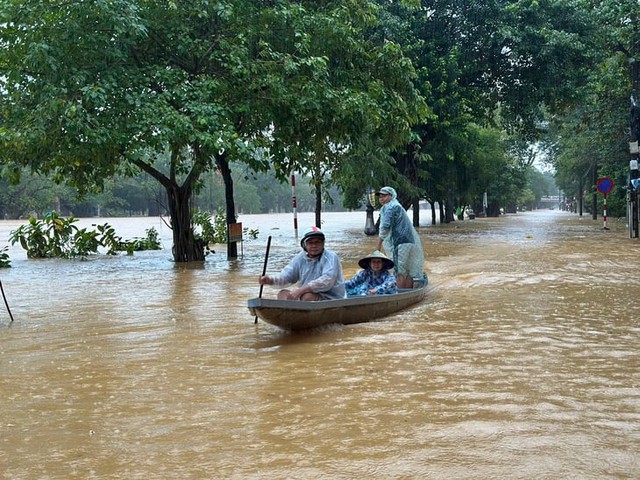
Flooding in Hue City, central Vietnam in November 2025. Photo: Nguyen Quy / Tuoi Tre
The weather agency said on Monday that northern Vietnam is also set to experience its first cold spell of this winter, while a tropical depression could develop over the East Vietnam Sea around September 12-13.
A cold air mass is currently moving from China toward Vietnam.
It is forecast to affect northern Vietnam from September 9 to 11, although the first cold spell of the season is expected to be relatively weak.
Under its influence, northern Vietnam could see rain, showers, and thunderstorms from the night of September 9 through September 10, with moderate to heavy rain possible in some areas.
Rain is expected to ease quickly afterward.
From September 10 to 12, daytime temperatures in northern Vietnam are forecast to fall below 33 degrees Celsius, while night-time and early-morning temperatures could drop below 25 degrees Celsius.
Temperatures in midland and mountainous areas could fall below 23 degrees Celsius.
The weather agency said this will be the first cold spell to affect Vietnam during the 2026-27 winter.
On average, the first cold spell arrives between September 12 and October 4.
The earliest recorded first cold spell occurred on August 16, 2003.
If the cold spell arrives on September 9-10 as forecast, it would be about three to five days earlier than the long-term average.
Meanwhile, an intertropical convergence zone is forecast to form over the East Vietnam Sea from September 9, with its axis passing through central Vietnam.
A tropical depression is likely to form along the convergence zone over the central East Vietnam Sea around September 12-13, with a 70-80 percent probability.
The system then has a 30-40 percent chance of strengthening into a storm.
If a tropical depression or storm forms and combines with the effects of the cold air mass and the intertropical convergence zone, central Vietnam is forecast to experience widespread moderate to heavy rain from around September 10 to 17.
The rainy spell could bring a high risk of whirlwinds, lightning, flash floods, landslides and localized flooding.
Forecasters have outlined two possible rainfall scenarios.
Under the first scenario, which has a 60-70 percent probability, heavy rain in central Vietnam would begin on September 10 and last through September 16, with the heaviest rainfall concentrated in areas from Ha Tinh to Gia Lai.
Under the second scenario, which has a 30-40 percent probability, heavy rain would begin around September 14 and continue through around September 17, with the heaviest rainfall concentrated in areas from Nghe An to Hue City.
Meanwhile, stronger southwesterly monsoon activity is forecast from September 9 to 12, bringing more frequent showers and thunderstorms to the Central Highlands and southern Vietnam.








Max: 1500 characters
There are no comments yet. Be the first to comment.